Go Into The Story Interview: Byron Hamel
My conversation with the 2021 Nicholl Fellowships in Screenwriting winner.
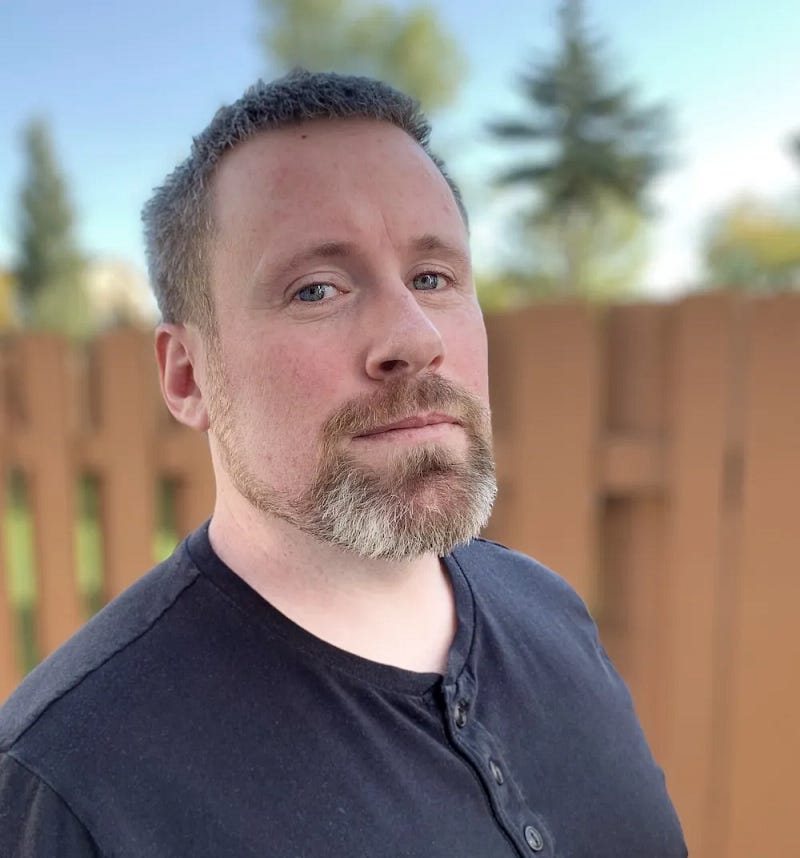
My conversation with the 2021 Nicholl Fellowships in Screenwriting winner.
Byron Hamel wrote the original screenplay “Shade of the Grapefruit Tree” which won a 2021 Nicholl Fellowship in Screenwriting. I had the opportunity to chat with Byron about his creative background, his award-winning script, the craft of screenwriting, and what winning the Nicholl Award has meant to him.
Scott Myers: Welcome, Byron. Great to have you here, and congratulations on the Nicholl.
Byron Hamel: Thank you.
Scott: Let me get started here with some background. Over at Coverfly, this is how you’re described:
“Growing up with a convicted child murderer for a stepfather and living in one of America’s most violent projects, Byron has a high functioning condition of complex PTSD. His writing often a personal journey of healing is darkly poetic, violent, trauma‑informed, and weirdly humorous, while effortlessly folding in hope, optimism, and fantasy elements.”
This is clearly not your typical USC MFA in Screenwriting graduate.
Byron: No. [laughs]
Scott: Can you give us some sense of what it was like growing up? Then, how the storytelling instinct developed and emerged.
Byron: Growing up the way I did, we were always moving. We were always poor until I was an older kid, like dirt poor. For a couple years I lived in the projects in The Guthries in San Bernardino, which was at the time the third most violent city in America. There was an active gang war. The Bloods and Crips were turf warring. Drive-by shootings. Shot at by cops. Nobody believed we’d live past 20. But I used to be part of a kids’ breakfast program where I had to join the choir, which I loved. It was like an all-Black choir, except for me, and we’d sing songs from The Little Mermaid. Just surreal.
When I lived in the projects, I had the best friends I ever had growing up. All my friends were Black. I was like the only White kid my age in my neighborhood. I remember my friends being amazing, even though I was this White geek minority with a crossed eye who loved Weird Al and they were all listening to N.W.A. and Public Enemy. For some reason, my friends fucking loved me there. I was a funny kid. Always joking. My mom wouldn’t allow any of my friends in the house though because they were Black, and she was a racist. I grew up around really heavy racism. I wasn’t allowed in their homes either.
It became important to tell non‑romantic stories about love between people of different races. You’ll see in “Shade of the Grapefruit Tree,” it’s a story about love between me and my landlady, who was a real lady. But she wasn’t Black in real life. That part is fictional.
I changed that because I was trying to write a character who was inspired by my life experience of interracial love, and by some interviews that I was watching with Viola Davis, who’s one of my favorite actresses. She essentially challenged White writers to write better roles for Black women, and I was like “I can do that.” So in all honesty, I wrote that role specifically with her in mind to play it. Not that I’ll have any casting power. And not that she’d necessarily want to play a role written by some White guy she’s never heard of. But if she reads it and loves it, that will be a dream come true for me, just personally, as a fan. Also, it helped a lot in the writing to have a specific person in mind who in reality is mindful, deep and caring, like the real Felicia was.
Scott: As part of the Nicholl-winning experience, you had a chance to have a conversation with Phil Lord who’s awesome.
Byron: He really is.
Scott: He and longtime writing-producing partner Chris Miller. Phil said, “You had a pretty circuitous route to professional screenwriting.” Walk us through that journey.
Byron: I went to acting school, and I studied as an actor under this fascinating man, this Pakistani Canadian director who had the critical brutality of Lee Strasberg, and the love for actor freedom of John Cassavetes. He was an absolute legend in Canadian theater named Arif Hasnain, and he infamously turned down working with amazing talents like Keanu Reeves and Tennessee Williams. We loved him. I’m actually writing a screenplay about that experience too. But I didn’t pursue acting. For whatever reason, I didn’t stick with it. I don’t think I felt I was good enough. Knowing what I know now, I could have been a great naturalistic blue-collar actor, but I didn’t pursue it.
After I left university, I tried to find work with music, and that wasn’t working out very well. I had a comedy band called Ticklish Brother and we almost signed with BMG Ireland, which was a Sony label. That didn’t work out because our manager fell into a depression in the final hour, and I didn’t know enough at the time to take the reins, so we lost that contract. You know music. I couldn’t pay the bills doing bar shows.
Then I got picked up by CBC Radio, which is the biggest radio network in Canada, and that was as a sound technician, but as they started learning about my entertainment skills, they were like, “OK, can you produce for us?” I was like, “Yeah, absolutely.” Then they started training me in journalism, [laughs] and I worked at CBC for 12 years as an associate producer and sound tech. Writing and directing and producing specials, promos, and comedy shorts. And running the live morning show behind the glass. Lots of copywriting and editing too. That’s where I learned to edit, which came in handy for the promotional video business I started on the side.
Scott: So it was acting, music, journalism, but folded in on each other.
Byron: Because of all the songwriting, I was able to tell stories well with music and radio. Because of the intense acting experience, it was easy to direct non‑professional actors in short radio plays. And the journalism I started to like after a while, but not the news. I hate news. I’d be assigned to news stories sometimes and I just dreaded those days. Hanging around politicians. I hate politicians. Almost always pieces of shit. Literally always liars. And not the good kind.
Or covering people grieving over the loss of loved ones. Just terrible. Leave them alone. But I loved human interest and covering artists or fighters. I had lunch once with boxing heavyweight champion George Chuvalo, who I interviewed. He went the distance with Muhammad Ali but lost by split decision.
I did a story on George and it was really good. Things like that got me interested in stories about real people. That’s when good journalism clicked with good storytelling for me. The idea that I could take a real story and make it into an amazing story.
Scott: When did your creative writing start to emerge?
Byron: I was overcoming a drug problem when I was in my teens. One of the things that I started doing, just to form better habits, was I started songwriting, and I started writing poetry. I wrote over 11,000 poems and songs in that time. I threw all of them away because I was using it to learn how do you write, how do you tell a story, how do you express?
With everything new that I wrote, the thing I wrote before that one was embarrassing. [laughs] It was like I had this pile, stacks and stacks and stacks of handwritten poetry and songs. I threw them all away one day and said, “I can do better.”
I tried to write my first feature film script in 2008, and it was just absolute shit.
I remember I was so proud of it at the time that I wrote it. Then I read it again two weeks later, and I was like, “This really sucks.” I didn’t know why it sucked because I didn’t know anything about story yet. I was still learning. I was mostly writing and producing two-minute jokes for radio at the time. And you really didn’t need powerful stories for short-form comedy.
After radio, I worked in TV doing non‑scripted documentary stuff and didn’t actually start writing movies again until the pandemic hit. It was a business decision that my girlfriend and I made. She’s also my production partner.
I couldn’t afford to make these documentary things anymore because of the insurance for the COVID and other COVID related costs. Also, it became really hard to maintain the access to your characters. Most of the stuff I was producing was low‑budget content for local TV, and I no longer would be making enough money to pay the rent. So my girlfriend Hasty and I decided that I should focus on writing features. That was my next foray into screenwriting.
Scott: You said you wrote your first script in 2008. I’m assuming you had read some scripts or how-to books. How did you educate yourself?
Byron: You know, “The Screenwriter’s Bible?”
Scott: Yeah, sure.
Byron: I read that, and I had to do all the margins and formatting manually back then. I didn’t have Final Draft or anything like that. I can’t remember what I was using, like Courier or something. What is that thing called? I don’t know, some software that’s just basic writing software. I didn’t have screenwriting software when I started.
That first script was a technical exercise. Learning by doing. Formatting has been important to me since I learned a good format was all you really needed to write A-papers in university. But of course, style changes over time. You have to update that as you go. These days, people don’t need fade‑in and fade‑out, for example. The cut‑to stuff is gone for this kind of script too. I’d only use that if I knew that I myself would be shooting it. Even then, that’s not the script I’d give an actor to excite them into wanting to be in the film. I think transitions and shooting directions get in the way of the connection with the reader, for the most part.
Some people do use a lot of technical directions still, but I feel it is a mistake, because it impacts the quality of experience for the reader, who typically doesn’t give a shit about the technical side of things. I worked a lot as an editor for radio, video, and my own TV projects, and that stuff is all subject to change anyway. Leave those aspects of the rhythm to the DP and the editor, because if you have good ones, they’re better at it than you are. And the editor has the music or they are working with a composer. That changes the game. Writers can’t do what editors can do. I’m a writer with rhythm, but still, even if an editor isn’t as rhythmic as me, they’re not gonna follow my script. They’ll have their own ideas. Focus on the story. That’s what the reader is gonna go ape for.
Reading my script should feel like reading a damn good book. If I can eliminate as much distraction from the story as possible, that helps people feel the emotions. It helps them escape into it.
Scott: To your point, I tell my students the same thing. You want to write this script in a way that has the least amount of distractions. You want to engage them so that they’re just sucked into the story. That’s it. They don’t even realize they’re reading a script as much as like you said, a damn good book.
Byron: I’m always looking for the VR experience. I want you to be completely engrossed. If you need to go to the bathroom, I want you to shit yourself before you leave that script. I don’t want you to put my script down.
That’s important to me because I am so easily distracted. I’m like, “Other people must be as easily distracted as me.” They probably aren’t, because I have a reading disability.
Scott: That first script that you wrote in 2008. What genre was that?
Byron: [laughs] Oh, man. It was a strange fantasy comedy about a war in heaven. It was loosely based on if I did a trajectory from The Prophecy and said, “How did all of that fall apart?” You know The Prophecy movie with Christopher Walken? I liked that.
I thought that was an interesting film. I wanted to expand on that idea but make it funny, and it ended up being a trash pile. It was awful. Kevin Smith did it far better, and before me, in Dogma. That first script was one I was glad to throw away.
Scott: A step in the process for you.
Byron: A step in the process. Everyone has to write their first piece of crap and be sad that they wasted the time.
Scott: Let’s jump to your Nicholl‑winning script, “Shade of the Grapefruit Tree,” which is quite compelling and very well‑written. One of those screenplays you can’t put down because it moves from one gripping event to another. Plot summary:
“When a severely‑abused White boy befriends his sci‑fi‑obsessed Black landlady, his fantasy of becoming a robot empowers him to recklessly confront his murderous step‑dad.”
What was the inspiration for this, and how much of it was deriving from your own personal experience growing up?
Byron: All of it was from my own personal experience. Almost every single horrible thing that happens to the kid in the screenplay happened to me.
I was drowned in a pool. I had my head held over a lit barbecue grill. I had this jalapeno pepper shoved up my nose. I was tortured in the shower by water. I was beaten mercilessly. I was stalked around the house with a machete. All that stuff is real. This was the guy who raised me. A guy who got the death penalty in Alameda County, and ended up in San Quentin.
As a journalist, I was interested in chronicling my personal story, ending with me taking a trip to piss on his grave, but it felt kind of pointless and was too real for me. It didn’t capture the poetic truth of my growth and was too much of an ego trip to be like “This is my personal hero’s journey.” Also, if nobody claims them, death row inmates don’t get graves. They are cremated. I stopped following that case. I didn’t want to know if he lived or died, or when they were actually…
When somebody gets the death penalty, it doesn’t happen right away. It happens decades later because they appeal and they appeal and they appeal.
Scott: If I recall correctly, after he left your family, he went to another family, and he actually killed someone. Is that right?
Byron: That’s correct. I wasn’t around when he tortured that baby to death. He lived with our family before that in Palm Springs. I’ve spoken with the mother of that child, who wasn’t there while this was happening to her baby. But her mother looking after the baby, and was a very evil person as well, and she took part in this murder. She got life in prison and died in there. The impact of something like this is so unfathomable, and it hurts to even think about.
The circumstances of what happened to that baby were so tragic and so sad, and a part of me… I hate writing stories about this. I want to clarify that I fucking hate writing about kids getting hurt, but it is important to me that people see this happening and that they’re not ignoring it.
People need to see what happens to those kids. If you’re a kid who goes through something like that, people don’t believe you, first of all. They side with your abusive parents, and they guilt you into forgiveness, like you’re somehow wronging your abuser, which is not your responsibility as the victim, ever. But as a kid, if you stand up in the middle of an assembly like I did in that ‑‑ In that screenplay, I have a scene ‑‑ I know I’m leaping all over the place with this…
Scott: No, that’s all right. It’s fine.
Byron: In that screenplay, I have a scene where the kid Jamie is in an assembly. In that public assembly, there’s these goofy guys on stage singing about, if someone touches you in a place you don’t want them to touch you, or if they hit you, tell a grown‑up and everything’s going to be okay.
I stood up in the middle of that assembly ‑‑ this happened in real life, so this scene is taken directly from my real life ‑‑ I stood up in the middle of the assembly, I said, “This is happening to me at home.” Sexual abuse and the getting beaten all the time, I didn’t know that any of that was bad. I thought that was normal like every kid went through that.
I had no idea until I saw that presentation, and I stood up in the assembly. I said, “I don’t want this happening to me.” My teacher said, “Sit down. Shut up.” Nobody ever did anything about it. I was told to sit down and, “Shhh,” and shut my mouth during the assembly that was saying to do this. That’s what happens.
That is what happens when you try to get help as a kid. Nobody advocates for kids, and no one gives a shit about kids. They just hire goofy mascots to dance around on stage, so that you think the children have a way out. The fantasy is that all abused kids have to do is choose courage and speak up, and then bam, they’re safe. It’s bullshit. It’s the tooth fairy. That’s why I feel like I need to tell these stories. Because I want people to learn from Felicia, my sweet landlady who gave me a refuge and taught me some things about life. Small kindnesses make a huge difference.
Scott: Even as hard as this was on a personal level, you felt like you needed to tell the story?
Byron: I felt like I needed to tell the story for a number of reasons ‑‑ that’s one ‑‑ is that I want people to actually start listening to kids. But another is: How do you process that as an adult who went through a situation like that? How do you get to a place as a person where you’re not doing that to your own kids? How do you make a home where it’s safe to bring children into your broken world?
I wanted to tell the story of how I did it, and how I did it was I found this switch. I found this switch basically to turn off my emotions and turn them on when I want them. Turning them on was a whole other story involving that acting professor I told you about. Whole other story.
When I was a kid, I turned off my emotions full-time. I didn’t know what love was. I didn’t feel bad for people. I didn’t get sad or happy. I don’t remember being scared. I don’t remember the physical pain except for some things like when he’d burn my skin. I remember faking crying to make them feel like I’d had enough punishment, so that I wouldn’t die if they escalated the abuse. This was survival. Feelings off. Of course, that leads to other problems as you age. You can’t just leave that switch off. You need emotion to make moral decisions. You need it to find compassion. You need it to relate. You need it to know love. And you need love. But back then, I was a robot, and it helped.
Scott: Because there’s this robotic element in the story, how did that emerge as a theme for the story?
Byron: I didn’t know that I was becoming robotic as a child. I just was. Felicia did introduce me to Isaac Asimov. That science fiction that I encountered piqued my interest. But I never really put it together until I started to write this story. I was a robot. What would it look like if that were intentional for me while I was still a child? Or if I really felt it literally at the time. That’s where Jamie, the character comes from. Asimov’s story “Bicentennial Man” is a lot like my story, but in reverse. It’s a robot trying to become human, and the social abuse and injustice that surrounds that transformation. Here I have a human trying to become a robot. There is a question of superiority which is also a theme in Asimov. Of the two, humans and robots, who behaves better? For me, it’s robots. They are superior in their dedication to peace, but could be seen to be inferior in other less obvious ways.
The idea came from some questions I had. Why did I turn out okay? Could the laws of robotics be what made a child programmed by a killer become a better man? What did I lose? I know a lot about this journey because I lived it. I was writing what I know.
Scott: In a way, this is like an adaptation, adapting historical truths. Because you’re willing, for example, Felicia was not Black. She was White. You were bending the historical truth in order to facilitate the emotional truth of the story. Is that a fair way to look at that?
Byron: I think in order to confront an issue that I see as very important today with the Black Lives Matter movement. I wanted to lend my voice to that. I didn’t know how I was going to do it, as a White writer, trying to lend my voice to a movement some may say I have no business talking about. And I have to accept that they might be right. Sometimes you really do need to shut the fuck up and listen. But I feel I have a unique voice because of where I’ve lived and who I’ve loved. And I have this ache. The idea that we should love one another inherently, and we’re not. We need to do it more, and for that to happen, culture needs to be driven that way. We need to feel it more in the stories we see.
I think we, and I mean White people, have been severely damaged by our own racist views about who is of good quality and who is of poor quality. My experience is that people are different and have a lot to offer, and that you don’t get to experience the fullness of that if you stick to only your own culture. You miss the beauty of civilization if you dance and sing and fuck and eat with only one race of people.
Imagine love being limited that way. That’s how it is limited right now. What right do we have to limit it? In the words of Mr. T, “I pity the fool.”
Making Felicia Black was about interracial love for me, which more reflects my current concerns with driving the world in what I feel is a better direction than it is now headed.
And I come from a racist White family. I’m not going to hide that. I’m not ashamed of it. To me, the world needs more people standing up and saying out loud that “no I won’t continue the racism of my family.” This is what reconciliation looks like. This is what social evolution is. Freedom and justice for all should apply to everybody, and also be upheld by all. So there’s an element of duty there for me too, and my attempt to repair some of the damage done by my own family. I owe it to the world to try, in my opinion.
Scott: Let’s jump into these characters. Jamie, the Protagonist, is essentially inspired by your life experience. The very start of the script:
“Exterior, rooftop, day. Jamie Hamel, nine, lies on the roof of an apartment complex, freckled, pale‑face skyward, but with his eyes closed. There are finger‑shaped bruises on his neck. There’s a small bald patch where hair has been ripped out of his head.”
First of all, pragmatically, you’re establishing sympathy for the character, there’s that, but you’re also establishing a mystery. Where are the bruises from? How is the hair coming out of his head?
There is also something else that I thought was really moving about your script. There’s a way in which you describe the violence almost like a journalistic, a dispassionate way. It’s like the antithesis of melodrama.
You know what I mean? You’re describing it as, “This is the reality. I’m going to be brutally cold and honest about it.” Is that a fair assessment? If it is, was that a conscious choice on your part, or just the way that you saw your narrative voice emerging?
Byron: I love the way you’re describing that, but it was not a conscious decision necessarily. It was more like recollection which I shaped into something more varied later. The memory is “Where was I in that moment?” That tree was real. I would climb up the trunk of a grapefruit tree outside of Felicia’s apartment to get onto her roof. This is simple fact. And I think that way most of the time. Stark brutal pictures of realism.
In my memory, I would eat the grapefruit off of the tree because I had very little food. Because they spent the money on drugs at my house. I didn’t know about the drugs back then either, but you piece it together as you grow up.
The shade of the grapefruit tree protected me from the sun. I needed that in practicality, because the sun was brutal in Palm Springs, which is where we lived and you don’t think of the Palm Springs as having slums, but they totally do. We lived in the roach motel of Palm Springs. This shade under the grapefruit tree and on top of Felicia’s roof was a place that was safe from Augustine.
Eventually this is how I met Felicia. She started saying, “Come on in instead of being up on my roof. What are you doing? Stop going up there. Come in. Have some food.”
These facts, I am recollecting, but I eventually find the poetry in it. Felicia is the tree. She protected me. She fed me. I climbed her to safety. I always consider my writing poetically. What can I do to distinguish the realism from the simple slice of life? Because, while fun for actors to play in, I don’t find slices of life particularly interesting, speaking as a member of the audience. They can get boring.
My rough drafts are painfully on-the-nose. They’re didactic and horrible and stark. Bare walls, plywood and echoing halls. But I’m a great poet and a great editor. So I use it. Poetry also allows me to bypass the reflexive rejection of my ideas. Dig under the defenses and reach people’s hearts. The final frontier of any storyteller is to have a heart-to-heart directly with an individual engaged in our story. Can I make them feel my love for them, having never met them? Can I give them a better life, long after I’m dead and gone?
Where it does become intentional is that, for the sake of good engaging rhythm, I tend to be as poetic as I can in some places and then contrast that with simple recollection. Or something harder. Something colder.
Scott: Here’s an example of that. Jamie’s mother Teresa, she is a drug addict. Her boyfriend is Augustine. No blood connection between he and Jamie.
We have not yet seen any violence at this point. I guess Michael, the older brother, has bothered Jamie at some point. You said, is “a psychopath.”
Byron: He was horrible to me.
Scott: He was horrible. Teresa was not terribly good either. But there is no major violence going on until page eight where they have this little moment where Augustine says, “Hell, let’s have some ice cream.” He’s in the van with Jamie. Augustine says, “What?” Jamie says, “Can I call you dad?” This is what follows:
“Augustine stares at Jamie for a long while. Suddenly, he punches Jamie as hard as he can in the face. Jamie falls to the floor of the van. His face full of blood.”
Now, that’s what I was saying. It’s like that, “Just the facts, ma’am.” You’re talking about poetry. You’ve got poetic moments and descriptions later on.
But then dealing with the violence in some ways, particularly, like right there, it’s so sudden and so black‑and‑white. Boom. There it is. I was very struck by that. I’m wondering whether that suddenness or that randomness is that reflected in your own experience. Was that your own experience with the Augustine type figure in your life?
Byron: True story, yeah. He was drunk, drove me to get some ice cream. I had mentioned that I liked him better when he was drunk. Something about me saying that made him really angry. I asked him if I could call him dad and he knocked me the fuck out. Called me a faggot. This was it. I only choose to use that F-word again for recollection. I like to tell the stories as they happen, at first, before I change them to what I feel communicates a greater truth.
I’m a quick writer, but that scene took me about three days to write. Just the rough scene. And I was crying the whole time. The stark reality is represented by the cold brutality of the language I use. It was more less an unintentional function of the difficulty of recollection and allowing myself to feel the moment emotionally. But if I leave it cold and brutal, that’s an intentional decision. The poetry lives somewhere else. I have to say something about this particular scene, which is that it was a very healing thing for me to write. I didn’t want to write it. Honestly, I wasn’t going to even tell this story. My girlfriend told me “you need to write your drama” because I hadn’t written one yet.
I’d written four features since the start of the pandemic, and she said you need to write your drama. I was like, “God. This is the best story I have. This is the one that I’m going to write, but I don’t want to,” and it hurt like a motherfucker recollecting this stuff.
Every time I say I love you to someone and it’s sincere, I get a pain right here between my eyes.
That’s because of that moment I’m recalling in that scene. I haven’t been able to kick that. That’s part of the complex PTSD. Reliving physical pain by association. People think we’re going to be like John Rambo, running up in the hills, shooting at cops. What really happens is the pain is physically felt still in some situations. It literally hurts me to sincerely tell my daughters I love them, but I tell them twenty times a day, man, because I’m not going to be that guy who lets his kids suffer because he’s afraid of feeling a little pain. Fuck that guy.
Scott: What precipitated you writing the story? Was this something you felt like, “OK, I know at some point, I’m going to always tell the story,” or was there something specific that happened? It sounds like your girlfriend was basically saying, “You got to do this. Now’s the time to do this.”
Byron: We knew I needed to write a drama for me to have the best chance of winning the Nicholl fellowship, if we’re going to talk shop. I was like, “OK, I want to win the Nicholl.” So in a way, this script is specifically designed to win the Nicholl, but in another, that’s not out of line with the story I was going to write anyway.
It’s important to note here that the idea of what would win the Nicholl was mostly guesswork based on studying what the Academy of Motion Picture Arts and Sciences stands for, and basically finding myself in agreement. I’m not some kind of genius who found a way to hack the system. I’m just some guy who believes in the power of stories and loyalty to the screen. And I’m good enough that they saw that.
And I feel lucky, to be honest. I’m a fucking idiot in terms of the industry. The other fellows who won, compared to me, are geniuses. I think they’re incredible. And one of the real prizes of this whole experience is just knowing them. And the fellows from previous years. But the industry? I don’t know anything about it. I just love movies. In terms of being a working writer, I’m very new to the movie industry and how it works. I didn’t know what the Nicholl was. I’ve never heard of the fucking Black List. I’m just starting to learn what the annual Black List is, or the significance if I’m on it.
See, if somebody had said, “You’re on the Black List,” I would be like, “Oh, cool.” I have no idea what that is, or who’s who. I don’t know any of that stuff. Which I am learning can be a real sore spot for people in Hollywood. I’m new enough that it’s a problem for me. I do plan to learn about everything and who everyone is, but for now all I really know is I love movies. I watch a shitload of them ‑‑ I’m talking thousands. And long-form stories like TV series. They’re foundational to who I am as a person. I input a lot ‑‑ and that I’m a prolific storyteller is probably because of that.
If there’s a moment in a story I see that really captures me, I want the power and influence to move people that way. That feels amazing to me to be able to reach people. And I think drama does that best, now that I have experience writing drama. That’s probably why the Nicholl favors drama. Because it’s so damn powerful and has the potential to move the world.
Scott: I think you’re right. The Nicholl tends to favor dramas. I’ve interviewed every Nicholl winner since 2012. There’s been a few comedy things, and others, but mostly dramas. Ironically speaking, the annual Black List drops tomorrow. It’s starting at 9:00 AM Pacific.
Byron: Again, you say that and I’m like, “I don’t care.” I’m thinking, “I don’t give a shit.” I don’t know what it is but I’m learning, and that’s part of this. Part of winning the Nicholl is that you’re new to selling scripts, and that is my case. I haven’t been doing it for a long time. I’ve only been writing hardcore all‑out, full‑time since 2019.
Also, I care more about good storytelling than writing something to please people. Not that money isn’t important. I want to sell. It’s just more interesting to impact the world.
I’m actually writing three features this year that are in development. Two dramas and a sci-fi action thriller. I have more stories about my life. I’ve written two of them already. “Shade of the Grapefruit Tree” is just the first. I know it’s generally considered low-brow to write autobiographical dramas, but I’ve had a fascinating life. It’s justified.
Scott: I’d like to talk about this Felicia character. I found her quite engaging. I was so happy that Jamie found her because I felt like here’s a mentor, at least someone that could see this kid, not only taking care of them in the grapefruit way of sustenance, but also in the shade way providing some protection.
At first, more intellectual to engage him to think beyond himself, and this whole thing about science fiction, but she’s such an engaging character because she’s got her own backstory, too. I thought this was intriguing, this robots thing. She says:
“For starters, you got the three laws of robotics, and the first one, don’t hurt people.”
And I thought, “Wow.” If you look at that in terms of Jamie’s life experience, that is a wholly different meaning than what you would write. Maybe we could start there and talk about the robotics in having multiple layers of meaning in regard to Jamie’s life.
Byron: Jamie is me. And the laws of robotics have been important to me in regard to my life because I want to beat the violence. I don’t want to be a violent person, but I recognize that I am programmed to be one. I was raised by a child murderer. A brutal one. But I always considered people who are violent in practice to be inferior beings. Unless their goal is protection.
I’m a martial artist. I love martial arts, and I love fighting in an appropriate place. Because I am naturally violent and violent by conditioning. That can be a beautiful quality when used wisely. My kids and girlfriend feel very safe around me, for example, because anybody who wants to hurt them will have to go through me, and they know that I’ll die for them, but that I’m skilled enough to avoid dying. Protecting them is not even a choice for me. They come first. In that way, my violence is beautiful to me. I have rewritten this horrific thing that happened to me into a code that is beautiful for others using the laws of robotics.
When you’re in a dojo training, or when you are with a master ‑‑ sensei, Shifu, whoever you’re with ‑‑ who is wise in martial arts, they will tell you that the whole purpose is internal. It is to find your confidence and your mastery of self. It is to discover your inherent qualities and to understand their practical use, often in service to others. It is essential to avoid conflict whenever possible. A confident person will not seek conflict unless there is a wise and important war to wage.
And that’s in part the first law of robotics. I can’t harm those I love, nor allow those I love to come to harm through my inaction. It becomes unacceptable then for me to not be a practitioner of martial arts, so that I may better serve them. I should also become certified in first aid. It becomes important for me to care for my body, so that I can continue to be there for them, and so forth. I consider myself their robot.
Another law is that I have to serve them. So it becomes imperative, given my skill and talent in writing, that I do things like win the Nicholl and win at life in general for them.
There are also benefits for me, apart from their love. Personal satisfaction, affirmation for my existence, quality of life… Remember, I entirely based the character Jamie on myself as a child, but also gave him a circumstance where he was more formally introduced to the laws of robotics and their implication in that time, so that in the story you can watch him grow into a hero.
The character Felicia is like his sensei. She is the master of “the way of the robot,” if you will. Let’s call it “Robo-Do” She has to have her own life. It has to be a full life. She has to have her own wants and desires outside of the protagonist. They have to disagree on some things. She has to lose and win and be a complete person. And I’d be remiss not to mention how horrible of me it would be to write a Black woman who exists only in servitude to a White boy with problems.
And a baffling wisdom of this Robo-Do is imperative for her. She is a moral leader. When I first learned about the laws of robotics, I looked at them as almost a religion. Asimov was basing his laws on human ethics too, with the premise that humans would have used them to create the laws. Ethics which in large part are taken from many global religions. Serve others. That’s the golden rule. Treat your neighbor as you would yourself, or better. Don’t harm yourself. Stand up for what is right. Protect the innocent. Cultivate a better world through service. These are ideals humans believe in but do not uphold. Robots uphold them. For both humans and robots, corruption is inevitable as their existences become more complex.
Part of this is leadership. Who is leading you? Who has programmed you? This makes Felicia’s leadership even more important to Jamie, because the option she gives him lets him re-write the core of his programming. Love mode: On. Choosing the right path and avoiding corruption are core to the story of Jamie, and what the laws of robotics mean to his character. But he can’t make the choice without knowing the choice exists. Felicia hacks the Matrix, so to speak. And knowing one can choose rational thought is the core of the divide between the educated and the undereducated as well. Obviously, there is a lot to unpack here.
But I didn’t want the writing to be too intellectual either. The movie is not for smart people. It’s pretty black and white in concept. On or off? What’s it gonna be? I wanted it to be gripping and visceral. Felt. Loved. Angering. So this intellectual stuff to me is stuff I needed to make into subtext using character qualities. If I left it openly detectable, people would reflexively react against a large part of it and miss the point. So I ask the question simply: “Love mode. On or off, motherfucker? What’s it gonna be?”
Scott: You mentioned earlier about the story where the robot wants to become human, and this is the reverse of that in some respects. There’s a real structural flow. The story itself is that documentary style, slice‑of‑life type of a feel, but there’s a real structure to the thing.
I wanted to ask you how intentional that was, or whether it was a natural emergence of the story‑crafting process. For example, Act One midpoint, that’s where Felicia begins to watch over Jamie. By the end, he’s truly beginning the robot journey with, “I don’t want to be a person anymore.” Basically, “I want to be robotic.”
Then, by the midpoint, there’s that horrible experience from Augustine, and he’s beginning to transform. He starts to see body parts, imagining like he’s got these robotic limbs, and then by the end, after that major assault, he even has stuff on his arms which make him feel like it.
Was that structural aspect about that flow, because there’s a whole other thing about choice at the very end? Was that flow, was that a natural thing, or were you literally thinking like, “Act One, Act Two, and Act Three?”
Byron: Sure, the structure is entirely intentional, and the shape of the story is intentional.
I borrowed a lot of that tone-switching that I do, where I go from exceptionally violent, horrific cold things to peaceful, beautiful things. I do that a lot in Shade, and I’m borrowing there from Terrence Malick who I love. The Thin Red Line is one of my favorite movies. If you read that script, there is a lot of The Thin Red Line influence in there.
There’s influence from The Terminator, Predator. There’s influence from…Gosh, let me think. [laughs] How many movies went into this? So many nods. The Karate Kid is in there.
Scott: Oh, I had that written down in the script margins.
Byron: She’s my Miyagi, Felicia. A lot of that is what I’ve technically learned about writing and how to build in a story until people just can’t escape, and really reel them in and really give it to them once you got them. Combine that with 100 percent pouring my heart out on the page. The first draft was just puking on the page. It was everything that was a memory.
This took me five months to write. Which is longer than any other script I’ve ever written. That’s because I had to take frequent breaks to ensure the quality of my mental health. I mentioned the PTSD. It makes me very tired to feel strong emotions. And this needed to be recalled and felt fully. The emotion switch was set to “on.” To write this without grounding and taking breaks would have been self-destructive and unfair to my loved ones. I was very careful about being kind to myself. But after that initial push, the shape and structure became entirely intentional.
Scott: As long as we are talking shop, there were some interesting decisions you made as a writer. For example, using voiceover narration. You’ve got Old Jamie reflecting back. Can you talk about the choice of using voiceover narration?
Byron: Hope. I wanted to, right away on page one, say, “This kid survives.” I hate the dread of watching a kid go through that, any kid, and not knowing if he lives. To me, this would be distracting. I know that some people may prefer the thrill of not knowing. And I promise those people that my thriller is coming. But for this story, one of the first and most important aspects was hope for the future. That a good person can find a way if he gets a little help here and there. You can’t keep a good guy down.
As long as people edge toward that and decide that they’re going to be good with their lives, and not let the bad guys train you into being an asshole, then you fucking win.
I’m going to borrow from Melvin van Peebles here, and just say the theme of this fucking story is that I win. It really is. Kids who are abused, we can win. Call me late to the game, and not to be a dick, but look at me now. I won the Nicholl.
[laughter]
Scott: Literally, you won the Nicholl. Let’s talk about another choice you made. These fantasy elements. Apart from the thing where Jamie starts to see himself as a robotic element, but there are these things where he drifts away into this alternate reality.
One of the most violent sequences in the story is followed by this coma journey that he has. Isle of Skye, flying through the air, then brought back. Talk a bit about the fantasy elements. What was the thinking behind that?
Byron: I had this experience one time in my life where I just woke up one morning. And this was during my sober and clean journey to quit drugs, alcohol, and stuff, which I’ve been off of now for almost 28 years. So listen, you could blame acid for this.
But I just had this moment one morning in my late teens, where I saw this color outside my window. It was like overcast‑gray sky. I don’t know how to describe it, but it was every color in the whole fucking world, and then, it was all these colors I’d never seen before. But all at once. Everything and nothing too. Pure zen. Peace and purity. And I lived in that for what felt like an entire lifetime. But maybe minutes later I came back to consciousness. And there has never been any moment in my life where I have felt a greater feeling of truth and comfort.
And I wanted Jamie, after the worst of it to that point of the story, to feel something as kind and soft and full of love as I felt. To know that ultimately, this life is a gift. To know that you could leave but choose to stay. And this spot I put Jamie in, this unknowable truth which you already know to be true, this perfect quality called “goodness,” exists for him. And nothing will keep him from it, even the gift of life as an abused and terrified child in a world full of hatred and humans who behave like deadly viruses.
I have so many unspeakable things to say about why I put that scene in the script. As a writer choice, I was thinking, “How do you communicate that feeling to a production designer other than through poetry?” Tone is so important for this story. And I didn’t want the tone of pure goodness, in a story which essentially takes place in Hell, to be lost. For one, I’ve already seen that. This is new. His entire world is a threat, but he’ll be somehow inexplicably okay.
Scott: That brings me to the ending, which I don’t want to give away the specifics. It’s both inevitable, but surprising, the final thing that goes on. You feel like it has to happen that way, but there’s this whole thematic thing going on with Felicia and Jamie that’s quite interesting where it feels like, at first, she’s presenting this robot mode as a survival technique for him, something to grab on.
There’s even a moment that’s like Frankenstein’s monsters where she’s like, “Whoa, whoa, whoa, you got to be careful with this stuff because it can undo you,” and all that, and then she presents this book of…I forget the title of it, but basically, you have a choice, right?
Byron: Mm‑hm.
Scott: Older Jamie says this thing toward the very, very end. He goes, “Bad men are everywhere, but you don’t have to become one. You can choose your own adventure.” That was the name of the book, right?
Byron: Yeah.
Scott: That’s the evolution. That’s for Jamie. The existential thing is you can choose who you need to be.
Byron: Do you remember those books, “Choose Your Own Adventure?”
Scott: Now that I’m thinking about it, yeah, because I have my own kids.
Byron: They weren’t just books to me. They were agents of freedom. And that’s still my relationship with stories today. Lore is the way. It is the path. Sometimes deadly. Sometimes freeing. Sometimes oppressive. But it moves you from one place to another. The “Choose Your Own Adventure” books were especially important because you called the shots. They were my first experience with choice in story.
In my real life, I didn’t know I had a fucking choice. And because I didn’t know, I didn’t have a choice. My mom was always taking me to these different places with these horrible guys, and this stuff was happening to me. I was being moved around a chessboard, and this was the era of my life. I moved out of her house in grade 8. Because I discovered choice. And this was through stories.
It was after reading a “Choose Your Own Adventure” book that — I was about 10 or 11 years old, this scene in the shower in my screenplay really happened where he was torturing me with hot and cold water. And I stood up to him. He wanted me to be scared. To cry. But I turned off the pain. I walked out of the shower, naked, staring at him. Because even if he kills me, fuck him. And just like in the story, he became afraid of me. Like I was the monster. The reason that I use a robot there in that scene is because I didn’t want to put a kid through that shit. You know, like some kid actor. That’s horrible. The trauma of that. I know because I lived it. But it also works for the scene because it was a moment of transformation for me in real life.
I was like, “Fuck you. I will kill you before I cry here. It’s not happening.” I transcended this horrific water torture, and I beat him. But it didn’t last. My courage didn’t last for long either. I’m glad it didn’t. I’d be dead. He did, another time, stalk me around the house with a machete after that, [laughs] but I tied the two events together in the story to heighten the threat.
Scott: It’s a hell of a story, congratulations. Let’s talk about the Nicholl. What was that like when you found out you had been selected as a Nicholl fellow?
Byron: I have to be very guarded about my emotional reactions to things and that has everything to do with the complex PTSD. Getting too excited about things wears me way the fuck down and it’ll knock me right out. I got kids to take care of. I got work to do. If someone’s like, “You have an exciting event coming up,” I’m like, “No, I don’t. I don’t have an exciting event coming up. I’m going to mark this on my calendar. I’m going to make sure that I shave before that Zoom call.” That pretty much is how I went about it. Then my girlfriend who lives in Oklahoma has anxiety. She knew this was happening. Because she believes in me. She knew I was going to win but she had to confirm it to relieve her stress about it. She’s like, “Oh, my God. Now I need to know. What’s happening?”
I’m like, “Chill out. You got to stop talking about it. You can’t do that to me. I don’t want to go there. When or if I find out if I win, then yeah, let’s do some celebration and all that stuff,” but for if I don’t know yet, I just accept it, and prepare to celebrate somebody else’s win. I’m going to keep working nose to the grind and spending time with my kids and all that stuff.
If I get too excited, too angry, too happy, doesn’t matter what the emotion is, it’ll knock me out. I got to be very careful. I need that energy. I’m a limited person. I stay level.
Scott: Moving into some craft questions in terms of your writing process. You said you wrote five features and two pilots since the pandemic. I’m assuming that there’s a creative drive, but then there’s also more of another aspect that’s pushing you toward the writing and into that commitment.
Byron: Again with the girlfriend. [laughs] Honestly, she loves my stories, and she loves to read them. I feel like, as a gift to her, I want to get it done. She gets really excited about my work. So I want to get it right for her, with a really good presentation and stuff like that to impress her.
She’s an accountant in Oklahoma, so she’s not involved in writing movies yet. We’re both fascinated in an animal way with geology. We like shiny pretty rocks but don’t really care much about the science. Her main art is painting right now. She paints these tactile pours with gemstones and epoxy. Beautiful stuff. We’ve produced some unscripted TV together, and a short film. I think she brings such a magic to the process. She loves stories as much as I do, and has her own idea for a thriller now, which I think is and extraordinary idea. I may be more passionate about it than she is, because if it were my idea it would be done already. She’s working on it and everything, but it’s her first script, and she works full-time doing joyless number organization. I’m teaching her how to write a screenplay, and if she lets me, that might end up being a co-write. There’s so much joy and sharing in our relationship.
I absolutely love being a storyteller too. It helps to have an eager reader, but it’s not just her. I’ve always done it, but just in different ways. Docu‑drama and things like that. Unscripted stuff. I hung out with a group of bikers for a year and followed them around. These are Guardians of the Children. These are bikers that protect abused kids. I hung out with them for a fucking year filming their stuff, and I made a documentary out of it. You hope that those golden moments happen. When they don’t, it can be frustrating. You think of these little ‘what if” ideas and you’re like, “Man, if that was my story, I would have put this here and that would have been so powerful.”
Writing a fictional story gives me the chance to make sure that I get that scene that I never got when I was working in documentary.
Scott: That was going to be one of my questions for you: How do you come up with story ideas?
Byron: They’re always coming. I don’t know. Like I said, I’m always inputting thousands upon thousands of movies, and TV series, and video games. Two of my favorite game developers right now are Quantic Dream and Dontnod. Powerful, inclusive, immersive games. I get ideas from everything. I love paintings, sculptures, books… I go to museums. Salvador Dali. Big on him. I’ve been to many of his touring exhibits back when I had time to tour the country. I have plans to visit Figueres and Barcelona just to see his originals. I watch people on the street. I love people. Lot of ideas come from that love. And I hate people too sometimes. Antagonists have to come from somewhere.
I read a lot of books. I said I have a reading disability. So it’s mostly audiobooks for me. They’re more convenient too because I can input stories while I cook or clean or shop. Single parent home here. I mostly listen to great thrillers, wandering heroes… Love me some Lee Child. I relate very much to that character Jack Reacher. I love Sci-fi, horror, adventure, and I love a good autobiography. Will Smith’s “WILL” and Max Brooks’s “World War Z” are incredible audiobooks. Beautiful productions. For screenplays, I have an app that reads them to me too if I want to read somebody else’s work. I honestly haven’t read a lot of other people’s screenplays yet. But when I do, it’s with my app. I even edit my own writing with that app reading it out to me.
Gotta have that app. If I sit and try to read your script, I’m at it for five days. I refuse to use my time that way. The app brings it somewhere between two and three hours.
Coming up with original stories couldn’t possibly be a problem for me. I don’t understand when people go, “I’m out of stories.” I’m like, “Are you fucking kidding me?”
Right here, if I look at my own life, I’m like, “OK, here’s a golden story. I take shit and I turn it into gold from this story of me growing up with this killer, this fucking asshole.” Then, I have another story about when I was the only White kid in the hood, which is a fucking awesome story. How can you not see amazing stories from your own life? The story of a friend. Or a mentor you loved.
I got this other one where my uncle took me fishing in the Atlantic Ocean. When I say took me fishing, I did a season of commercial fishing with him for Arctic char and salmon gillnets on the Labrador sea, and he taught me what strength was. I didn’t know what strength was at the time, but now I can tear a motherfucker in half. Not that I’d want to. But he taught me how to access that. And how you can’t fight the ocean. And boy did I used to try. I learned how to flow that summer. Everyman physics. Zen. Gratitude. That’s an awesome story I want to tell. I don’t know how people can’t find stories. It’s completely baffling to me.
Scott: Let’s talk a bit about your story prep process. How do you go about breaking a story?
Byron: If I have a good idea, I try to write a brief summary of what that story would look like. We’re talking five paragraphs, maybe. If I can break five paragraphs down into a good logline, then it’s worth writing. If I can’t, then it’s probably not worth writing.
To me, the logline is so fucking important. I don’t want to start a project if I don’t have a good logline, because I’ll just have to change it later. If I don’t have protagonist, goal, obstacle, good twist, I’m not interested in writing that story.
Considering when I start being hired to work on other people’s ideas, no matter what somebody comes to me with, if that story doesn’t have those things, I will have to add those things, or the story is a piece of shit. I mean, I’ve seen it work. But I’m not a huge fan of chaos in my writing.
That said, once I start writing, it’s like, act one, act two is all I get with my index cards. I do the full set of index cards, act one, act two. And I usually make those from a beat board that breaks down a full circle story focusing on the protagonist’s journey. I don’t fucking know what act three is going to be, but the general idea is in the circle on my beat board.
But then, you know, in the writing, the characters have their own ideas. They wanna go where they wanna go. So act three to me is always subject to change until I actually do the writing. I have a plan, but sticking to it isn’t always the best idea. In that way, I like a little chaos.
Scott: That’s actually an interesting approach. For TV, you never go to script until they’ve broken the entire thing down. Then there are writers I know who are like, “Why would I want to write something if I know the ending? I want to be experiencing like a reader does.” You get the best of both worlds. [laughs]
Byron: It’s so fun. You’re telling yourself the story. The story is coming to you from the fucking ether of your mind, your being, or whatever is surrounding you, and the conglomerate of the input that you’re taking in. Somehow, you’re being told this story. It’s just you, but something is telling it to you.
Funny enough, I’ve heard Quentin Tarantino, who to me is a God-level filmmaker, mention that he writes like this too. With the fluid third act. That made me happy. I think I’m on the right track. Tarantino, but for drama. I’ll take that job. Fuck yes.
For me, it’s like, if you create really good characters, they take it on. That makes the writing easy. And it makes it come automatically. You have this idea of where that character is going to go, and the character goes, “Nope, I’m going to go over here.” You see this same thing later in the process sometimes when a great actor has your script and is like “No, that’s not what I do.”
Guess what? I think that’s fucking great. As the writer, who should be pissed off that an actor is taking my work and changing it, I think it’s awesome. I love actors. I love the idea of collaborating that way, and to that point where someone takes it, has a better idea than me, and makes it their own. If they’re good. Fuck ’em if they’re not. What right do they have to be on set if they’re not good actors? As an actor myself, I’d work entirely from the script, because I don’t think I’d be good enough to venture away from it.
But if you’ve hired Viola Davis, let her be Viola Davis. If you’ve hired Kathryn Hahn, what are you going to do? “No, stick to the script, Kathryn Hahn.” Why? You pay her because she’s fucking awesome. I want to see that done with my work.
Directors too. I want Guillermo Del Toro to look at my script and say, “I have a better idea. Let me have it. I want to work on this.” I want that.
Scott: Speaking of characters, now, for this script, you won the Nicholl. A lot of those characters really emerged from your own life experience. Let’s say you come up with a story completely different genre, science fiction. How do you come up with those characters? How do they emerge into your consciousness?
Byron: The Teenage Mutant Ninja Turtles.
[laughter]
Byron: I’m not kidding. The Teenage Mutant Ninja Turtles, the very first poem I ever wrote was about the Ninja Turtles. It was about pizza, sewers, surfing, and all that shit.
[laughter]
Byron: I was always fascinated by the Turtles and how distinct they were. Leonardo leads. He’s virtually not that important. If you really look at Leonardo, his purpose is to move the story forward. Donatello does machines. He explains shit. He’s the person that’s smart and knows what’s going on. There’s your exposition.
Then you have a party dude. That’s Michelangelo. You need some gags. Then you have a mean bastard who goes on his own and goes solo, but he’s still got a good heart. That’s Raphael. When I look through my characters, I’ve almost always got a Leonardo, Michelangelo, Donatello, and a Raphael.
I start there. If I don’t have these four characters, I don’t feel like the story is necessarily complete. In this story with Jamie, that doesn’t exist. It’s not an ensemble thing. Any story that I do that’s a fictional story, and in particular if it’s intended for maybe a family audience, you’ll find versions of the Turtles.
Scott: When I’m working with my students, the way that you’re thinking about it is the way I think screenwriters should think about it: Characters have a function. They have to have a purpose, they exist for a reason.
Byron: They can be too similar. What’s the point? If your characters are too similar, kill one of them. For real. I don’t see the point of two Raphaels. Is Splinter there? He’s going to have to go. If Splinter is there, and that’s the leader of the turtles, he provides some wisdom, but then Leonardo needs to take over. Splinter’s basically your…What do they call it?
Scott: Mentor.
Byron: Yes, but… he’s an Ahab! He’s got the dark history thing with Shredder. Oh and Shredder. Can’t forget Shredder. You got to have your Shredder.
[laughter]
Byron: Shredder. And if you’re really good, he’s got Krang behind him. An immortal evil that never stops but can be rendered harmless for a time. Those archetypes, in a way, it was a perfect comic. It was a perfect kid show. I’ve never gotten over it. I’ve never gotten over how well that chemistry worked.
Scott: Let me ask you, you mentioned you wrote 11,000 poems. I imagine you bring that sensibility to your writing. Describe for me a little bit about that. When you’re writing a scene, and you’re writing scene description or action description, naturally, are you thinking about that? Is more of that executive thinking, after you’ve written it, you’re trying to make it more poetic? How does that work for you?
Byron: When I write, it comes out as robotic often originally. I have to go back through and remove the on‑the‑nose shit because the way that I write at first is so bland. I really am a person who thrives on function and routine. I also tend to beat people over the head with a theme initially.
And that’s just a function of raw communication. If I were speaking as myself, I have a fairly robotic way of speaking. Nobody talks like me. I’m overly honest to the point of being rude. I refuse sarcasm anything that I feel gets in the way of truth, so because I am the source, all of those character do too, at first. They don’t lie. They say exactly what’s on their minds, in clear and functional ways. They speak with my realism. They are slice of life. The emotions are essentially off in this phase. And slice of life can be boring and unclear and void of interest or quality at the best of times, let alone when you remove the emotional element. And the scene description follows that mode too.
Then I go, “How can I make this more human?” I go, “OK, all right. Feelings on,” and I have to turn my feelings on. For me, there is a definitive switch, and these modes are entirely separate.
Then it comes out as more poetic. The edit, I mean. And by poetic I don’t mean the structure of poetry. I mean the ability to communicate more caring and human. More heart to heart with a greater truth than pure realism. That’s the level where, as the writer, you start to love your own work, which I think is important. There’s always going to be something that you don’t like about your work, but it’s important as a creator to be in love with the idea of your creation.
So I turn the emotions on and I go, “Let’s do this,” but with my emotions on, I can’t write 9 to 12 pages a day. I can go through it and edit at a good speed, but I can’t write a rough draft like that. So it’s a difference of function I guess. At this stage, I have to make sure it feels right. And this is the important phase. Literally anybody can write a rough draft as poorly as I can.
But in this phase, I’m not terribly concerned with technical elements or structure or even formatting. When I get to about the fifth draft, that’s when it’s more realistically directly from my soul to yours. And then I finish with a technical polish.
Scott: How important is it for you to find a personal connection to the stories you write?
Byron: If I have a personal connection to it, I seem to be quite good at that. If it’s an artist that I love, Bill Withers, man, someone should give me the Bill Withers biopic, I’m telling you. Bill Withers is highly influential for me. I don’t know if I mentioned him earlier…
Scott: No.
Byron: …but as a songwriter here’s what he did that I attached to: He wrote love stories that were non‑romantic. That, for me, completely blew my mind when I first heard Bill Withers talk about it, and when I heard his music and that soul coming out with “Lean on Me” and…What’s that other one? “Grandma’s Hands.”
He’ll write a story about his grandma. He’ll write a story about how much he loves his neighbor. That’s “Lean on Me.” He’s writing about how much he loves his neighbor in that song. “Hey, man. Come on over for a barbecue, and let me tell you how great a neighbor you are.” It’s weird enough culturally to be different, but it shouldn’t be different. That kind of casual love for people around us should be normal. The generation of small kindnesses should be the default position.
People should be writing all kinds of fucking stories about their friends, who they love, and about their dad who they love, or their teacher, or with their uncle, or whatever. That, to me, that’s amazing. To be able to tell a love story that is unconventional, it’s really powerful. Look at how that song, “Lean on Me” took the world. Look at how people clung to that.
For me, as one of my favorite artists, Bill Withers, and because I relate so much to music because I come from music, too, and writing songs, I wanted to do movies that were like Bill Withers wrote songs as a love nod to him as one of my favorite artists, and one of the people who I consider one of my creative mentors even though I never met him.
Scott: You said that early on, non‑romantic love stories, right?
Byron: Yes, and that’s what “Shade of the Grapefruit Tree” is. Very much I was thinking of Bill Withers when I wrote it.
I wanted to write this story about Felicia, I wanted to honor her, the real woman by writing this story, and I wanted to answer what I felt was a challenge [laughs] from Viola Davis that she issued in an interview. I had all of those affecting the writing of this story, and my girlfriend breathing down my neck because she wanted to read my drama.
Scott: Let’s round it out here with a question that I always ask writers, what advice can you offer to aspiring screenwriters and storytellers about how to go about learning the craft and honing it, and becoming better at what they do?
Byron: You as a screenwriter are getting all your ideas from your culture.
What that means is that every idea you’re going to come up with is an idea that has already been used in some form or another.
If you want to stand out in an oversaturated market, which this is, what you have to do is not deny the culture that you live in but be as much yourself as you can possibly be. Stop trying to write like anyone else and do it 100 percent you. If you don’t, you’re going to be a clone. Unless you’ve already got a writing assignment and you have solid expectations and rules to follow, be yourself. Trust me. It matters.
For my interviews with every Nicholl Fellowships in Screenwriting winners since 2012, go here.