Go Into The Story Interview: Aaron Guzikowski
My in-depth interview with the screenwriter whose credits include Prisoners, Papillon, and the TV series The Red Road and Raised by Wolves.

My in-depth interview with the screenwriter whose credits include Prisoners, Papillon, and the TV series The Red Road and Raised by Wolves.
One of the best movies of 2013 was Prisoners, written by Aaron Guzikowski, directed by Denis Villeneuve, and starring Hugh Jackman and Jake Gyllenhaal. So in February 2014, I was excited to have the opportunity to have an hour-long conversation with Aaron about his background as a writer, his work on Prisoners, his involvement in the Sundance Channel TV series The Red Road, and his thoughts on the craft of screenwriting.
Scott: As I understand it, you grew up in Massachusetts. How’d you find your way into writing for movies and TV as an interest?
Aaron: I don’t know, I kind of took the long way. I grew up in Brockton, Massachusetts. I had mostly been doing visual art for most of my life. Drawing and making short films and stuff like that. I went to art school and I did major in film there. I made some short films but when I got out, I didn’t really have any entry into the business and I just ended up doing an assortment of weird blue collar jobs in New York City of a good long time.
I was doing music and art and all of this other kind of stuff. I was all over the place and at some point, I decided I would pick one thing and see how that went so I decided to just try writing scripts exclusively and not doing anything else. I was working a job at the time so I would write in the morning, write at night and just try to start writing spec scripts.
I had written one and basically sent a query letter to three management companies in LA that I randomly pulled out of the Hollywood Creative Directory and one of those responded. The guy is Adam Kolbrenner who is my manager today.
Soon after that, we would write back and forth, and I would send him drafts and stuff like that. After a little bit, I sent him the idea for Prisoners and started sending him drafts of that. Then about 2009 I had finally finished it after I had worked on it for about ‑‑ it was late 2009 ‑‑ so I was working on it for about two years. Then at that point we were able to sell it and that allowed me to move out here and start writing full time.
Scott: Let’s break that down a little bit, because actually I met Adam in Austin for the film festival. First of all, he told me you sent him a letter, right? An actual envelope?
Aaron: Yeah, it was a written letter. [laughs] I don’t really recall exactly what the letter said, but the fact that it was an actual letter, I think persuaded him. The fact that I lived in Brooklyn was also something that he responded to. He’s from Long Island, so he appreciated the New York City angle of it all. That seemed to help. Those two things caused him to actually get back to me, so it worked out, I was lucky in that respect.
Scott: That’s what Adam told me. He said, “I looked at the envelope, and I saw the return address was Brooklyn. I said, ‘You know what, I’m gonna read that letter!’”
Aaron: Exactly, I had kind of a long, strange name, I was from Brooklyn. All of these things, for some reason, pushed him to actually read the letter. Which was good.
Scott: At some point, you decided to focus your writing on screenplays, but that presumes at some point, you understood there are actually people who actually write movies.
Aaron: Yeah, Right out of high school I’d gone to art school. I majored in film there, so I knew how everything worked, in terms of just basic film production. After I got out of school, I made short films and things like that. I was very much aware of the process and screenwriting as a possible career, or what have you. I’d never really applied myself towards that aim until like six years ago.
Scott: Did you take screenwriting courses when you were in art school, or did you pick up the craft some other way?
Aaron: I never really did. I never took any courses. I think I might have taken a very basic one at some point during film school. I think it was a required class you had to take, and I think they went over the format a little bit. Other than that, I never took any writing courses or screenwriting courses or anything like that. I just tried to read as much as possible. In general just reading fiction, just reading books.
I read some screenplays, but constantly watching movies. Which I’ve been doing my whole life. I definitely think it’s one of the best, in terms of an education in screenwriting, was just I think watching way too many movies, probably. [laughs]
Scott: Yeah, that’s the great thing about doing this gig is you can always just say, “I’ve got to watch a movie,” and that’s part of the research.
Aaron: Right, exactly, part of the job.
Scott: What are some of the movies that influenced you early on, inspired you to write?
Aaron: Definitely The Silence of the Lambs was always a big one for me, both the screenplay and the movie, I always had a great deal of admiration for it. I always loved The Exorcist. It was one of my favorites. The Shining is another one of my favorites. All of the Kubrick films. I like popcorn movies. I like a lot of early Spielberg stuff, Raiders of the Lost Ark and Jaws are two of my all time favorites, just to name a few.
Scott: Evidently you’ve got an interest in the horror genre because I believe the script you sent to Adam that he first read was a horror script.
Aaron: That’s correct, yeah. Yeah, I’ve always loved horror as a genre, elevated horror movies. Yes, the script I actually caught his attention with was a horror script.

Scott: You worked on Prisoners for two years with Adam. How many drafts of the script do you figure you wrote?
Aaron: Oh, many, many drafts. Obviously, I was working full‑time while I was working on it. I would send it to him and it would take time for the notes to come back to me. Just the process itself was kind of stretched out. But yeah, I did. I wrote a lot of drafts. The basic story always kind of remained the same, but I think it was just trying to find the best way to maximize all the elements and figure out who and what to focus on and when.
I definitely probably wrote almost a novel’s worth of stuff, just in terms of scenes that weren’t used or all the stuff that I think, in some weird way. informed what ended up being the final script. Many, many drafts, for sure.
Scott: If you didn’t know that adage, “Writing is rewriting” before…
Aaron: [laughter] Yeah, I had heard that adage, but I hadn’t really thought much on it. But yes, it surely is. Writing certainly is rewriting. It’s quite true in my experience.
Scott: Prisoners has an interesting history. There were several people attached to it at various points. Mark Wahlberg was the first person connected with the script, yes?
Aaron: Yeah, Mark Wahlberg had read it early on. He was very interested in it. He helped get some more eyes on it. Originally he was attached to star in the film, and Christian Bale was attached at one time, when Mark was. I think Bryan Singer was attached to direct, and then it changed over.
It was going to be Antoine Fuqua for a while, and then it changed over to Leonardo DiCaprio was going to star in it for a bit. It went through a lot, in terms of the various players, of different incarnations over the years.
Scott: That’s another lesson. Hurry up and wait.
Aaron: Oh, yeah, for sure. That’s the ultimate lesson of Hollywood, making features anyway. There is no schedule, so you just have to keep on keeping on.
Scott: At some point, you were hired to write Contraband. Maybe you could talk a little bit about how that happened.
Aaron: Yeah. When we figured out Mark wasn’t going to do Prisoners and that was in limbo, he still wanted to do something with me and they had found this Icelandic thriller called “Reykjavik to Rotterdam” that they wanted to do an adaption of into an American film. I adapted that film, that became Contraband, and turned into more of a gritty, Departed‑esque type thriller.
The original was a little bit more of a semi‑comedic, kind of a light, fun romp, but it had a great three act structure to it. It was a great movie. That happened really fast in terms of the writing of the script and we went right into production. It just rolled along in a really smooth way, so that was great. That, oddly enough, ended up coming out long before Prisoners did.
Scott: Did that contribute at all to Prisoners getting set up and getting made?
Aaron: Perhaps a little bit, but the thing that was keeping Prisoners from going was they couldn’t get all the right elements together at the same time, for the right amount of money. They were continually trying to find the right talent to make the movie they wanted to make.
Scott: Here’s the IMDB summary for Prisoners:
“When Keller Dover’s daughter and her friend go missing, he takes matters into his own hands as the police pursue multiple leads and the pressure mounts.”
You’ve got Hugh Jackman playing Keller, Jake Gyllenhaal as the investigating policeman, Detective Loki. Terrance Howard as Franklin, the father of one of missing girls, his wife Nancy played by Viola Davis. Paul Dano as Alex, the prime suspect, and Holly his caretaker, Melissa Leo. That’s an amazing cast.
Aaron: Oh, yeah, for sure, and they’re all fantastic. It was an amazing thing when I’d gotten word that they’d assembled all these great actors. It’s a huge thing, definitely.
Scott: The origination of the idea, if I remember correctly, was a short story you did. It was about a man who captured someone who the man believed had hit his teenage daughter with a car.
Aaron: Exactly. It was a short, unpublished story that I had just written for myself about this guy. He believed this guy was guilty of hitting his daughter with his car. He captures this guy and keeps him in this well in his backyard. He keeps him just down in this well and he feeds him just enough to keep him alive over the course of a year. It slowly drives the guy nuts, like the “Tell‑Tale Heart” thing.
It was this little horror story, but that was the kernel that gave birth to the larger story.
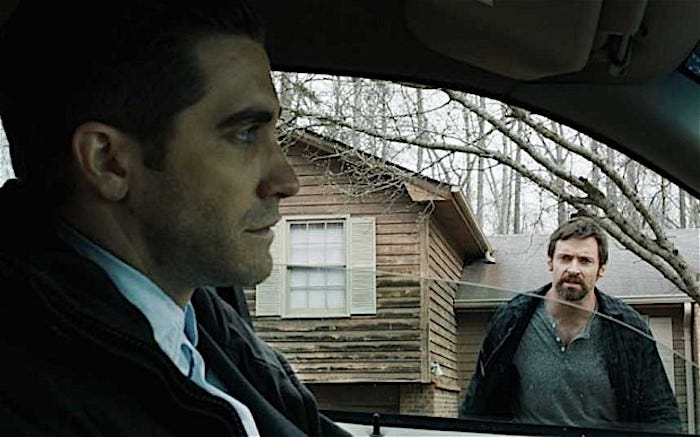
Scott: The focus of that story was with the father, and Prisoners is more of a dual‑protagonist story.
Aaron: It became a two‑hander. Even in the early drafts of the script, it was more exclusively focused on the father character. As it progressed, it became more of a two‑hander. You have more of the investigative side, in addition to the father’s point of view and what he was up to. Which was good, which expanded the whole thing and makes it a more exciting ride.
Scott: Was that a decision that arose organically in your story‑development process, where you were just digging into the characters and the detective was emerging more? Or was there some sort of pressure in terms of casting, to amp up that role?
Aaron: No, the script never really changed after it was bought. This was all stuff that happened before it was purchased. After it was purchased, the detective character, we enlarged that piece of it a little bit more. But in terms of changing the story into a two‑hander, that happened about midway through the initial writing process. It organically started happening that we want to see more of what this guy is doing, and get this different perspective on this chain of events.
Scott: I’d like to work through the story, and get your thoughts on some of the narrative choices you make. The opening scene, the father Keller is out with his son, and they’re hunting a deer. How did that come to you, and why that scene for an opening?
Aaron: The scene has a lot to do with the fact that Keller’s trying to teach his son to survive. He’s trying to teach him to be ready for anything. The hunting the deer is a very visceral way to start telling a story. Of course, he tries to instill these values in his son, and be prepared to anything. He has a basement stocked with all this survival gear, but at the end of the day, he’s in no way prepared for the fate that life does have in store for him. It comes out of that.
Scott: Keller’s a religious man, a god‑fearing man. What was the inspiration for you with that?
Aaron: I was brought up Catholic, so I definitely have it knocking around in my brain anyway. I’m not a practicing Catholic, but I often make connections to Catholic iconography or Bible stories, and things like that. It’s an attractive thing to layer into certain types of stories for whatever reason. There’s mystery to it, and all the connotations that come along with it that are always interesting, but also it’s just part of the world.
He’s just a religious guy, and the idea that when the chips are down, you look to God, the whole idea of what that means, and the question of whether or not God is listening to you, and how that plays into the larger story.
Scott: I thought that was an interesting choice for several reasons. One, I figured this story has got a philosophical set of questions at the heart of it, in some ways, with regard to how far a person will go in order to do something, specifically related to torture. By having him a god‑fearing man, a religious man, who would presumably have a very strong moral code, like right and wrong, that really set up that tension even more strongly.
Aaron: That’s absolutely true. It added an extra layer to the whole thing, in terms of his internal dilemma.
Scott: In the script Grace, in referring to the daughter’s fixation on this lost red whistle ‑‑ that’s a great little subplot that whistle, by the way ‑‑ she says, “She’s just like her father. She can’t let anything go.” I thought is that a tip‑off to Keller’s obsession that we see play out with Alex Jones, later on?
Aaron: Yeah, absolutely, it definitely is. He is that kind of guy. It’s his greatest strength, and it ends up being this thing that almost destroys him, even though it’s all in the pursuit of trying to find his daughter. The idea that you have someone who will never give up, never say die, and you put them in a situation with such a narrow path to the lights.
It makes it extraordinarily painful, just because he’ll never give up regardless of what the consequences might be. He gets that singular purpose and that drive inside of them. The same drive that pushed him to put all these supplies down in his basement and teach himself how to survive and do all these other things.
Scott: The two girls, Anna and Joy, go missing on the script at page 10. I’m assuming that the movie is probably around minute 10. I’m sure you’re aware of that whole conventional wisdom among script readers, right? Hook them by page 10.
Aaron: Right.
Scott: Was that a conscious choice on your part to get to the kidnapping by page 10? Or was that just a natural evolution of the story development process?
Aaron: I think it was just organic. I’m not super aware, other than basic acts one, two, and three, in terms of what should happen on what page and all that stuff. I wanted it to happen early on in the story. It was definitely more about what happens after these girls go missing is the story. You want to get to that as soon as possible.
Scott: Let’s switch to Loki, the Jake Gyllenhaal character, the cop. You give an interesting little bit of business in terms of his background, where he’s known for having solved every case he’s ever been assigned. I’m assuming you did that to add pressure to his character? He’s got a streak, so in addition to everything else, he’s got this thing to live up to?
Aaron: Yeah, exactly. I just love the idea that he thinks this is just going to be one more case that he’s going to solve, when this is the case that is going to break him, essentially. Then that kind of pressure he has on himself. He’s a climber and he’s trying to get ahead. In some way, Keller, in a sense, has this insane sense of drive.
In a case like this, it becomes completely illusive in terms of actually solving everything and slowly drives him nuts because he is that kind of person.
Scott: There’s a big fork in the road from a narrative standpoint midway through act one. Should we know Alex is guilty or should it be up in the air? In effect, you chose the latter. Why did you make that choice, that we don’t know if Alex is guilty?
Aaron: I just think it’s important and a large part of the story is a “Who done it?” You have to in keeping certain things hidden from the viewer. It’s just essential, in a sense, in a move like this. It’s part of the game and part of the fun. The fun of watching it is you don’t know and trying to figure it out. Trying to put forth enough information where it’s not a cheat, but also concealing things in order to just maximize those reveals when they do happen.
Scott: There’s a beat in the script where Alex and Keller meet in the parking lot, and Alex whispers something to Keller. In the script it’s spelled out, it’s what Keller tells people that he whispered. In the movie, it’s not entirely clear what he said. Why that decision?
Aaron: I think when you see it on the page. In the movie he hears something. Then afterwards he tells the captain, “Look, I heard him say in the parking lot he didn’t cry until I left him.” You can only barely hear it when it’s actually when we see it happen on film. In a way, I think it’s good. You always want to believe, “Did he really hear that? Did you really hear that? Or did he just want to hear it?” That’s always a good thing to keep up in the air.

Scott: I thought that was a great choice. He could have actually said it. Or it could be an example of Keller’s obsession that he interprets it that way or wants him to have said it.
Aaron: Exactly, yeah. I think that’s to keep that questioning thing alive.
Scott: One of the stellar things about the movie is the layers you provide to the characters in terms of their motivation. For example, Keller, in the first line in the movie as he’s talking to his son about his father, says, “The most important thing your grandfather taught me is to be ready.”
Aaron: Right.
Scott: Then his daughter gets kidnapped essentially right from under his nose. I was thinking about that character and what he would feel, a sense of shame. Then I was reading in the script where there is this accusation by his wife, “You said you could protect us from anything.” Then, in the scene description, you literally have, “He looks sickened with shame.” Could you talk about that as a motivating dynamic for his character?
Aaron: Yeah. It’s basically what you said. You have this guy whose whole philosophy is built on this idea of being able to protect his family, being able to provide for them and to be ready for whatever the world might throw at them. Then to have this happen in addition to just the pain of not knowing where his daughter is, there’s this added layer of failure and shame.
He is this guy who, on the surface, seems so completely capable and unshakable. Yet, his daughter is gone and his wife is falling apart. All of these preparations he’s made have all been for not. That works really well to just drive him to these extreme places in order to try and get back to where he believes he needs to be.
Scott: Arguably the most central motif of the movie is torture, how far a parent will go to try and save their child. What about that theme interested you?
Aaron: I think any pressure that actually causes people to change and behave in ways that are totally different than how they would normally. It’s always interesting inside of a movie like this or any movie. I think this is such an extreme form of that, the way that it infuses everything with this added layer of electricity, tension, and anxiety. I think that’s what attracted it to me, all things that make a great thriller.
Which was my goal, try and write something that was at the end of the day, just really visceral. A thriller that’s about something, but definitely at the end of the day it’s a movie that just chugs along. It’s a machine in terms of making people feel uneasy. Then taking them on a ride and having that good old fashion thriller experience.
Scott: One of the key turning points is after Keller has taken Alex, and then he’s brought the other father, Franklin, and shown him what he’s done. Keller says this about Alex: “He lost his right to be considered a human when he took our children.”
It reminded me ‑ you mentioned Silence of the Lambs — how Buffalo Bill dehumanizes his kidnap victim Catherine Martin. We see that when he refers to her not as “you,” but “it.” “It puts the lotion on its skin,” right? A similar dynamic here where essentially Keller has said this character, Alex, has lost his humanity, right?
Aaron: Yeah. I think certain characters are able to do that. They have this control over their own mind and perception, that they can just make a decision to see something a certain way. They can just go with it.
Keller has that extreme force of will that allows him then to stop. He has this cold logic and it makes perfect sense to any parent. After having done this, this person has forfeited their right to be a human being. That’s always a hell of a thing. [laughs]
Scott: There’s a Pandora’s Box dynamic. First, it’s Keller and Alex, then Keller, Franklin, and Alex, and then Nancy, Keller, Franklin, and Alex. There is this tension of basically how much this scenario will grow, how many people will find out what’s happened. Do you remember how that dynamic evolved as you developed the story?
Aaron: It was pretty organic. I always thought of it like this plague, what Keller is doing. This form of violence and darkness just keeps spreading. That anyone who touches it is infected by it. There was never any plan in terms of how that all was going to work. I think the characters, after having figured out who these people were, that informed what decisions they would make. That dictated how things would evolve in terms of the story.
Scott: Pivoting a bit and looking at the story from Loki’s perspective, at some point, he begins to suspect that Keller has done something wrong and they get into an adversarial relationship. Do you remember, early on in the process, what the inspiration was in that shift in the narrative and how that happened?
Aaron: It was very early on. Even when it wasn’t a two‑hander and Loki was just a minor character. Not a minor character, but certainly not as big a character as he is now. There was always this thing where the father for some reason, was just rubbed the wrong way by this guy, and in no way had any faith that he was going to find his daughter.
Loki was always this strange presence in terms of his social interaction with other people. He has a hard time in terms of relating to people and he’s very internal in a weird way. Then there’s just something about him that makes people uneasy. That combination of facts just caused these guys to instantly not get on very well.
Scott: One thing you did that was quite interesting in Prisoners is you’ve got these series of what would ostensibly be red herrings. There’s the priest, there’s Alex, there’s Bob Taylor, and there’s a corpse in the priest’s basement.
What you did was great. You tied all of them together. It’s not like any of them is just a fabricated dead end, they’re all tied to this one central event. I’m curious how important was it for you to bring all of that together into this one narrative?
Aaron: I always knew that I needed to have Mr. X. I didn’t want to have a cheap type Mr. X. As you said, I wanted everything to be part of the same fabric. I always had the basic landscape of this whole world sort of figured out, and then it was just a matter of figuring out which pieces of it to employ to create these dead ends, but dead ends that actually are important in their own way once you get to see them in a certain light.
I don’t know. It’s hard to look back and figure out what the order of figuring that stuff out was, but I think a lot of it was you figure out the larger story, and then you just go over it with a microscope, and you find these little pieces of the story that, when taken out of context, become these dramatic misdirects.
Scott: You have an interesting beat with Loki where at some point he does his own little mini‑version of torture when he assaults Bob Taylor.
Aaron: Yes, it’s interesting, because in a lot of ways Keller and Loki are somewhat alike, and they both have this pent‑up violent side. Loki, like Keller, is also playing into the reason these children are being taken, which is, as the Holly Jones character states at the end, to turn the people who are searching for them into demons, to make people lose their faith and start behaving like monsters.
Scott: That dovetails into my next question. How did you come up with Holly Jones’ worldview, the justification for her actions?
Aaron: I would just think about it and try in one word, what could the logic possibly be for committing these sorts of crimes. However it came about, I’m not really sure. But it’s just this idea that God had betrayed you, because she was very devout. Her and her husband, they did all these things to preach the world of God, but they thought they were doing everything right.
Then their son dies of cancer and they feel betrayed and they feel betrayed by the world in a very significant way. Not that it’s really rational, but for a certain personality one could then say, “Well, if God’s betrayed me then I’m going to do something to hurt God,” which is to make children disappear and turn people into demons, essentially, and seeing everything in this very stark, obviously completely insane way, but there’s still sort of a strange logic to it.

Scott: Mazes play a big role thematically in the movie, and I’m curious about one short sequence that happens, whether you were conscious of this or not, when Loki, he’s driving, desperately weaving through traffic. He’s been wounded, he can barely see, and he’s going through all these cars. It occurred to me that he’s going through his own maze at this point. Was that a conscious choice on your part or was that just me picking up on something unintentional?
Aaron: No. I was never quite conscious of that piece, but obviously all the characters are trying to navigate their own internal mazes, or whatever it might be. The case is sort of maze‑like. But that particular piece, I don’t know if I ever thought of it that way, but I quite like that you saw it that way. That’s a great [laughs] thematic bit of business there.
Scott: The ending has intrigued film critics. In the script I read, it says, “Loki limps through the snow to the Trans Am, dread blossoming in his eyes. He hears the whistle again and picks up the pace. Almost there and then we’re out.” Do you remember when you landed on the ending and said, “That’s it?”
Aaron: It was fairly early on. It was actually before we sold it, and the ending never really changed after that though we did toy with the idea of doing extending ending that would kind of wrap things up a little bit more tidily, but, thankfully we didn’t have to do that so we could just leave it as is. But it was fairly early on.
I think it just felt like it was just a good way to go out. I just liked the idea. I like movies where certain things, even though you can infer what’s going to happen, are left slightly ambiguous. The movie ends and you’re still thinking about what happens next is always something I’ve enjoyed in movies.
Scott: And for me it was so perfect, because it was like the whistle was what started the whole thing.
Aaron: Right. Exactly, yes.
Scott: So it’s like a perfect bookend.
Aaron: Definitely.
Scott: The title Prisoners — did you come up with that title, and why does that work for you thematically?
Aaron: Yes, I did. It was called Prisoners. At the very, very beginning of it I called it, The Prisoners, and eventually it became Prisoners, but it was always some variation of that. Just the idea it obviously has the double meaning of it’s about this guy who takes this captive and holds him prisoner, and obviously people are kidnapped and they’re kept prisoner, but it’s also that these characters are prisoners of their own psyche, their own mental decision making.
Prisoners of their own greed, or whatever it might be. So there’s multiple meanings, and I think even the way Denis shot the film and Roger Deakins, the way certain things are framed and the geography of a lot of these rooms and the claustrophobic feeling of it all play into that idea.
Scott: So as of today, the movie’s grossed over 60 million at the box office and there’s some buzz in terms of some possible Academy consideration.
This is probably a dumb question, Aaron, but as you sit here now and knowing what you know about how, basically, making a movie is like a space shuttle launch ‑ a million things can go wrong ‑ what are you feeling now about the movie and the experience of having seen this thing go from that letter you sent to Adam Kolbrenner to today?
Aaron: It’s hard for me to describe. I just feel at the end of the day, it’s just an amazing thing. I think now least of all I’m just very proud of the finished product, which has always been the goal. It’s like what’s on the screen. I think at the end of the day, the only thing that lasts is the movie itself. It’s so nice that so many talented people were brought together to work on it to make it into what they made it.
I think that’s the part of it that I’m always feeling great about, but it’s just a surreal thing. It’s hard to really even think about it in any kind of a rational way, so I just keep working on other stuff and try not to think about it. It’s almost too much to think about [laughs] .
Scott: Moving onto another project, you are in post with the Sundance Channel series, “The Red Road” which is described this way: “Centers on a local cop struggle and to keep his family together while simultaneously policing two clashing communities ‑ the small town where he grew up and the neighboring mountains where a Native American tribe resides.” Can you talk about how that project came to be?
Aaron: Sure. The executive producer, Sarah Condon, had brought an article to my attention that was written about a tribe called the Ramapough Indians in New Jersey and they live in the Ramapough mountains, or thereabouts, and there’s all this controversy involving their origins.
They want to be federally recognized as an Indian tribe, but they’re unable to gain federal recognition. There’s all these folk tales in terms of the surrounding towns in terms of what goes on in the mountains, and it’s just a really interesting and very real place to set a dramatic thriller.
So I had all these other types of stories I wanted to tell, and I wanted to try television, so it was the perfect way to do that. It became this mix of “Breaking Bad” and “Twin Peaks,” I guess, in terms of two touchstone type things, but it’s very much like a set of thriller.
For a television show, it doesn’t really save a lot of story. We just kind of eat through it and just try to, in terms of the economy of storytelling, keep the thing moving as fast and furious as possible and try to make each episode satisfying as a feature film thriller might be.

Scott: How is that working in TV?
Aaron: It’s great. It’s very different as a writer to work in TV. Obviously, you have a lot more control over the various aspects of production, and casting, and editing, and the whole thing, which was a big reason why I wanted to do it. I wanted to get into directing sooner or later so I thought it’d be a good way to get my feet wet in that regard, and it’s been great.
Beyond that you just get the idea of being able to tell these stories over seasonal story arcs that can go on and on. You can do things that you don’t really have time to do in a feature film so it’s really gratifying. It’s a lot of fun.
Scott: Six episodes, is that right?
Aaron: Yes, six episodes. We got James Gray to direct the first episode, which was great, because I’ve always been a huge fan of his films. We finished shooting almost a month ago, and we’re in the midst of post‑production, and it should be airing in February.
Scott: OK, great. Some craft questions for you. First one. How do you come up with story ideas?
Aaron: I don’t use any particularly way. I think I just try and take in everything around me, and, obviously, I have a ton of books and comic books, and, like I said, I’ve watched way too many movies, and I just sit around and think about things and see what occurs to me.
I guess I don’t have a specific way of doing it. Something occurs to you while you’re driving down the street, and it just seems like a good idea. I think anything that presents itself in my brain as something that I’d like to see on‑screen, and then you just want to make it real so you can see it. It’s all very selfish [laughs] .
Scott: How much time do you spend in prep writing, say if you were writing a spec script, and what do you focus on ‑ brainstorming, character development, plotting, research, outlining. What’s your approach to prep?
Aaron: For prep, it’s tough to say. I usually write some kind of an outline, and I’ll spend a couple of weeks on that just trying to get everything figured out, but not too figured out, but just figured out enough so I know where everything ends up. I don’t do a hell of a lot of research, usually. I usually research after I’ve written the script to make sure I haven’t gotten anything too terribly wrong.
Research is a great deal of fun. I do like researching, but it can kind of just become a way of procrastinating. At the end of the day, unless it’s really integral to the story, I just try and tell the best story I can possibly tell and then go back and then research and figure out, “Oh, is this thing I’ve written is completely implausible or not?”
Scott: How about when you’re developing your characters? Are there any specific tools or approaches you use to dig into them and figure them out?
Aaron: Not so much. I think that I just usually kind of pull from people I’ve known from my life or you can trace it. I grew up mostly drawing, so I have to draw scenes from my head, and then I write them so it’s the same sort of thing with characters.
I get a feeling for that they look like and get pictures of their life and try putting it together that way, kind of like a mental collage. Then if you come up with one that sort of sticks, and you want to follow them for a little bit, then that usually means it might be a good character for the script.
Scott: What about dialogue? How do you go about finding your characters’ voices?
Aaron: I think it’s all trial and error and rewriting and also just. Everyone has a rhythm to the way they talk. It’s like writing different kinds of songs for different characters, different songs and different bands, and everything has it its own rhythm. I think if you can just sort of find the rhythm that belongs to that character then that’s a big part of it.
Scott: Let’s talk about theme. I read an interview with you where you talked about Prisoners, and you said basically the theme of the story is what happens when you take away something somebody loves and then give them a very narrow path to get it back. How important is theme to you, and are you one of those writers that starts with that up front, or is it something where the themes emerge as you’re writing the story?
Aaron: Definitely that they emerge whenever I’m writing the story. I definitely think a little bit about it at the beginning, but usually it’s more after you’re writing the story, the theme just emerges. If it’s a story that’s working, then themes generally just start to bleed out of it, and they just present themselves to you. They just appear.
I think if I came up with a theme first and then was trying to bend things to match to that I don’t know if that would work for me, I mean for me, personally, anyway. They just kind of come about as I’m writing a story.
Scott: What do you think about when you’re writing a scene? Do you have specific goals in mind when you approach writing a scene?
Aaron: Not so much. Like I said, it’s the scene I would want to watch. I just start writing it, and, “Oh, this would be this cool if this happened, and wouldn’t it be fun if we did this over here?” It’s all this trying to reconstruct something so when you play it back in your head, it’s fun to watch and it’s compelling, and it makes you want to know what’s going to happen next I think is the big one.
Scott: You might be the perfect person to ask this question to, Aaron, if indeed as I’ve heard, you wrote 20 drafts of Prisoners before it even went out to the marketplace. Rewriting. Do you have a process and if so what are your keys?
Aaron: I think you just have to continually keep yourself excited about it. You can’t really look at it like you’re rewriting. You have to look at it as if you’re starting from scratch even if you’re not really doing that. I think when you get notes and stuff like that, and you’re trying to execute notes you have to find something inside the note that appeals to you and changes how you want to make the story to make it more interesting to you and look at it that way.
I think it’s all just finding ways to trick your mind into not knowing that you’re rewriting, that you’re not working on the same material endlessly. You have to find interesting ways to trick yourself into believing it’s all fresh and new and look at it that way.
Scott: What’s your actual writing process?
Aaron: I write all day, but I get my best stuff done really early in the morning. I wake up at five or thereabouts and just work in the early, early morning, and I work in a room. I definitely don’t like working in public. Just a quiet room or with music is always the way to go for me.
Scott: What’s your single best excuse not to write?
Aaron: [laughs] I don’t know if I’ve been able to afford myself such an excuse yet. I’m trying to think. My wife’s having a baby is probably the one. That baby stuff has always been a good excuse. Beyond that even when I fucked up my back I still tried to dictate into and iPhone or something. I think the best excuse is just be horribly cruel to yourself and say, “There is no excuse,” and just force yourself to do it very day.
Scott: That’s the built‑in excuse. You can just go play with the kid.
Aaron: Playing with the kids, anything kid‑related is always a good way to get out of writing.
Scott: Conversely, what do you love most about writing?
Aaron: It’s hard to say. It’s just the surprising things that come out of it. It’s hard to even say. It’s a weird relationship, because I think at times, it’s a painful endeavor, but something about it that’s sort of addictive. I couldn’t even say. I couldn’t even say what I love about it. It’s a mysterious thing.
Scott: You mentioned you wanted to get into directing, so let me ask you, where do you see yourself in 5 or 10 years? In an ideal world, what are you dong?
Aaron: Oh, I don’t know. Hopefully, just making movies and TV in some way, shape, or form. Obviously, I want to continue writing, and I’d like to direct so I think just continue making stuff for the screen and being able to do that would be my ideal future for sure.
Scott: Finally ‑‑ and this is a standard question ‑‑ what advice can you offer to aspiring screenwriters and filmmakers about learning the craft and breaking into Hollywood?
Aaron: I think learning the craft is how you break into Hollywood. You just need to do it everyday and love it and be passionate about it and write things that you care about and that you want to see made into movies. I think that’s the best way to do it and just continually work at it, way beyond the point of that seems logical. I would say you just have to keep working at it and just love the doing of it, and I think that’s the best way to go.
For more Go Into The Story interviews with screenwriters, filmmakers, TV producers, and industry insiders, go here.