Go Into The Story at the 2019 Sundance Film Festival: February 1
Notes and reflections from Park City, Utah.
Notes and reflections from Park City, Utah.
I am part of a group from the DePaul University School of Cinematic Arts participating in the 2019 Sundance Film Festival. You can read about our Day One, Day Two, Day Three, and Day Four experience here, here, here, and here.
My final day at the Festival: Three wildly divergent movies, each entertaining in their own way. First up: Imaginary Order, written and directed by Debra Eisenstadt. Screening at the Egyptian Theater, there was a touching moment as Debra introduced the film, acknowledging her 86 year-old father in the audience.
Plot: The sexual, psychological, and moral unraveling of an obsessive-compulsive suburban mom.
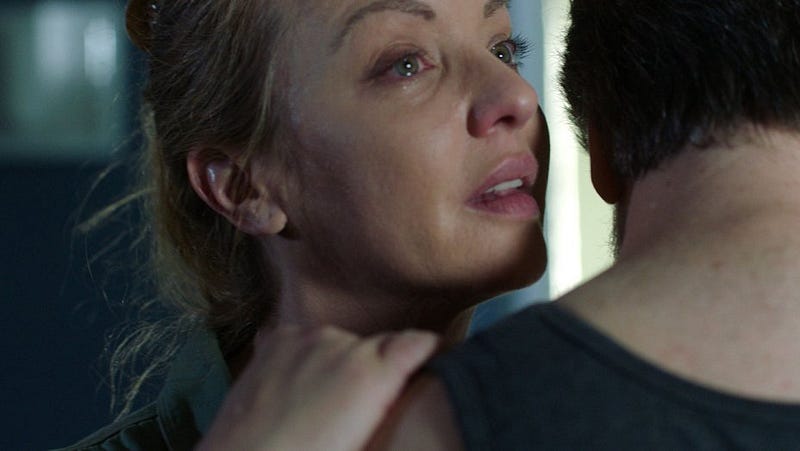
The specific journey of the story’s Protagonist Cathy, played wonderfully by Wendi McLendon-Covey, is a metaphor for the illusion of control we think we have over our lives. Fate intervenes in Cathy’s well-ordered life when he sister, grieving the loss of her husband, heads off for a six-week spiritual retreat. Taking over cat-watching duties, Cathy has a brief intersection with her sister’s neighbors which leads to the unraveling of Cathy’s life, one twist and turn after another. The movie manages to hit a sweet spot of genuine humor while exploring complex characters and a spiraling plot.
Gemma Jean (Christine Woods), the chief instigator of Cathy’s deconstruction, is a great example of a shadow character, a projection of the chaos which exists in Cathy’s psyche, forcing Cathy to deal with that which she so steadfastly attempts to control — hence, imaginary order.
My second film of the day was Ms. Purple, co-written and directed by Justin Chon. Plot: A young woman who works as a karaoke hostess in Koreatown reconnects with her estranged brother in the final days of their father’s life.
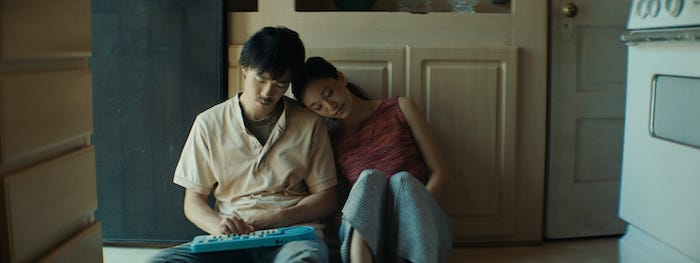
There is a saying about storytelling — “Find the universal in the specific” — and Ms. Purple is a good example of that truism. It immerses us in the life of Kasie (Tiffany Chu), a daughter tending to her dying father at home, forced to entertain men in a unique Koreatown subculture. Compelled to seek out her estranged brother’s help, Jake Choi as Johnny, that sibling relationship plays out in a complex, yet relatable fashion.
The story does a good job exploring both Kasie and Johnny’s respective psychological journeys, and that of a symbolic ‘couple.’ There is an interesting visual device in the film: the placement and use of palm trees.
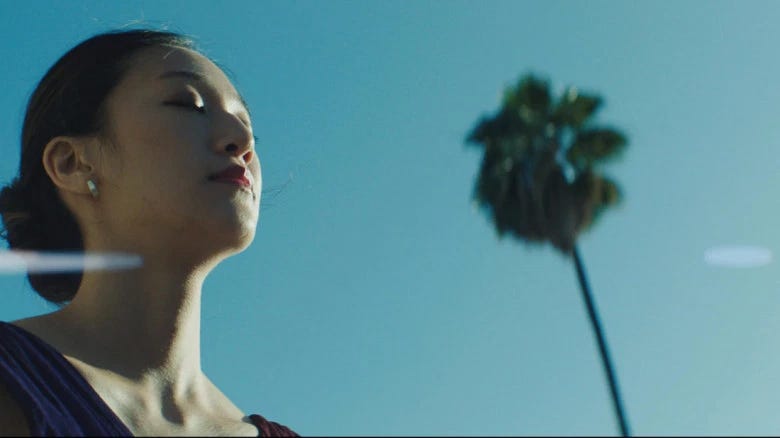
It recurs several times as a single palm tree, but as the narrative progresses and the emotional and historical walls of separation between Kasie and Johnny break down, there is a background image of two palm trees, suggesting connection, not alone-ness. This visual touch reflects director Choi’s use of specifics — images, moments, scenes, relationships — to touch on universal themes of human existence.
My final movie of the 2019 Sundance Film Festival was the joyous musical drama-comedy Blinded by the Light, co-written and directed by Gurinder Chadha. Plot: In 1987 during the austere days of Thatcher’s Britain, a teenager learns to live life, understand his family and find his own voice through the music of Bruce Springsteen.
I say ‘musical’ not in the traditional sense, but rather the use of The Boss’s music functioning as both the spine of the narrative as a well as providing a Mentor function for the story’s Protagonist Javed (Viveik Kalr). He yearns to be a writer, but struggles with his own creative and personal freedom against the patriarchal demands of his father Malik (Kulvinder Ghir).
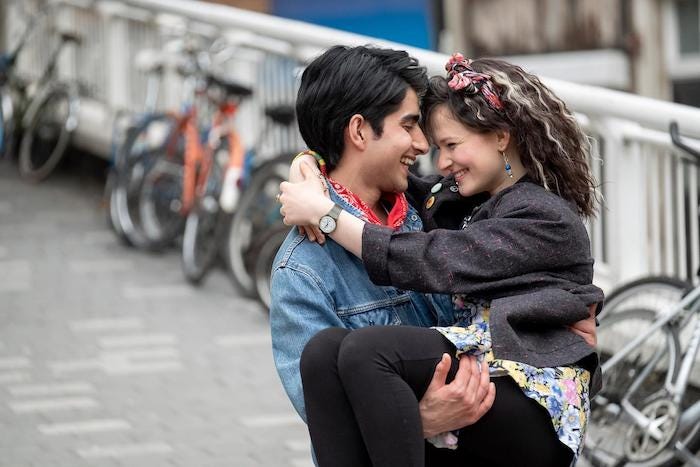
Reminiscent of Bend It Like Beckham, the story is a funny, joyous exploration of self-identity with the Javed getting in touch with his inner Springsteen.
Here’s some background on the movie from a Variety interview with the movie’s director Gurinder Chadra:
How did you get the music rights from Springsteen?
So the film is based on a book by Sarfraz Manzoor. Sarfraz is like a super fan of Bruce’s. He’s seen him 150 times, so much so that Bruce recognizes him at concerts, because he’s probably the only Pakistani in the audience, and he’s got a big afro. When Sarfraz wrote his book and gave it to me, I said I know how to make this film, but we have to get Bruce on our side.
And then what happened?
In 2010, Bruce was attending the premiere of his film “The Promise” in London. I was invited. I took Sarfraz as my plus one. We stood on the red carpet, hoping to take photographs with him. As he walked down, he banana-ed and walked over to Sarfraz and said, “Man, I read your book! It’s really beautiful.” Sarfraz started hyperventilating. And then I ran over and sort of seized the moment and said, “Hi Bruce! My name is Gurinda. I’m a film director. We really want to make a film of the book.” He looked at Sarfraz and me and said, “Sounds good. Talk to Jon Landau [his manager].”
We knew from that moment, once we had that nod from Bruce, we had to write a script he had to love. Bruce’s words are as much part of the narrative as our own dialogue. We sent it to him, and waited and waited and waited. The message we got back is: “I’m all good with this. Give them what they want.” Our timing was great because he really has been looking at legacy and the impact of his work and what that means for him at his age.
The movie, which features 17 Springsteen songs, sold global distribution rights to New Line for $15M. Screening it at The Ray was a great way for me to round out my 2019 Sundance Film Festival experience as that was the theater where I watched my first festival movie: Sister Aimee. Watching Blinded By the Light, I found myself laughing at the humorous moments, swept up in the simple plot inhabited by inviting characters, and, of course, the tapping my feet and bobbing my head at the awesome soundtrack.
Now I’m back in Chicago thankful at having missed out on the latest polar vortex freeze (it dipped down to minus 20 degrees here) while enjoying a slew of movies and conversations about all things film. I plan on writing a reflection on the storytelling I saw at work in this year’s Sundance Festival as I discerned a common thread throughout, but for now, I’m still living with the echoes of my experience in Park City. As much as I love movies, my week-long immersion into films there has taken my affection for cinema to the next level.
Thank you, Sundance. I hope to be back next year!