Dug the Dog’s Role in Pixar’s Movie “Up”
You may think he’s just a funny character (“Squirrel!”). Think again.
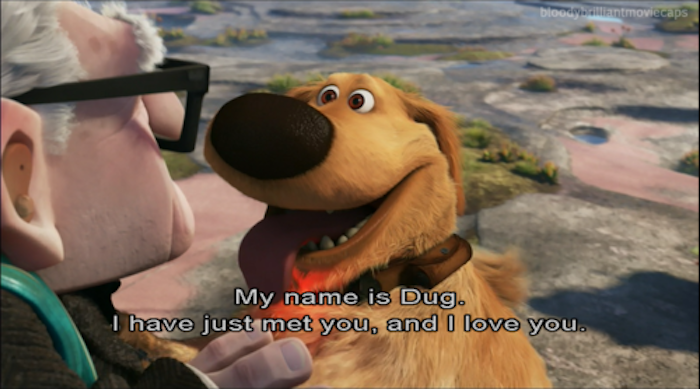
You may think he’s just a funny character (“Squirrel!”). Think again.
In my current Create a Compelling Protagonist online class, as part of our discussions, we are delving into three recent movie Protagonists: Mark Zuckerberg in The Social Network, Annie in Bridesmaids, and Carl in Up. Per the latter, I posed this question to the group:
Compare these two exchanges and track Carl’s attitude. The first from Page 52 of the script as a frustrated Carl confronts Russell, Kevin and Dug:
CARL
I am nobody's master, got it?
(points to bird)
I don't want you here,
(points to Dug)
And I don't want you here.
(points to Russell)
I'm stuck with you. And if you two
don't clear out of here by the time
I count to three...Dug sees the tennis balls on Carl's cane.DUG
A ball! Oh boy oh boy! A ball!CARL
Ball?Carl pops off one of the tennis balls.CARL
You want it boy? Huh? Huh? Yeah?DUG
Oh oh oh! Yes, I do. I do ever so
want the ball!CARL
Go get it!Carl throws the ball far away. Dug chases after it.
The second from Page 81 when Carl is setting off to help Russell who has gone off to save Kevin:
KNOCK KNOCK KNOCK. Carl's eyes go wide.CARL
Russell?INT. CARL'S HOUSE, PORCH -- CONTINUOUSThe door swings open.CARL
Dug!DUG
I was hiding under your porch
because I love you. Can I stay?CARL
Can you stay? Well, you're my dog
aren't you? And I'm your master!DUG
You are my master?!Dug lunges forward and overwhelms Carl with dog kisses.DUG
Oh boy. Oh boy!
What is going in the subtext of Carl’s dialogue? The meaning beneath the text? What do these two exchanges say about Carl’s inner life?
We had an interesting discussion in which I posted this:
The Carl-Dug relationship in Up is a secondary, but considerably important subplot in the movie. For all we know, Carl may have loved only one person his entire life: Ellie. Yes, we may assume he loved his parents, siblings (if he had any), but we never see him with another person up to the point of her death than Ellie. So he’s not only caught up in grieving for her, it’s entirely unclear if he even has the capacity to love anyone else.
His behavior with Russell from the first time they meet up through the first scene cited above does nothing to persuade us otherwise.
This is where Dug becomes so important. Dug, as a dog, is all about unconditional love.
In effect, Dug represents the capacity for love. And his selfless commitment to Carl throughout their journey together — despite Carl’s cantankerous nature as evidenced in the first scene above (“I don’t want you here”) — has an impact on the old geezer.
One way of looking at the story is everything that happens to Carl is intended to break down his staunch emotional defenses, open him up to connecting with others, allowing him to finally accept Ellie’s death (“Go have a new adventure”), and enable him to embrace his new surrogate ‘family’ (Russell and Dug… and in a way, Kevin, too). By so doing, they fill the Protagonist-Attractor void created when Ellie died.
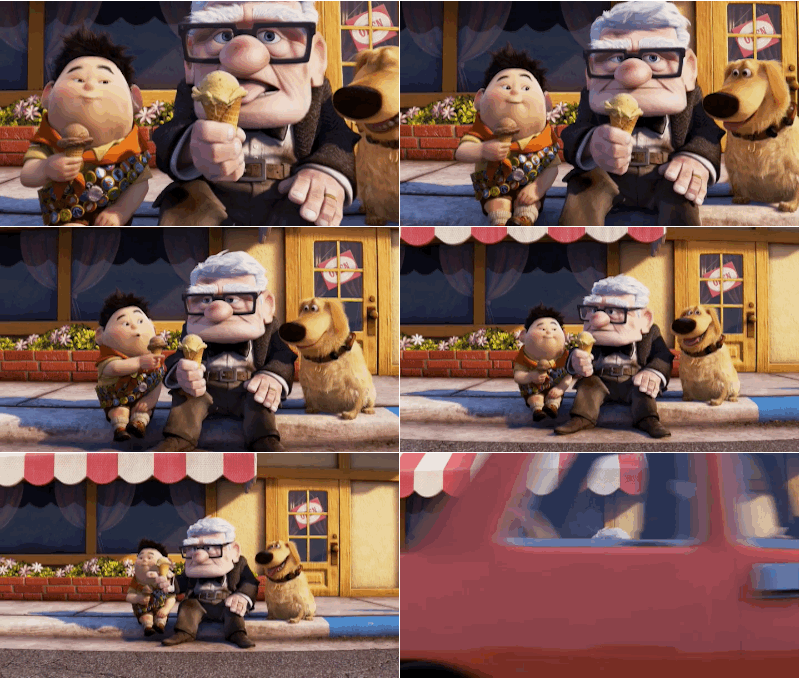
Dug’s role is to create an emotional ‘bridge’ for Carl and in that regard the dog’s wisdom (“I have just met you, and I love you.”) as well as his knowledge of Muntz, his dogs, Muntz’s lair make him a Mentor figure.
He teaches Carl how to love, to respond to the growing feelings of attachment Carl has toward Russell… and toward Dug.
Hence, the second scene above: “Of course, you can stay. And I am your master.” That’s payoff to the setup in the first scene (“I am nobody’s master, got it?”), a clear set of markers denoting the trajectory of Carl’s transformation.
I know Mary Coleman, senior development executive at Pixar Animation Studios, and when I interviewed her several years ago, I said, “Carl’s story is in effect a resurrection story, isn’t it?” And she agreed wholeheartedly. It is about a man who goes from being life-less to life-full, symbolized by his embrace of new adventure… but most pointedly by his ability to love.
And Dug is one big key to that metamorphosis.
A key concept we are exploring in my Create a Compelling Protagonist class is the idea noted above: Everything that happens in a story, each event and character relationships, services and supports the Protagonist’s psychological journey. It’s another way of saying what Joseph Campbell stated was the whole point of the Hero’s Journey: The Protagonist’s transformation.
Takeaway: Dig deep into your story’s Protagonist. What is their Conscious Goal (Want)? What is the Unconscious Goal (Need)? What is the synthesis between Want and Need? What do they Fear the most? Why does this story have to happen to this Protagonist at this time?
Use that understanding you have of your Protagonist, then consider each scene… each plot point… each character… and think about how they tie into and impact the Protagonist in their transformation journey.
For more information on Screenwriting Master Class courses, go here.