Do Studios Dream of Android Stars?
Striking actors and writers fear A.I. Executives don’t seem to. It’s a longstanding battle over technology and control in Hollywood that…
Striking actors and writers fear A.I. Executives don’t seem to. It’s a longstanding battle over technology and control in Hollywood that plays out onscreen, too.
New York Times film critic Manohla Dargis is one of my favorites. She has a vast knowledge of cinema as well as a deep passion for this unique form of visual storytelling. Here is an excerpt from her latest piece in the Times, reflecting on the impact A.I. may have — is having — on the film business.
The movies have long been haunted by these fantastic machines, particularly those humanoid inventions that look unnervingly like us, be it the robot woman in Fritz Lang’s “Metropolis” (1927) or the duplicitous android in Scott’s “Alien” (1979), ingenious creations that are “virtually identical to a human,” to borrow another quote from “Blade Runner.” More recently, though, another specter — artificial intelligence — has by turns captivated and alarmed the world, onscreen and off. In the latest “Mission: Impossible” flick, Tom Cruise battles a sentient A.I.; in the forthcoming postapocalyptic thriller “The Creator,” John David Washington plays an operative sent to retrieve an A.I. weapon that looks like an adorable kid.
I’m keeping an open mind about “The Creator” even if artificial intelligence admittedly gives me the willies. I blame Stanley Kubrick. I’m joking, sort of, but my bone-deep suspicions about A.I. haven’t deviated much since the eerily affectless voice of HAL 9000, the supercomputer in Kubrick’s 1968 freakout, “2001: A Space Odyssey,” took up permanent residence in my head. It’s HAL’s calm, measured, unrelenting voice I heard when I read the May 30 statement from more than 350 leaders in A.I. “Mitigating the risk of extinction from A.I.,” it read, “should be a global priority alongside other societal-scale risks such as pandemics and nuclear war.”
By the time that warning was released, the Writers Guild of America had been on strike for four weeks, spurred to action, in part, by fears that generative A.I. would not only encroach on their livelihoods, but might also at least partly supplant them. Similar concerns drove SAG-AFTRA, the union representing some 160,000 performers and media professionals, to hit the picket line on July 14, making this the first time since 1960 that both groups are on strike. The Alliance of Motion Picture and Television Producers, the trade organization that negotiates on behalf of studios, has waved off union worries with bland promises that all will be fine. “We’re creative companies,” it asserted in May, “and we value the work of creatives.”
If you snorted reading that line, you aren’t alone. Given the history of the movies and, you know, capitalism, and putting aside the obnoxious use of creative as a noun, it is hard to take this assurance in good faith. The writers’ worries, though, are nothing if not serious: Among other things, they don’t want A.I. to be used to write or rewrite literary material or be used as source material. In July, John Lopez, who’s in the union’s A.I. working group, added a romantic spin to these conditions, writing in Vanity Fair that “meaning in art always comes from humans, from having something to say, from needing to connect.” I’m sympathetic, but I wonder if he’s ever read the transcript of a Disney earnings call.
That last line reminds me of a quote attributed to actor Charlton Heston: “The problem with movies as art … is they are commerce.”
The truth of that observation was made manifest by comments opined by Sony Pictures Entertainment chief Tony Vinciquerra. As reported in Deadline:
Writers “are very afraid that we’re all going to put them all out of business. That is so far from the truth,” Vinciquerra said. “AI is an unbelievable tool for the writers. Every writer we talk to says, ‘We’re using AI to speed up our process and make it better.’ You can’t copyright a product that is generated by a computer. You can only copyright product made by a person. So, we’re not going to take a script written by a computer and make it into a TV show or a film.”
— —
While Vinciquerra observed that “there are a lot of things that play into” the resistance to AI, he said it would need to be adopted in some fashion. “You can’t get in the way of technology. People who get in the way of technology don’t last long in business,” he said. “You look at the buggy-whip business, radio manufacturers. When radio started in the ’20s and ’30s, there were thousands of companies making radios. There aren’t many people making radios anymore.”
AI, the CEO argued, makes production “more efficient. It makes it faster. Speed is one of the biggest problems in production.” Producing TV shows or films is “a complex process” and AI “will speed that up.”
Yeah, but at what cost? Not to the companies’ bottom line, but the human and creative cost? The former, despite his protests, in terms of actual employment and reduced salaries. The latter in terms of the quality of storytelling.
This attitude yet again reflects the terrible shift in thinking since the tech companies like Netflix, Amazon, and Apple jumped into film and TV production, approaching it all like content.
To writers, actors, anyone involved in the actual creation of a movie or television series, that is an awful term.
You think in terms of “content,” that leads to a world where CEOs can talk about “efficiency” and “speed” when it comes to AI’s “positive” impact on the business of cinematic storytelling.
To be sure, A.I. is not going away. What the Guild is proposing is this:
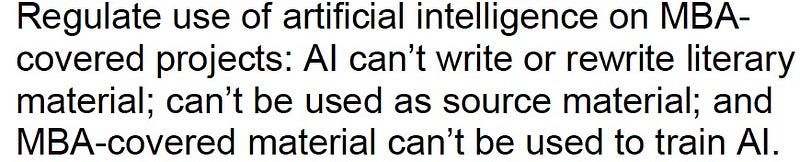
Here was the AMPTP response:

Professional screenwriters are skilled at subtext. The underlying meaning of the AMPTP response is abundantly clear: They are already down the road on this technology. If we don’t successfully negotiate effective guardrails on the use of A.I. in the script development and writing process … Hollywood writers face a stark future.
To read the rest of the New York Times article, go here.
#WGAStrong
For the latest updates on the strike and news resources, go here.
Please consider contributing to the Entertainment Community Fund.