Difference Between Scene Heading and Shot
What they are and when each should be used.
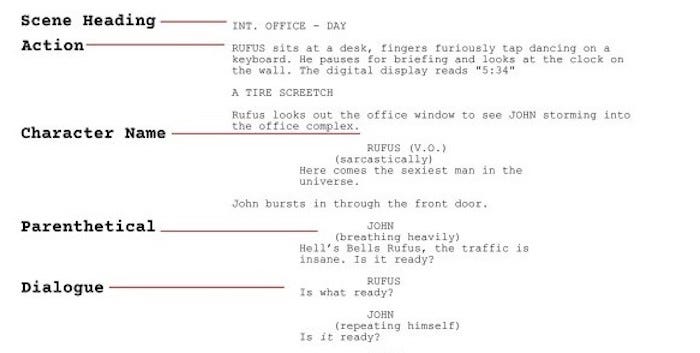
What they are and when each should be used.
A typical screenplay may have between 50 to 100 scenes. If you track the scene numbering system of a production draft, some scripts have what appear to be 200 or more scenes. The discrepancy raises the issue of the difference between a scene heading and a shot. Definitions:
Scene Heading: A line of text at the beginning of each scene that lets the reader know the location and the time of day the scene is taking place. Example:
INT. POLICE STATION — DAY
Shot: Either a specific visual image (as in camera shot) or to indicate the relocation of the action within the context of the primary scene location. Example:
MASTER BEDROOM
Back in the day, these script elements were referred to as a Primary Slugline (Scene Heading) and a Secondary Slugline (Shot).
Here’s where things get confusing. Some writers use Scene Headings where they could be using Shots. Here is an excerpt from the wonderful script for The Devil Wears Prada.
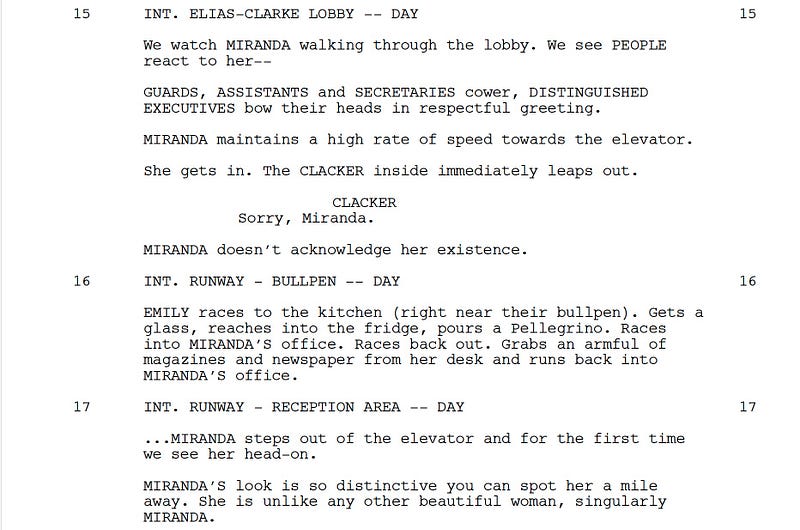
This is a continuous scene: Miranda arriving in the office. Therefore, one could have used Shots instead of Scene Headings like this:

Each Shot represents a sub-location within the context of the primary scene location. There is nothing inherently wrong with using Scene Headings where Shots could be employed, but there is this issue: It gives the writer an inaccurate scene count. If, on the other hand, a writer only uses Scene Headings to indicate the beginning of a scene and shots everywhere else, then that would provide an accurate accounting of the number of scenes.
Why is this important? Let’s say you’re up to page 80 in writing your new script. If you only use Scene Headings to indicate new scenes, you can do a scene count and compare to your page count… let’s say my scene count is 30. That tells me my average scene length is over 2 pages. By today’s standards where the typical scene is about 1 1/2 pages long, I am writing long: 30 scenes, 80 pages. If I used Scene Headings where I could be using Shots, I wouldn’t have an accurate number of actual scenes and could not assess the average length of my scenes.
This is likely where you read scripts which have 200 or more scenes because they’re counting Scene Headings as scenes even if many of them are actually functioning as Shots.
Let’s take a time out to draw a distinction between a selling script and a shooting script. The latter, which is also referred to as a production draft, will differ from a selling script in that it has numbered scenes, this to help with production issues such as budget, schedule, etc. One could argue that using Scene Headings for Shots is helpful for the production crew precisely because they are numbered and easy to reference. However, a selling script (or spec script) does not have numbered scenes, so it’s still preferable to use Shots.
Here is something interesting. I did an analysis of Butch Cassidy and the Sundance Kid for my book The Protagonist’s Journey. I went back to the script to reference some dialogue. Its writer William Goldman is famous for using CUT TO between every single camera shot as in this excerpt from the script:
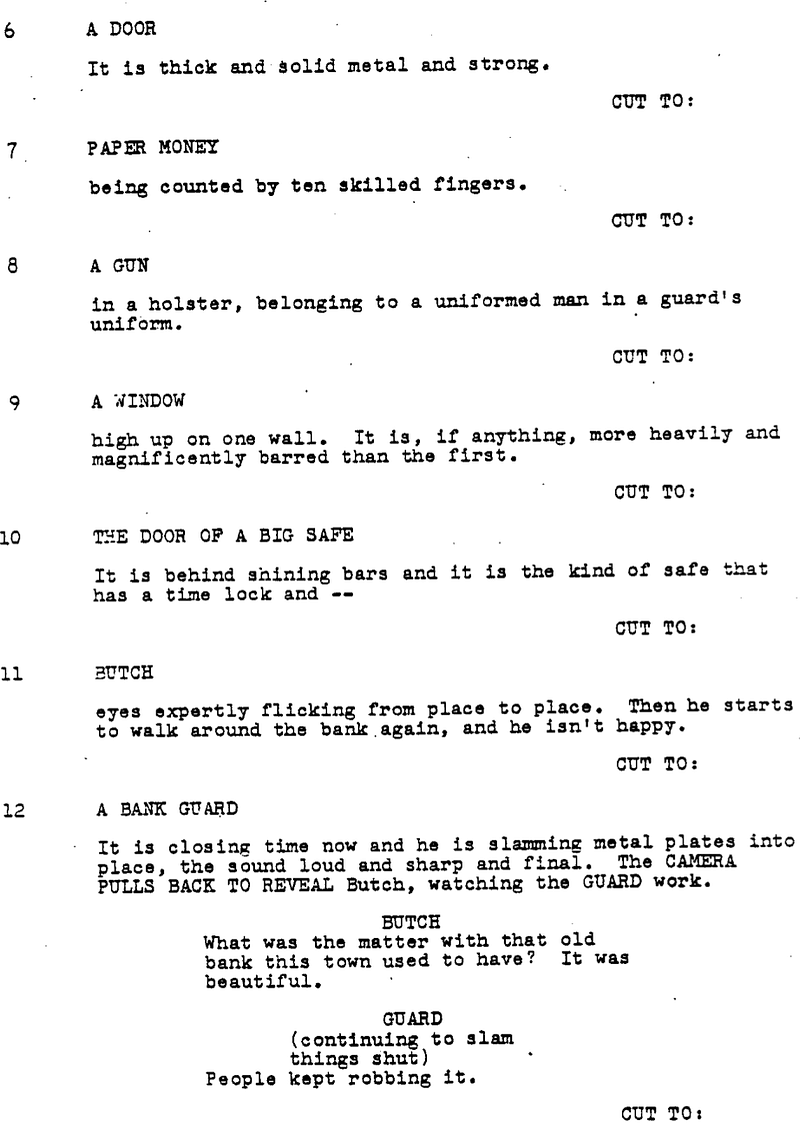
If you download the script here and check it out, it technically has 823 numbered scenes! Clearly, there are not 823 scenes in the movie. If I were to go through the movie and do a scene-by-scene breakdown, my guess is I’d end up with about 100, maybe 120 scenes.
Again, it comes down to one’s definition and how one handles Scene Headings and Shots.
My advice when writing a spec script: Use a Scene Heading when you begin an actual scene.
If you need to shift to a sub-location within the scene… move the perspective from one character to another… or highlight a specific image… use Shot.