Dialogue = Conversation with a Purpose
A 3-minute video excerpt featuring… me.
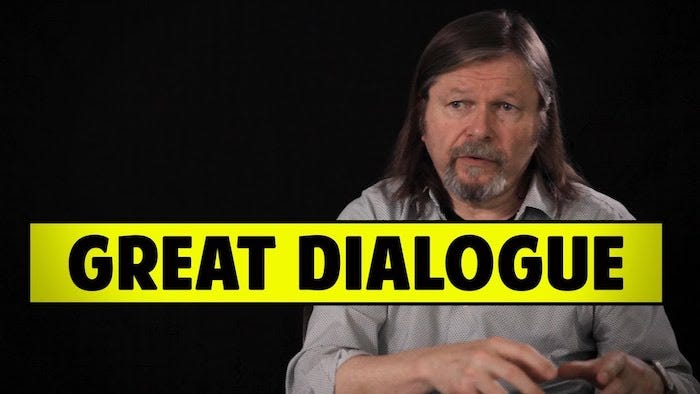
A 3-minute video excerpt featuring… me.
I pack a lot into this video excerpt of an interview I did back in August with the fine folks at Film Courage — Karen Worden and David Branin. In just three minutes, I talk about:
- How every line of dialogue needs to move the story forward
- Revelation, Conflict, Exposition
- Dialogue as subtext
- Sometimes how the best dialogue is no dialogue — what is unspoken
- Good dialogue is conversational, but also precise and efficient
- Why you should read the script to Michael Clayton by Tony Gilroy
If I’d had more time, I would have drilled down into three additional points:
First, it’s easy to say, “The best dialogue is subtextual,” but the unstated question is this: How to write subtext? One key is to go inside a character’s psyche and ask: What obstacles might there be which would cause this character NOT to say directly what’s on their mind? Here’s a brief list:
- Fear of telling the truth
- Manipulate a situation
- Embarrassment at being found out
- Defiance of authority
- Concern about reputation
- Sensitivity to the needs of the others
- Test someone
- Delude ourselves
- Vamp for time
- Uncertainty about what we’re thinking
Get inside your character’s head and see if there’s a reason which somehow blocks them from on the nose dialogue.
The second thing: The single most important key to writing great dialogue is to immerse yourself in the lives of your characters.
- They live in a specific PLACE with its own subculture, slang, jargon, and verbal affectations.
- They have a distinctive PERSONALITY influenced by their upbringing, socioeconomic status, education.
- Their psyche is comprised of unique COMPLEX of emotional baggage, personal history and backstory, coping skills and defense mechanisms.
- And at the base of their identity is their CORE, the psychological foundation upon which all the rest of who they are is built.
The more you get to know your characters, to really delve into their psyche and backstory, the more likely they will come alive in your imagination.
Third, while dialogue is conversation with a purpose, after they do lots of character work, I encourage my students and clients to write a first draft of every scene coming from a feeling place. Don’t think your way through a scene. Feel your way through it. Get in touch with each character — where and who they are in the moment, what their goals are for that scene, what their emotional and psychological state is — then close your eyes and let the words come. It’s important to try your best to come a more subconscious or intuitive place when writing dialogue. In subsequent drafts, you can always shape and edit dialogue to ensure that each line does have a purpose, but you want the content of that initial pass — especially the dialogue — to bubble up from the characters themselves.
There’s more of the interview to come over the next few weeks, so check out the video clips at Film Courage. Let me know if you agree, disagree, or if you learned anything from the conversation.
Twitter: @filmcourage