Daily Dialogue — April 25, 2020
“I made no campaign promises, because until a few weeks ago I had no hope of being elected. Now, however, I have something more than a…
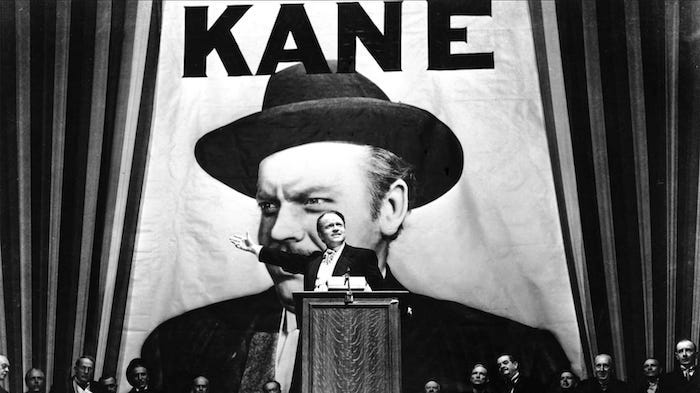
“I made no campaign promises, because until a few weeks ago I had no hope of being elected. Now, however, I have something more than a hope. And Jim Gettys… Jim Gettys has something less than a chance. Every straw vote, every independent poll shows that I’ll be elected. Now I can afford to make some promises! The working man… the working man and the slum child know they can expect my best efforts in their interests. The decent, ordinary citizens know that I’ll do everything in my power to protect the underprivileged, the underpaid, and the underfed! Well, I’d make my promises now if I weren’t too busy arranging to keep them. Here’s one promise I’ll make, and boss Jim Gettys knows I’ll keep it: My first official act as Governor of this State will be to appoint a Special District Attorney to arrange for the indictment, prosecution, and conviction of Boss Jim W. Gettys!”
— Citizen Kane (1941), screen play by Herman J. Mankiewicz and Orson Welles
The Daily Dialogue theme for the week: Politician.
Trivia: One subplot discarded from the final film concerned Susan Alexander Kane having an affair that Kane discovers, said to be based on Marion Davies’ rumored affair with Charles Chaplin. There were scenes written and storyboards designed for this sequence, though as rumors of William Randolph Hearst’s ire grew, Orson Welles ordered the sequence deleted from the script. He refused to discuss the real reasons for its removal in any public forum throughout his life, even long after Hearst’s death, as he claimed elements of the subplot were so scandalous they could cost him his life. Privately, however, he did discuss the subject with his close friend Peter Bogdanovich. According to Bogdanovich, the danger of the subplot stemmed not from the affair, but of its result: Welles claimed that Davis did in fact have an affair with Chaplin, and Hearst learned of it while on a trip on Hearst’s yacht with Davies, Chaplin and a number of other celebrity guests. Welles asserted that Hearst walked into a room and saw Davies and Chaplin having sex. He pulled a gun, and Chaplin ran out of the room onto the deck. Hearst fired at Chaplin, but accidentally shot pioneering producer/director Thomas H. Ince, who shortly afterward died from the wound. An elaborate cover-up followed (supposedly, columnist Louella Parsons was on board and witnessed the killing, and Hearst promised her a job with him for life if she kept her mouth shut. She did.).The legend became the basis for Bogdanovich’s own film The Cat’s Meow (2001).
Dialogue On Dialogue: Kane at the height of his power. And he would have become ‘king’ were it not for his indiscretions with Susan Anthony.