Creative Writing Tips from Metallica
Three lessons from the heavy metal band’s songwriting process.
Three lessons from the heavy metal band’s songwriting process.
In the most recent issue of The Atlantic, there is an article called “The Story of a Song.” Given my history with songwriting and screenwriting, as well as my lifelong interest in creativity, I was interested to give the article a read. I’m glad I did. First, I discovered a podcast which I’ve now added to my listen list: Song Exploder.
Hrishikesh Hirway’s Song Exploder does what it says on the tin. In each episode, a single song gets explained/expanded/exploded — broken down into its constituent parts and ideas, its drum tracks, its backing vocals and strata of emotion. After a brief intro, the host (previously Hirway; as of January, the musician Thao Nguyen) cuts out, so the only voices we hear are those of the composers and makers, telling the story. And telling it coherently, sequentially — a tribute to the show’s agile editors, who construct narrative from even the most musicianly rambling.
It’s a revelatory method. “Musicians like to exist in a state of pure potentiality,” Joe Carducci, the author of Rock and the Pop Narcotic, once told me. “They never want to finish anything.” But things do get finished somehow, thank God, and Song Exploder takes us — economically and expertly — from the roots of a song all the way to the completed work, which gets played in full at the end of the episode.
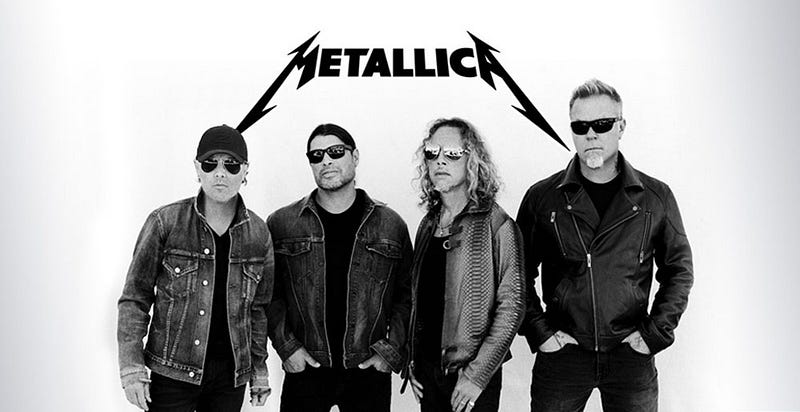
The article explores the creative process of musicians like Thundercat, Lorde, and Fleetwood Mac, but what really caught my attention was the section on the American heavy metal band Metallica:
Metallica, on the other hand, has bypassed serendipity: In the band’s senior years, its process seems to be completely and satisfyingly industrialized. As a prelude to writing its latest album, drummer Lars Ulrich is given an iPod containing 1,500 proto-riffs and maybe-ideas: chordal blurts, noise-stammers, and hummings-into-the-mic produced by guitarist James Hetfield during various sessions and sound checks. (“There’s nothing that happens in this band these days that’s not recorded.”) Ulrich winnows it down, this vast germinal pile, to 20 or 30 viably squirming riffs, and takes them to Hetfield. Is this even songwriting? “I’m letting you in on a lot of trade secrets here!” says the jumpy Ulrich. “I’ve never really talked about this stuff in this detail.” One of these riffs — the one known as “plow” because, Hetfield says, “it had that feeling of just, it could push through anything. It’s like, Okay, nothing’s gonna stop this riff” — will eventually form the basic grid of Metallica’s “Moth Into Flame.” Which, as it happens, is not that great a song. It’s no “Master of Puppets.” But oh how I love, having enjoyed it in its nudity and sincerity, that beautiful plow riff.
I took away three creative writing lessons from Metallica’s approach:
- “As a prelude to writing its latest album, drummer Lars Ulrich is given an iPod containing 1,500 proto-riffs and maybe-ideas”: To me, that looks an awful lot like brainstorming. In my role as an assistant professor in the screenwriting concentration at the DePaul University School of Cinematic Arts, I created a class called Story Development. The goal is for students to end up with a scene-by-scene outline for a feature length screenplay which they then write the following quarter, however, before we get anywhere near the plotting process, we begin with several weeks dedicated to working with the story’s emerging characters. At the heart of that work are a series of brainstorming exercises: Indirect Engagement Exercises (Questionnaire, Biography) and Direct Engagement Exercises (Interview, Character Sit-Down). One of the keys to successful brainstorming is not to pre-judge any idea, rather put everything down into a Master Brainstorming List, aggregate these ‘proto-riffs and maybe-ideas’ as a collection of narrative elements. The philosophy behind this approach is to encourage writers to connect with their characters in a free-wheeling atmosphere to surface as much potential story content as possible.
- “Ulrich winnows it down, this vast germinal pile, to 20 or 30 viably squirming riffs”: This parallels what my students do next which is to start wrangling their Master Brainstorming List by asking, “Which of all these narrative elements feels like it may be of value moving forward in the story-crafting process.” In creating a concentrated list of bullet points — everything from character traits, scenes, lines of dialogue, images, themes — students watch their story begin to take shape as their characters come more clearly into view.
- “One of these riffs — the one known as ‘plow’… will eventually form the basic grid”: As students continue to develop their stories through a series of story summaries — Character Map, Synopsis, Breakdown, Treatment, Beat Sheet, Narrative Throughline — they zero in on the story’s central theme. That theme serves as the ‘plow’ to help the student “push through” crafting every scene because every scene is tethered to that theme.
See if you can hear the “plow” in Metallica’s song “Moth Into Flame”:
That song represents hours upon hours of whittling down hundreds of “maybe-ideas” into a concentrated collection of promising “proto-riffs,” then zeroing in on a “plow” to serve as the thematic linchpin for the song. What we do in my Story Development class echoes Metallica’s process.
Writers, take note. You can do the same.
For the rest of The Atlantic article, go here.
For the entire episode list of the Song Exploder podcast, go here.