“Conversations With Wilder”: Part 9
Billy Wilder is my all-time favorite filmmaker. Consider just some of his movies: Double Indemnity (1944), Sunset Blvd. (1950), Ace in the…
Billy Wilder is my all-time favorite filmmaker. Consider just some of his movies: Double Indemnity (1944), Sunset Blvd. (1950), Ace in the Hole (1951), Stalag 17 (1953), Witness for the Prosecution (1957), Some Like It Hot (1959), The Apartment (1960), an oeuvre that demonstrates an incredible range in a filmmaking career that went from 1929 to 1981.
One of the best books on filmmaking and storytelling is “Conversations With Wilder” in which Cameron Crowe, a fantastic filmmaker in his own right (Say Anything, Singles, Jerry Maguire, Almost Famous) sat down with Wilder for multiple hours and they talked movies.
Every Monday through Friday for the next several weeks, I’m going to post excerpts from the book, add a few thoughts, and invite your comments. I trust this will be a good learning experience for each of us. And while we’re at it, why don’t watch some Wilder movies to remind ourselves what a great writer and director he was.
Today’s excerpt in which Wilder talks about his philosophy of how to shoot a movie comes from Page 58:
CC: The way you shot The Apartment seemed very specific, a lot of wider shots and masters. By doing that, C.C. Baxter always seem very alive, struggling against the bigger world of business. Was that the visual concept?
BW: Yes. The idea behind shooting it is getting everything that is written on the screen. Everything, making it clear. I did not shoot a face like this, and like that, and then over again, from other angles. No, I just shot it once. And that was about forty-some-odd years ago. I did not endlessly try to find any specific good angle. I just tried to be good, careful that one thing led into the other thing. One close-up here, another there…never too many, only when necessary. And when I’m through with a picture, there’s only about a thousand feet left on the floor of the cutting room. We did The Apartment in fifty days and edited it in less than a week. We had three feet of unused film. That was good.
The story was good, our ideas worked. For example, we had the dame, a broad with Lemmon, coming back into the apartment. And he was dancing around, and making fun, and suddenly he sees the girl, Shirley MacLaine, asleep in his bed, but he cannot wake her up. That’s why, in structuring it, we invented a doctor who lives next door, Dr. Dreyfuss.
CC: The mensch who helps save her and teaches Baxter how to live a better life.
BW: Yeah. We never went into the apartment [of the doctor]. No time for that. We only went into the doorway.
Some takeaway:
- In previous posts, we have seen how in Wilder movies, there is a sense of economy. Nothing grand. Nothing elaborate. Simple shots, rarely if ever calling attention to himself as a director. But then, his fingerprints are all over things that really mattered to him: Story, Scene, Character. In other words, the script: “The idea behind shooting it is getting everything that is written on the screen.”
- “The story was good, our ideas worked.” Having worked out the story in detail — “…careful that one thing led into the other thing” — he could do the shoot with confidence. I mean, really! They edited The Apartment in less than a week… with three feet of unused film.
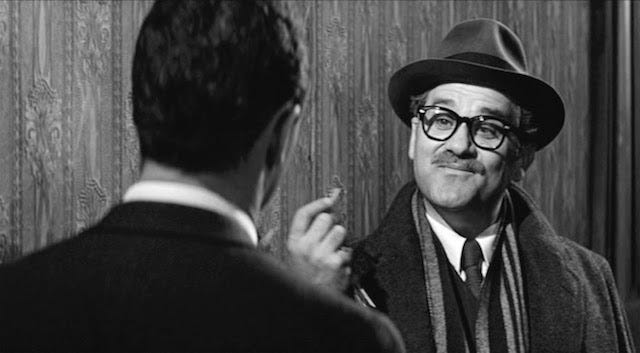
- For you screenwriters out there, Wilder lets slip a gem about his process, and it’s about this character in The Apartment:
This is the heretofore mentioned Dr. Dreyfuss. How did this character come into existence?
“…suddenly he sees the girl, Shirley MacLaine, asleep in his bed, but he cannot wake her up. That’s why, in structuring it, we invented a doctor who lives next door, Dr. Dreyfuss.”
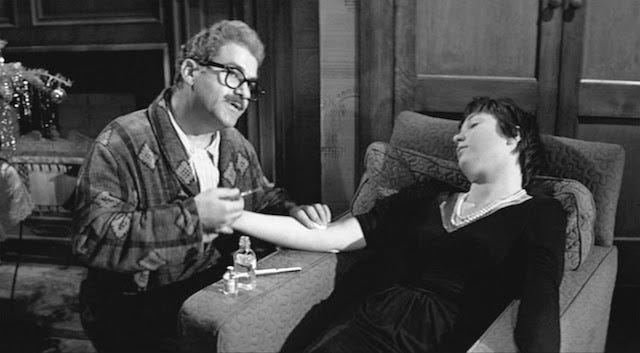
One thing leads to another, right? You’ve got Baxter back at his apartment. There’s his Attractor (Kubelik) completely passed out and he knows she’s taken his sleeping pills, but how to wake her up? Establish a doctor who lives next door and introduce him earlier, then voila! Problem solved.
This is the beauty of creativity: The potential of this character to provide an important narrative function. Dreyfuss is, as Crowe suggests, a Mentor figure: “The mensch who helps save her and teaches Baxter how to live a better life”. I did a post on this very subject in 2010 as part of the Great Character series. Here is the relevant excerpt:
How is Dreyfuss a Mentor character? Here are three examples:
The first time we see Dreyfuss, he is returning from an emergency call and happens to see Baxter as he’s setting out a trash can full of bottles of booze all the guys using his apartment for their trysts have consumed. Dreyfus assumes it’s Baxter who has been carrying on with all the booze and late night carousing with a variety of women. Here is an excerpt of their exchange:
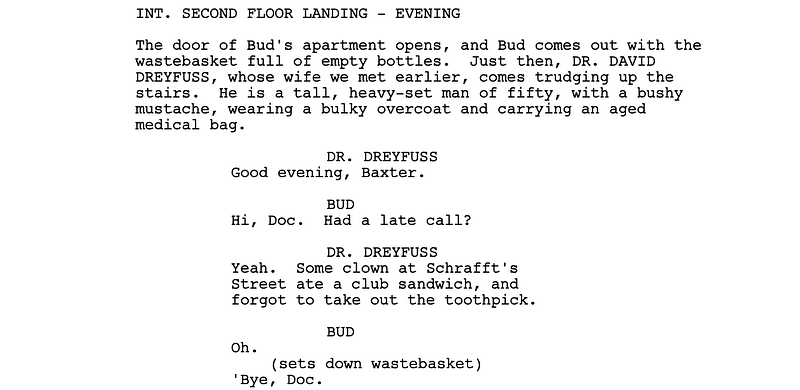
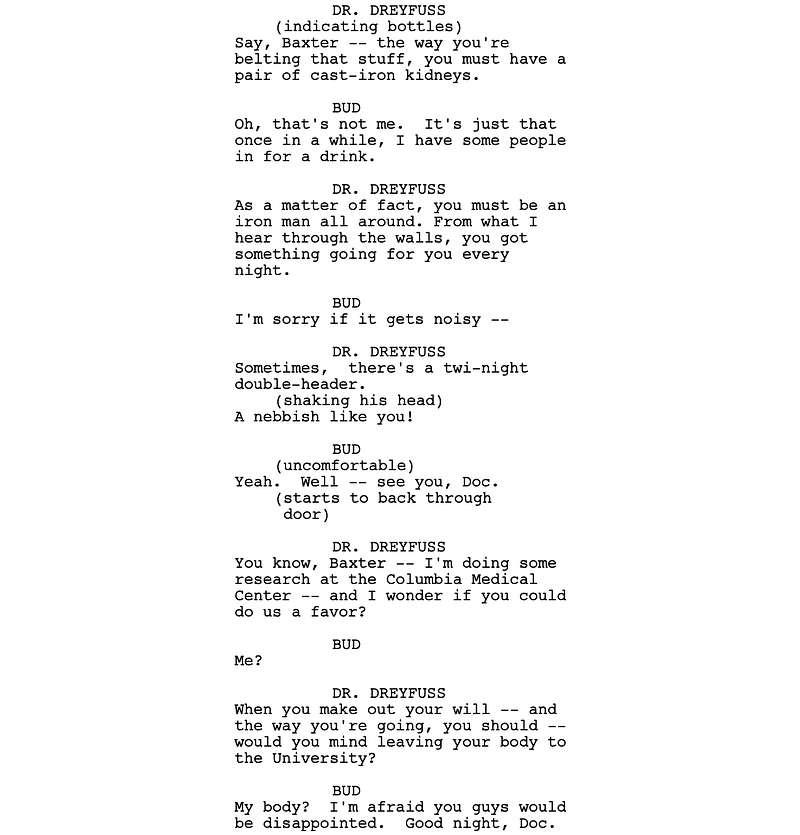

“Slow down, kid.” Prudent advice befitting a Mentor. Another instance is how Dreyfuss uses his medical knowledge to help save Fran (Shirley MacLaine) from dying due to her suicide attempt:
And the third instance? After this close call, Dreyfuss tells Baxter:
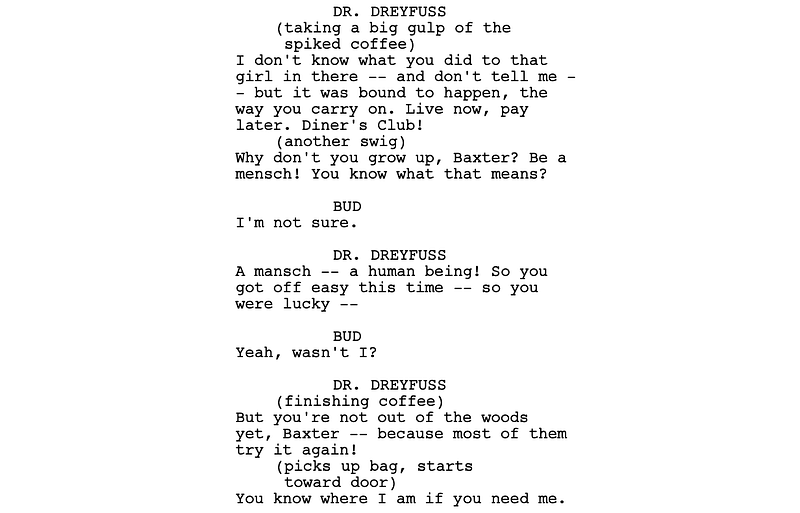
And why is that important? Because when Baxter quits his job — remember a promotion was his conscious goal at the beginning of the movie — he offers these words to his boss Sheldrake (Fred MacMurray), proof of his personal metamorphosis:
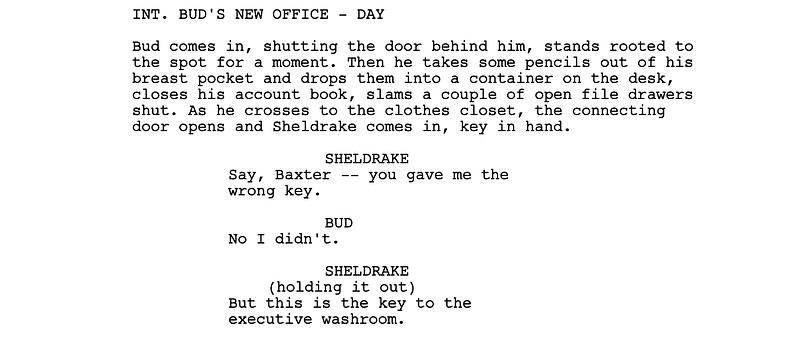
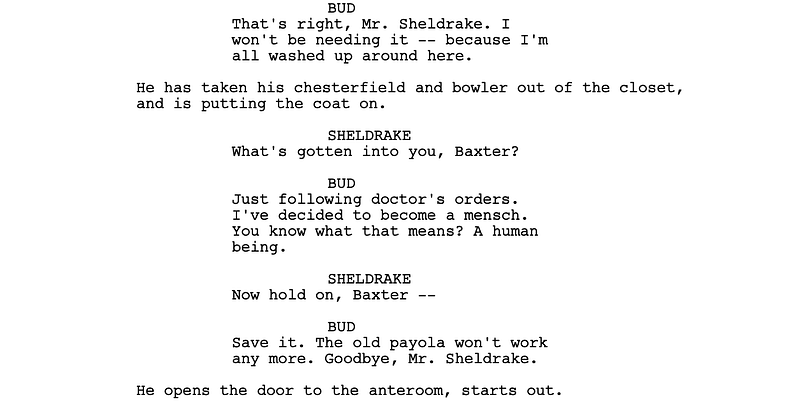
Dr. David Dreyfuss is an excellent reminder that even the secondary characters we write should be great ones, too.
Sometimes in our stories, characters or moments emerge out of necessity. When they do, don’t just think about how they may solve this specific problem. Rather look at them in the larger perspective of the narrative. Perhaps you can use them in a bigger sense… like turning a doctor into a Mentor.
Tomorrow: More from “Conversations With Wilder.” If you have any observations or thoughts, please head to comments.
For the entire series, go here.