“Conversations With Wilder”: Part 5
Billy Wilder is my all-time favorite filmmaker. Consider just some of his movies: Double Indemnity (1944), Sunset Blvd. (1950), Stalag 17…
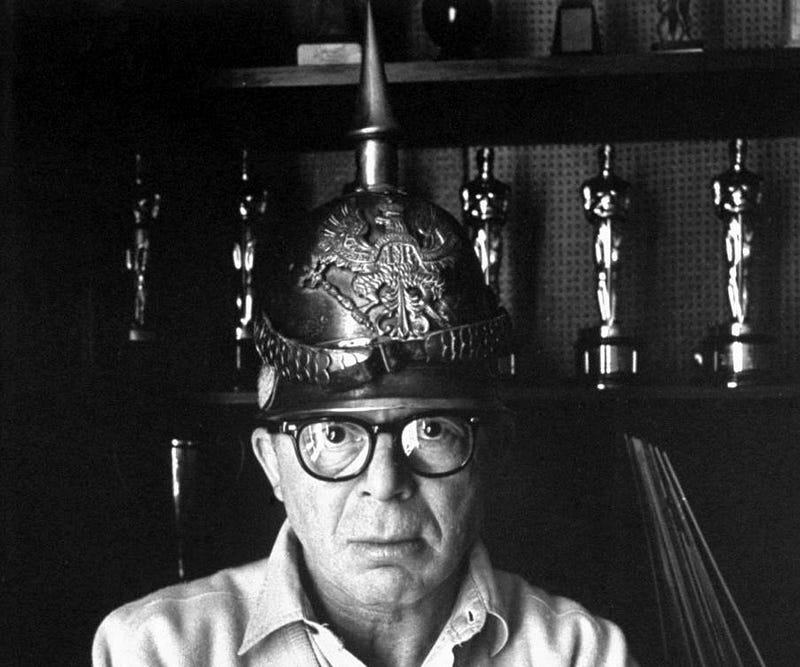
Billy Wilder is my all-time favorite filmmaker. Consider just some of his movies: Double Indemnity (1944), Sunset Blvd. (1950), Stalag 17 (1953), Witness for the Prosecution (1957), Some Like It Hot (1959), The Apartment (1960), an oeuvre that demonstrates an incredible range in a filmmaking career that went from 1929 to 1981.
One of the best books on filmmaking and storytelling is Conversations With Wilder in which Cameron Crowe, a fantastic filmmaker in his own right (Say Anything, Singles, Jerry Maguire, Almost Famous) sat down with Wilder for multiple hours and they talked movies.
Every Monday-Friday for the next several weeks, I’m going to post excerpts from the book, add a few thoughts, and invite your comments. Today’s excerpt comes from PP. 20.
BW: My only ambition was to entertain, this way or that way. To entertain and not to repeat myself and to make as few mistakes as possible. There are so many mistakes. I remember, I lived at 704 Beverly Drive, and the way to the studio, to Paramount, is a ride of about fifteen or eighteen minutes. I mapped out in my mind where, on the way back, on the corner of La Cienega and Melrose, I always hit my leg, my thigh, and I said, “Goddamm it, that’s the way I should have done it!” But most of the time it’s too late. Too late, because the picture is cut and the actor’s in Yugoslavia and the sets are down. If you do a picture like George Stevens — he did that very famous picture A Place in the Sun [1951]. Now, there is a district attorney in that picture who limps. I talked to somebody and said, “It’s a very fine picture, but he did not have to make justice itself limp.” That was too allegorical. That was not good. Because it was just a wonderful picture. And I just told him, “Look, if that was in the theater, you go backstage, and you tell the actor who plays the district attorney, ‘Tonight, no cane.’” But “Tonight, no cane” in a picture, you have to remake 80 percent of the picture!
The anecdote about A Place in the Sun is typical Wilder: A character’s limp being too allegorical. Wilder’s movie show a consistent kind of restraint. His camera work, never flashy, just set it, and let the actors act. Remember the George Cukor story Wilder told here, how the director told Jack Lemmon to keep doing a scene over and over, each time just a “little bit less,” to the point where Lemmon said, “Mr. Cukor, for God’s sake, you know pretty soon I won’t be acting at all.” To which Cukor responded, “Now you’re getting the idea.” Why did Wilder love that story? In part because it’s funny, but also the story reflects Wilder’s “less is more” attitude toward storytelling, his restraint as a filmmaker.
A great example of this is the classic 1944 film noir film Double Indemnity, written by Wilder and Raymond Chandler [their relationship is a whole other story]. Wilder wrote and shot an ending scene in which the Protagonist Walter Neff (Fred MacMurray) is put to death in a gas chamber. Here is the only known photo of that scene:
These are the only known photos of that scene:
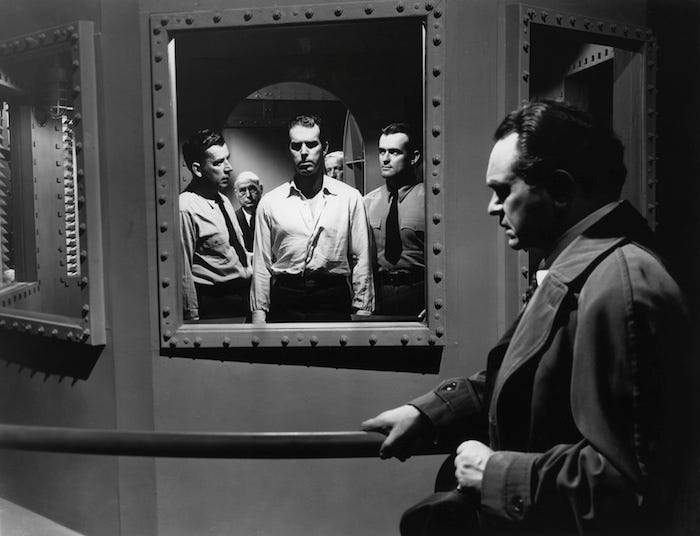
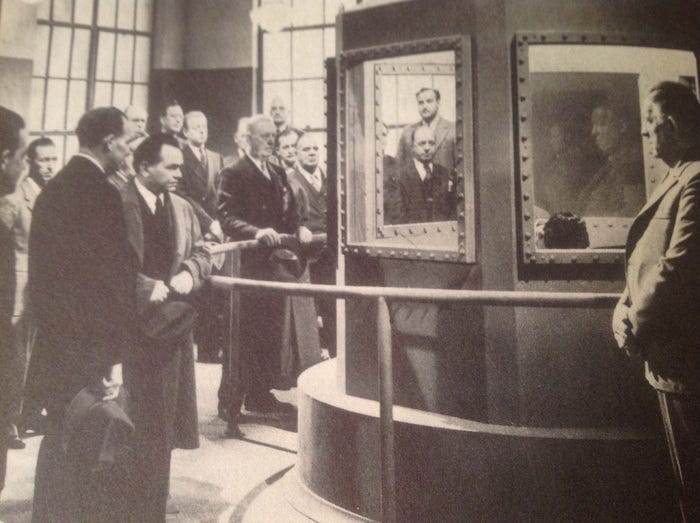
Wilder shot the scene, but it didn’t feel right to him, too much, over the top. Despite the considerable cost of shooting the scene, he cut it. Which has left us with this final scene:
As it should be, some final “bromance” moments between Neff and Barton Keyes (Edward G. Robinson), capped by the payoff to the lighting-the-match runner. Wilder’s restraint gave us a pitch perfect ending to a great movie.
One takeaway for writers and filmmakers: We don’t have to clobber a reader over the head with emotion, exposition, action, style and all the rest. Sometimes the best path is to explore our characters at such depth that we give them room to do their thing. Restrain our instincts, get out of the way, and let them ‘tell’ the story.
Now let’s zero in on this line: To entertain and not to repeat myself and to make as few mistakes as possible.
I’ve just written this out on a 3x5 inch index card and tacked it up on my desk. Why?
- “To entertain”: Always good to remember this is Job Number One whenever we write a story.
- “Not to repeat myself”: Once we find a bit of business, angle, theme or whatever narrative element that works, it’s so tempting to go to the well again… and again… and again. But that is the easy way out. Even if we write in one genre, we should challenge ourselves to approach tropes and memes, and even those aspects of our writing that work, and push to find new ways to use them in telling a story.
- “To make as few mistakes as possible”: I would never use this advice during prep or writing early drafts. That is primarily a journey of discovery, finding the story, and the process is rife with decisions and passes that prove to be unfruitful, but in the end, we will have needed to go through all that to land on the story we want and need to tell. However, when it comes to rewriting and editing, we can push ourselves to avoid falling into narrative traps. Moreover from a career standpoint, this is also solid advice. The fact is, you will fuck up with your career choices. Learn from them and minimize your mistakes.
Final thought: Think of all the filmmakers working today, how so many of them — in effect — repeat themselves, making the same movie. Hell, the studios have totally bought into this mentality. Sequels. Remakes. Reboots. Fundamentally, that is not a creative choice, rather it reeks of playing it safe.
That wasn’t Wilder. He told stories that interested and challenged him regardless of genre. Indeed while he did focus on comedy, he trafficked in a myriad of other story arenas. As a result, he left us with a fascinating opus of movies…. and we are all the better for it.
It makes me wonder: Would Wilder have had the opportunity to work in Hollywood as it is today? Frankly, I doubt it. We are blessed he was alive and stumbled into Hollywood when he did because I don’t think anybody, other than perhaps Megan Ellison, would have supported his type of wide-ranging artistry just as her production company Annapurna Pictures has with Paul Thomas Anderson, Spike Jonze and David O. Russell.
To think a talent such as Wilder would not find a home in today’s Hollywood is an incredible statement on the current state of affairs. It’s not an inspiring commentary.
Next week: More from “Conversations With Wilder.” If you have any observations or thoughts, please head to comments.
For the entire series, go here.