“Conversations With Wilder”: Part 4
Billy Wilder is my all-time favorite filmmaker. Consider just some of his movies: Double Indemnity (1944), Sunset Blvd. (1950), Stalag 17…

Billy Wilder is my all-time favorite filmmaker. Consider just some of his movies: Double Indemnity (1944), Sunset Blvd. (1950), Stalag 17 (1953), Witness for the Prosecution (1957), Some Like It Hot (1959), The Apartment (1960), an oeuvre that demonstrates an incredible range in a filmmaking career that went from 1929 to 1981.
One of the best books on filmmaking and storytelling is Conversations With Wilder in which Cameron Crowe, a fantastic filmmaker in his own right (Say Anything, Singles, Jerry Maguire, Almost Famous) sat down with Wilder for multiple hours and they talked movies.
Every Monday-Friday for the next several weeks, I’m going to post excerpts from the book, add a few thoughts, and invite your comments. Today’s excerpt comes from PP. 18–19:
CC: The champagne-popping device worked for you once before, in Ninotchka. When Melvyn Douglas pops the champagne and Garbo crumbles behind his back, as if she’s been shot.
BW: Yeah, she crumbles, she is blindfolded. There were three of us on that script [Wilder, Charles Brackett, and Walter Reisch]. And the fourth one was [Ernst] Lubitsch. He never took credit, but he did a lot of wonderful writing, or offered suggestions. He was absolutely the best when it comes to that kind of picture. He didn’t do any comedies in Germany, he did great big expensive historical pictures. Just great big pictures, they were locomotives — showmanship pictures like Madame Du Barry…He himself was a comedy actor in two-reelers. Schuhpalast Pinkus [1916] was the name [of one]…a shoe palace where he was one of the guys who sold shoes. It was all very funny and very solid. It never occurred to him that there was gold to be mined in directing comedy, because he did not make out-and-out elegant comedies in Berlin. He arrived in Hollywood in the early twenties with an avalanche of European people, actors, directors. They cam because they were searched out by Mr. Louis B. Mayer, who had gone to Europe to look at talent. Whereas I came here because I didn’t want to be in an oven.
I came here with nothing. Lubitsch was then making his first American picture. He just did not know what they wanted him to do. And in his bewilderment, he made Rosita [1923], a picture with Mary Pickford. A serious picture, not very good, and he left Hollywood right away. He had a contract with Warner Bros., I think. It was then that he saw a picture by Mauritz Stiller, a Swedish director, and this is where he got his style. This is where Lubitsch saw that his future was in comedy, silent as it is. Sound came later. The first or second sound musical, he made, The Love Parade [1929]. But he was already searching for comedy subjects. And he did them gloriously. He realized that if you say two and two, the audience does not have to be told it’s four. The audience will find it themselves; let the audience find the joke. There was always an innuendo, in setting up situations, and you were rewarded by the laugh of the people who added it up. And it was a whole new technique. That was in the Swedish picture too. Mauritz Stiller did it. I never saw it. And this was where Lubitsch became Lubitsch. This was where he discovered the “Lubitsch touch.” He was absolutely astonished, and thought, “My God, what things you can do by innuendo!” It changed his life; it was the beginning of the Lubitsch touch. And the next picture he made [after Rosita] had it — The Marriage Circle [1924]. And the emotions of his work got sharper and sharper and sharper.
From then on, he only made comedies, if you call The Shop Around the Corner [1940] a comedy, which I think it was. His favorite was a picture called Trouble in Paradise [1932]. He told me so himself.
It stars [Herbert] Marshall as a thief. He acts the part of a doctor and he places something [chemically treated] over the mouth of his patients that puts them out. And then he and his girlfriend commit thievery. I remember the third act was that Marshall goes to a party. And he sees Edward Everett Horton, who he had robbed, and who then tries to remember, where did he see that man before? Every time he passes him, he looks. Then ultimately, he smoke a cigarette and uses an ashtray, which is a metal gondola. And the gondola reminds him, because it happened in Venice. The Lubitsch touch [marvels]. It was his favorite picture; he liked it better than any other that he did, including Ninotchka. But the beginning of it all was this picture made by Mauritz Stiller…
And to this I must say, Mauritz Stiller was a very, very find director. Swedish pictures were then not as popular as American. But Swedish, French pictures, Polish pictures, Argentinian pictures, it did not matter…they were silent pictures, you only had to translate the titles, that was all…
But you see, I am a great admirer of Mr. Lubitsch. I really loved the man, as a human being, and as an artist — way ahead of his time.
To say that Wilder was a fan of Ernst Lubitsch may be the biggest understatement in the history of cinema. Wilder famously had this plaque hanging in his office:
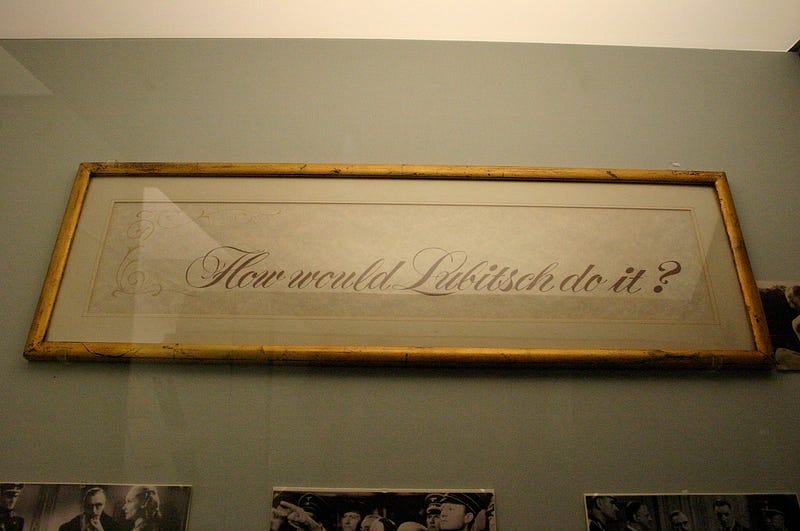
“How would Lubitsch do it?” That one illustration of the “Lubitsch touch” Wilder provides is illustrative of so much of Wilder’s approach, not only to humor, but storytelling in general: Let the audience find the joke. Let’s parse that observation:
- It implies a respect for the moviegoer: Wilder didn’t think of the audience as dumbbells for whom everything has to be telegraphed and explained, but rather gave them credit for having brains, experience and common sense to figure things out themselves.
- It engenders active engagement: If the viewer is given the opportunity to think for themselves, indeed, challenged to put two and two together, this makes them an active participant in the process of the unfolding narrative, rather than a passive one for whom everything is laid out for them.
- It requires the filmmaker to have confidence in their storytelling ability: One key to this “innuendo” approach is for a filmmaker to have a solid instinct for how much little / how much to dole out to the audience. This was particularly important for a writer-director like Wilder whose movies often pushed the envelope in terms of tone, not fitting into neat little genre-boxes.
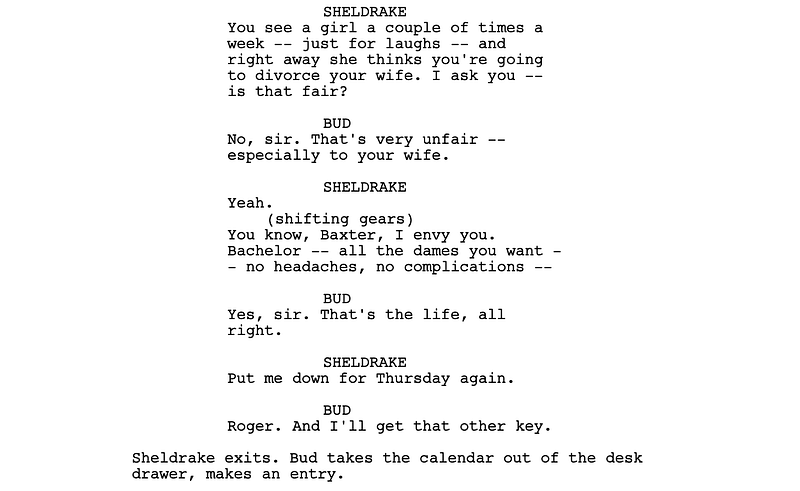
Here are two examples of this approach, both from The Apartment. In this first scene, Sheldrake (Fred MacMurray), the head of the company, has called in Baxter (Jack Lemmon) because Sheldrake has heard a rumor about a “certain key floating around the office.” Baxter thinks he is being called on the carpet for allowing four upper level managers at the company use his apartment for their extramarital affairs, perhaps even concerned that he [Baxter] is about to be fired:

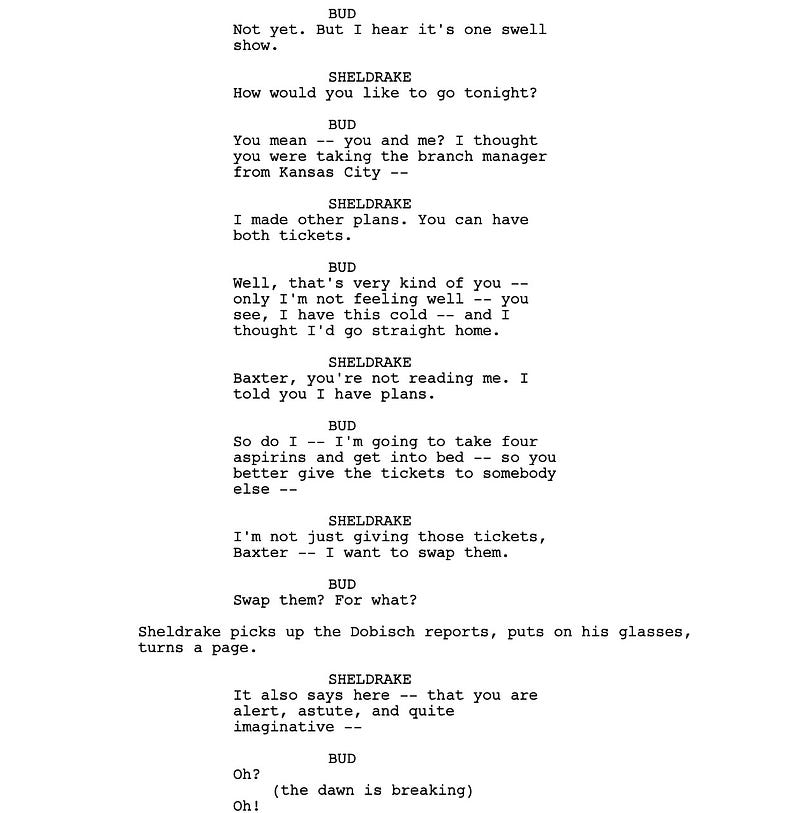
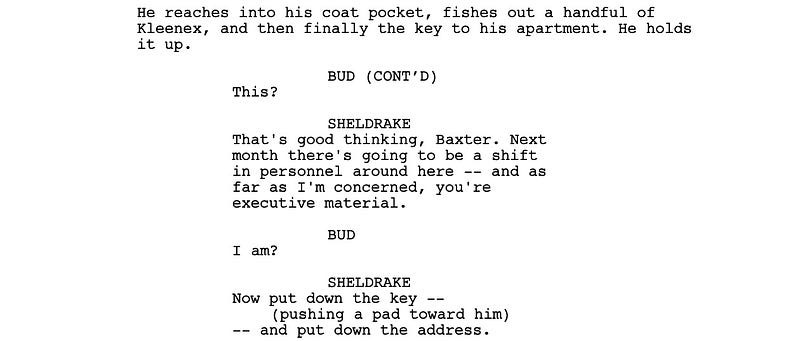
Here is a case where we — the audience — are way ahead of Baxter. Wilder and his co-writer I.A.L. Diamond give the viewer room to figure out where Sheldrake is going before the story’s Protagonist does.
An even more sublime example is the use of a ladies compact which plays out as a setup and payoff. In this first scene, Baxter is in his office when Sheldrake visits, now using Baxter’s apartment for his trysts with Fran Kubelik [Shirley MacLaine]. Note: Baxter does not know Sheldrake is having an affair with Kubelik, who as it turns out is the woman Baxter has a thing for.
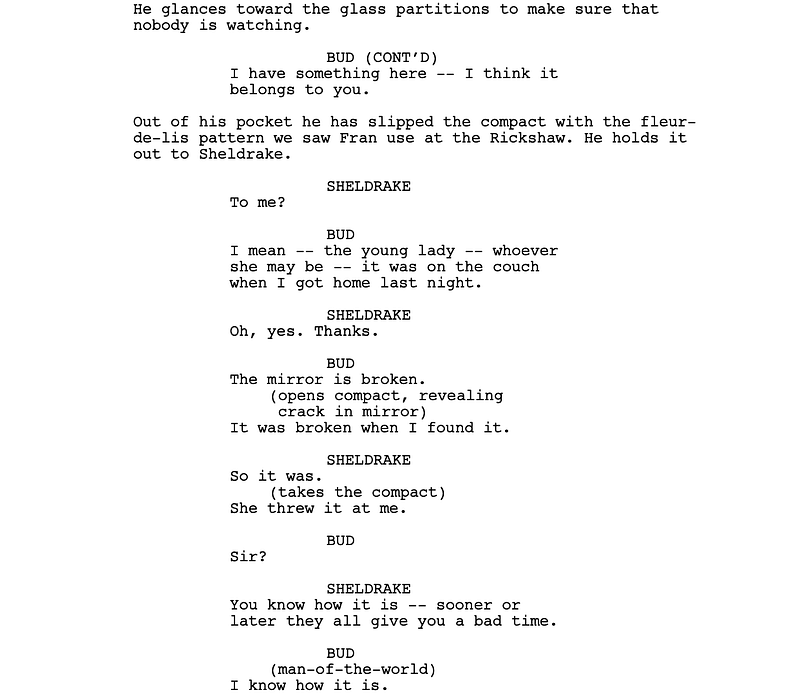
Let’s acknowledge how this scene demonstrates how far down the slippery moral slope Baxter has slid, buying into the whole married-man-can-justifiably-have-an-affair mentality of 1960 when the movie was released. But per the focus of this post, the point of the scene is to establish Baxter’s awareness of the compact, especially its broken mirror.
Onto the second scene, this time at the office Christmas party. There is so much going on in this scene — for instance, Kubelik has just discovered Sheldrake has a history of flings with women in the company — but let’s focus on the compact.
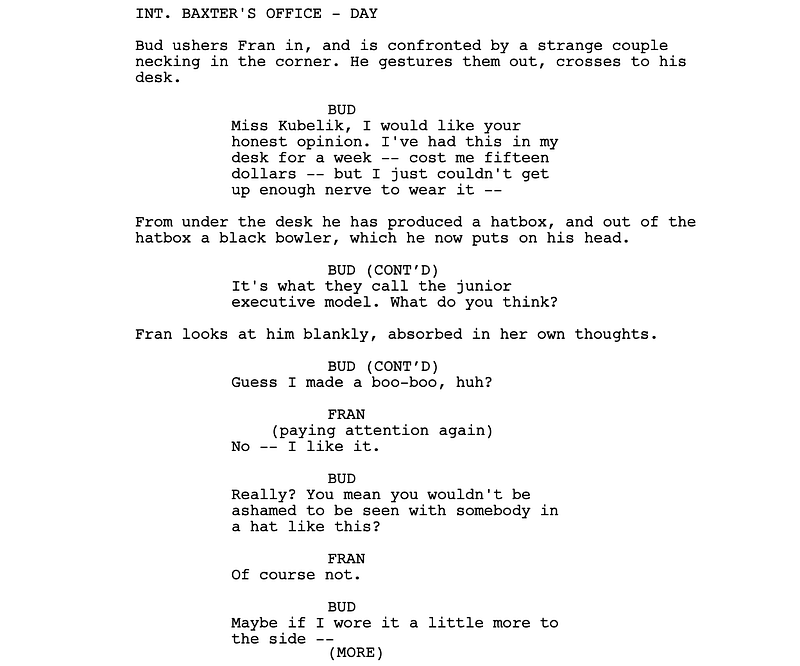
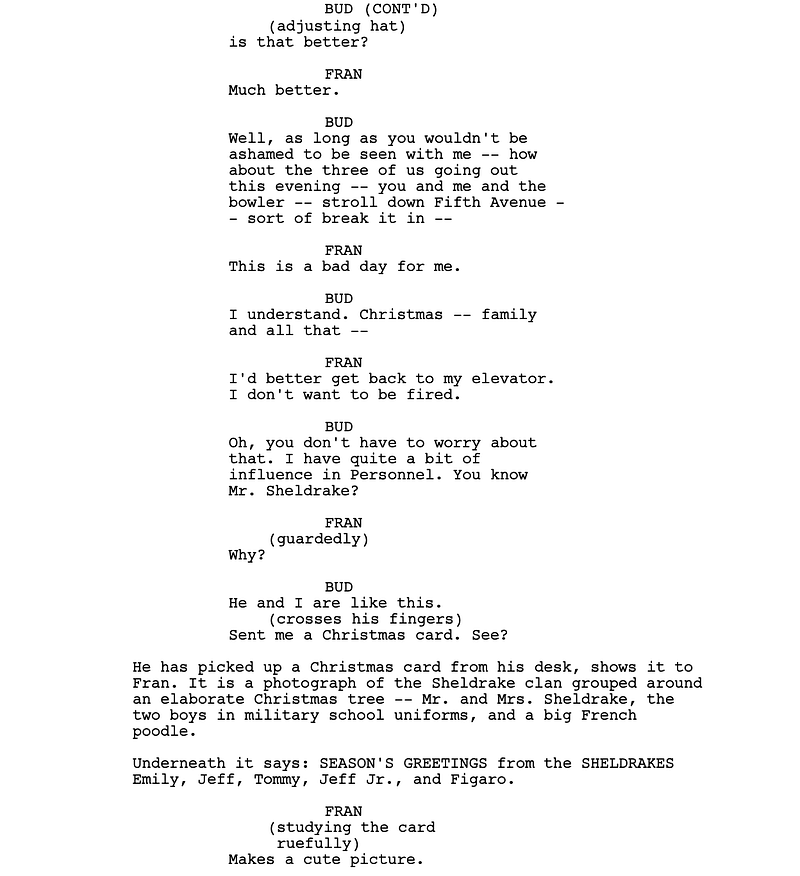
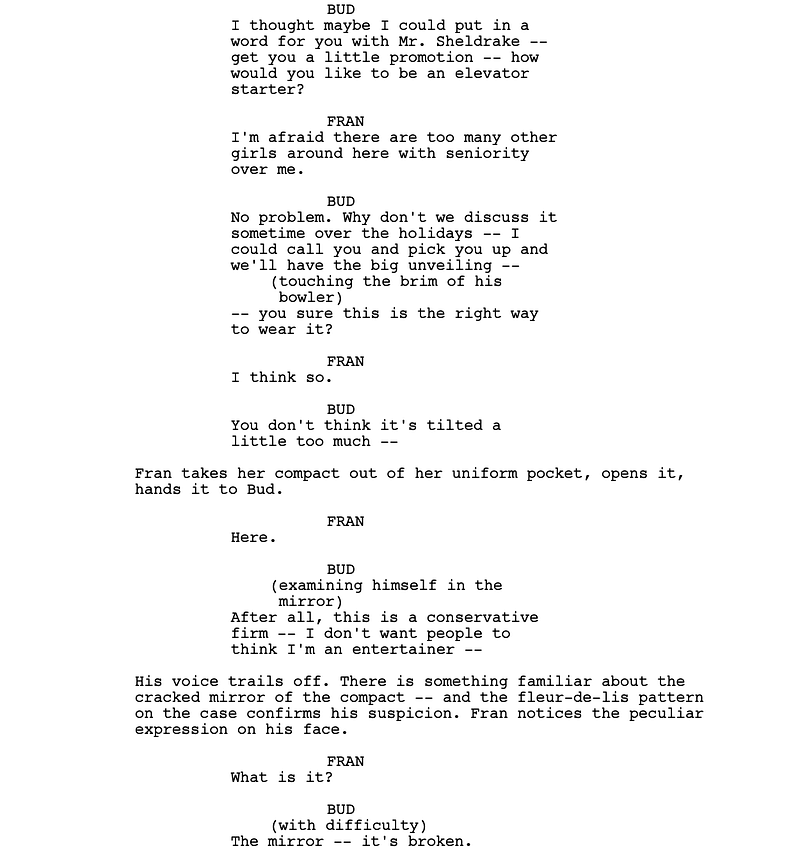
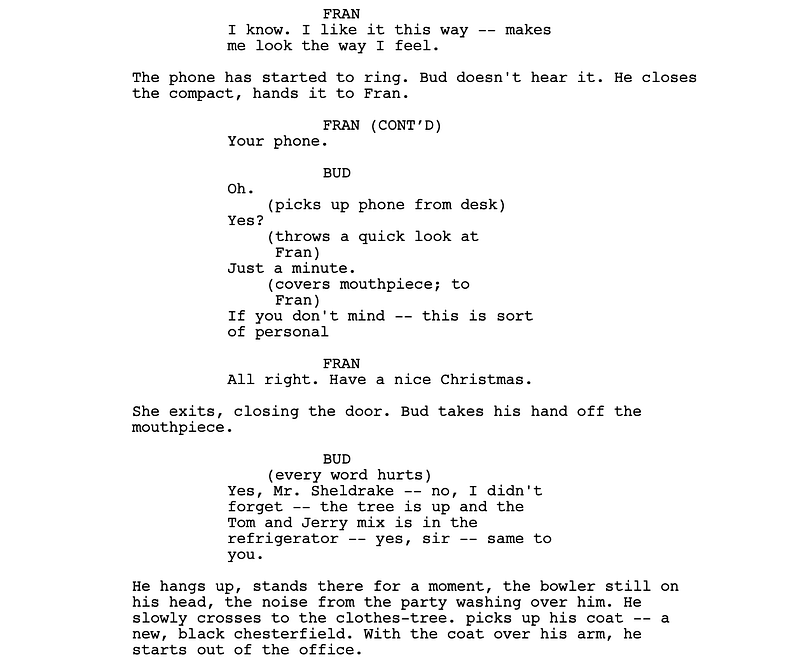
Once again, we are ahead of Baxter. As soon as we see the compact, we can anticipate what Baxter’s reaction will be because we know that Kubelik is Sheldrake’s mistress and that the compact is hers. Moreove,r this significant plot point is conveyed through an object, a visual clue. None of the characters says anything directly to suggest this revelation has happened, it all occurs in subtext.
Just one more reason why this scene is so brilliant… and yet more evidence that The Apartment is — in my view — a perfect movie.
Takeaway: Respect the audience. Don’t spell out everything, rather use innuendo as a tool. Tease the script reader, provide clues, and get them actively engaged in the story process.
Two last things. First the 1920 silent film Erotikon by director Maurice Stiller, “A comedy in five acts”:
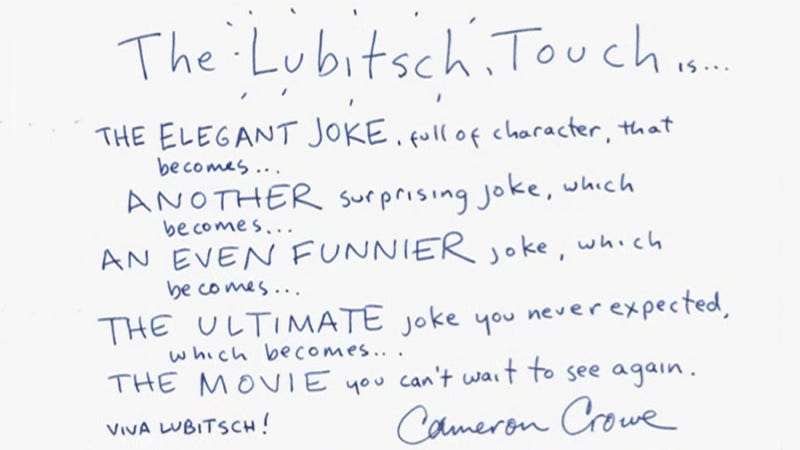
And this from Cameron Crowe:
Tomorrow: More from “Conversations With Wilder.” If you have any observations or thoughts, please head to comments.
For the entire series, go here.