“Conversations With Wilder”: Part 3
Billy Wilder is my all-time favorite filmmaker. Consider just some of his movies: Double Indemnity (1944), Sunset Blvd. (1950), Stalag 17…

Billy Wilder is my all-time favorite filmmaker. Consider just some of his movies: Double Indemnity (1944), Sunset Blvd. (1950), Stalag 17 (1953), Witness for the Prosecution (1957), Some Like It Hot (1959), The Apartment (1960), an oeuvre that demonstrates an incredible range in a filmmaking career that went from 1929 to 1981.
One of the best books on filmmaking and storytelling is Conversations With Wilder in which Cameron Crowe, a fantastic filmmaker in his own right (Say Anything, Singles, Jerry Maguire, Almost Famous) sat down with Wilder for multiple hours and they talked movies.
Every Monday-Friday for the next several weeks, I’m going to post excerpts from the book, add a few thoughts, and invite your comments. Today’s excerpt comes from PP. 16–18:
CC: Who wrote the last line in The Apartment — “Shut up and deal” — you or I.A.L. Diamond?
BW: [Famously cagey on the subject of which collaborator wrote which lines, Wilder eyes me evenly] “Shut up and deal”? I don’t remember. Could have been Iz. Could have been me. [Pause]. We had that gin game in the plot — when she’s recovering from her suicide attempt, they played gin, and the game’s not finished — and we didn’t want to have a kiss, and we didn’t want to have something too sweet. But we had a very good stepping stone for the last scene. We had planted somewhere that he once attempted suicide, with a gun, but he did not quite know how to handle it and shot himself in the knee. So we knew that he had a gun. Then we also planted there that it’s in his luggage which he’s packing up because he’s going back to Cincinnati, or wherever. We also planted there that Dr. Dreyfus brings him a bottle of champagne. So we had that thing, you remember, it was at midnight, the lights go out. It’s New Year’s Eve. Mr. Fred MacMurray, by this time, is divorced. He’s popped the question to Shirley MacLaine, finally, finally, finally. Then when the lights go on, she’s gone. We used that trick at midnight all the lights go out. Now, she’s running, she’s running and running and running to the apartment. And we know that it’s…that could be the ending, right?
CC: Right —
BW: He could be standing in the window and wave at her, or he opens the door and she kisses him. We didn’t want to have that ending, that kiss ending. We had that good idea of, she’s running, and now she hears a shot. And now, we don’t know yet, but she thinks, “My God, he wanted to commit suicide on account of another girl, but maybe this time he’s not gonna hit his knee!” So she hurries up much more, and she’s faster and faster, and she gets to the door, and she knocks. He opens it and he’s got the bottle of champagne foaming over [grinning], which it always does when you shake it. So, “Oh, God, thank God,” but still no kiss. But he wants to ask her, “What’s the matter?” “Nothing, let’s finish the gin game.” They’ve got the cards there, still down on the table. And he asks her something amorous.
CC: He says, ‘I love you, Miss Kubelik.”
BW: “I love you.” Then she says, “Shut up and deal.” And he deals the whole deck, you know, not just ten cards.
CC: The kiss would have been too romantic, too sweet.
BW: Yeah. It’s not an ending like “Nobody’s perfect.” but then again, at least it was not too schmaltzy.
At least it was not too schmaltzy. Ha! Talk about underselling yourself! To me, “Shut up and deal” is the best last line of any movie ever. There’s such a perfection to it, I have always just felt that. But in reading Wilder’s background on the line’s genesis, we can see why it is just right. Look at all the plot details Wilder and Diamond set into motion for the line:
- The game of gin.
- Baxter’s previous attempt at suicide.
- He has a gun.
- Dreyfus gave Baxter a bottle of champagne.
- Midnight on New Year’s Eve when the lights go down which enables Kubelik to ‘escape’ Sheldrake.
- It figures Baxter would pop open champagne, seeing as (A) he’s moving and (B) it just turned to the New Year.
So all of those bits of business were set in place for the actual details of what the characters did and said in the movie’s final scene. But what Wilder doesn’t mention is in the story’s Internal World, the psychological domain: Kubelik would not be running on the streets of Manhattan to see Baxter unless certain things were revealed to her. And that’s precisely what happens in the movie’s penultimate scene.
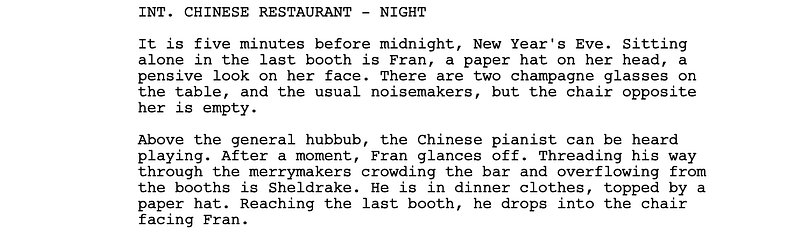
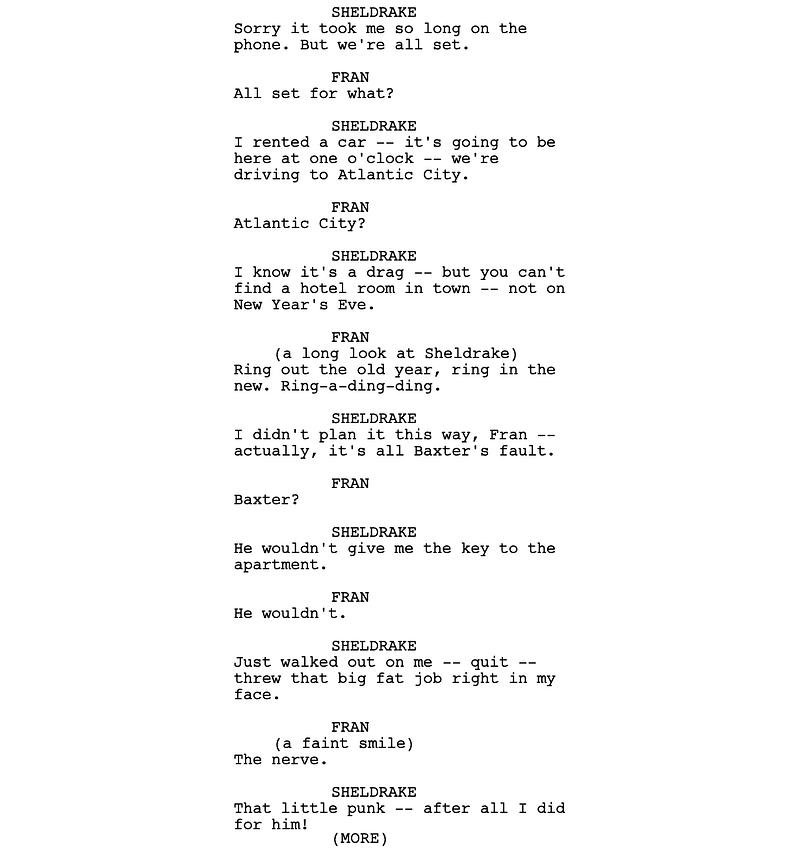
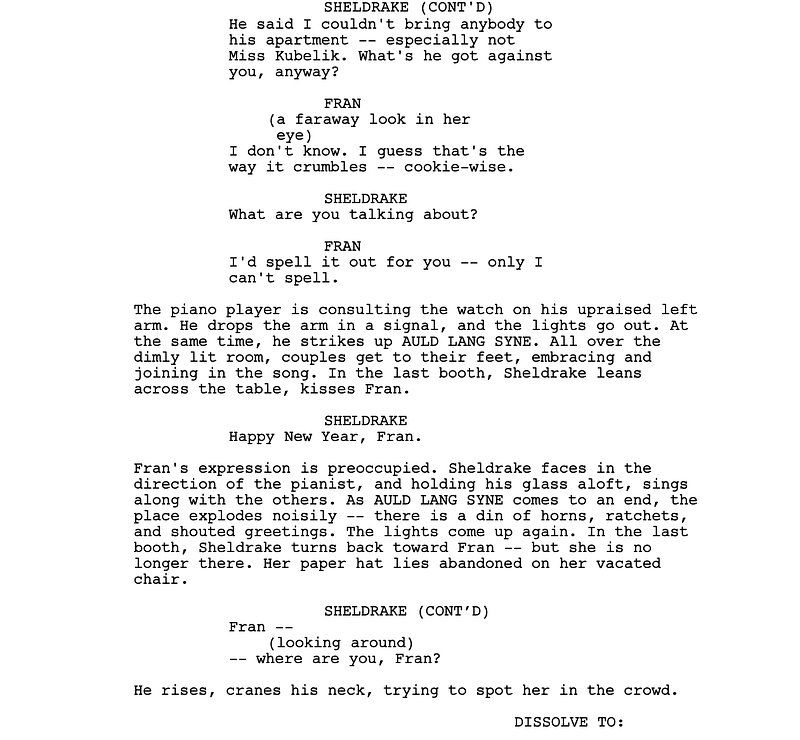
The fact that Baxter quit his job — his dream job — because of his feelings for Kubelik, not only convinces Fran that Baxter is a guy she deserves to be with, his courage to make a break from Sheldrake inspires her to do the same thing, which provides the emotional impetus — combined with everything about the plot Wilder mentioned — to take us to this:
Wilder and Diamond had two other hurdles they had to overcome to come up with the perfect ending line, both self-imposed. (1) As noted, they didn’t want “that kiss ending,” nothing “too schmaltzy.” While that would have been the easy way out, such an ending would have flown in the face of the entire atmosphere and tone of The Apartment, basically a dark comedy about office politics and sexism in the workplace. (2) Wilder and Diamond had to write a line that fit Fran Kubelik’s character. Fortunately, she herself is not “too schmaltzy,” indeed several times she conveys an edgy, even biting sense of humor. Here is one notable example, Fran in Baxter’s apartment for a tryst with Sheldrake on Christmas Eve.
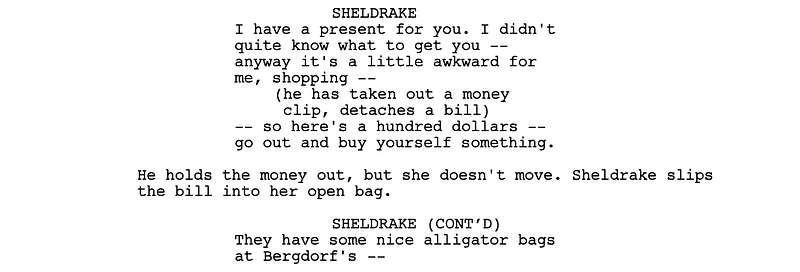
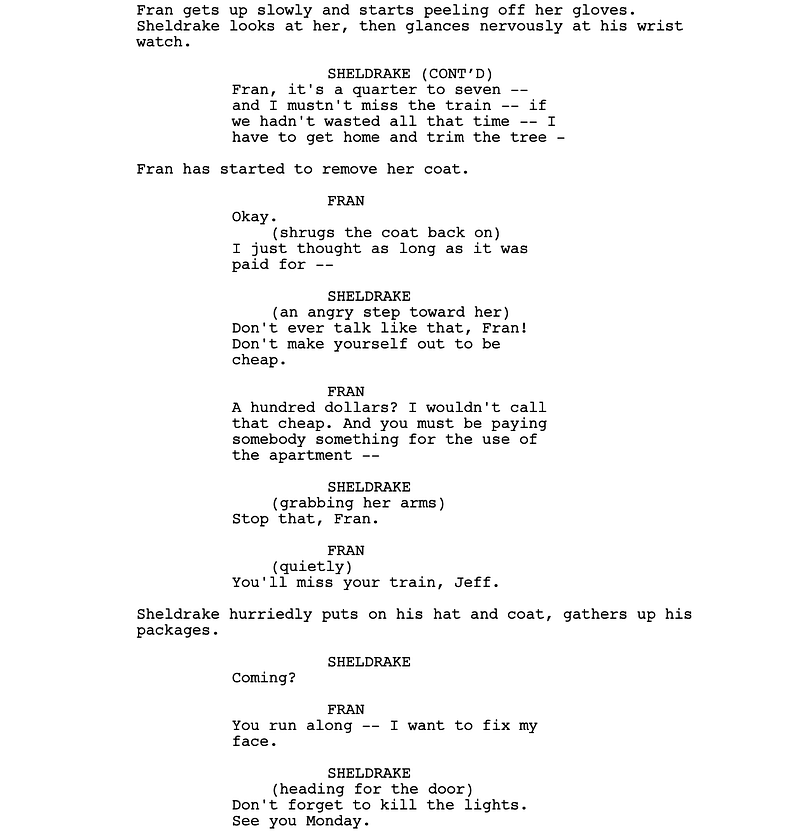
Don’t forget to kill the lights. I’ve watched this movie dozens of times and never caught this line which dovetails directly into Fran’s ensuing suicide attempt.
That ending side — “Shut up and deal” — is something Kubelik’s character would totally say, very much in line with her established character. Of course, understanding the character and her voice is one thing. Grabbing the magic which results in four simple words that translate into perfection is another. But that was the genius of Wilder and Diamond.
What can we learn here? Well, short of resurrecting Wilder and Diamond to oversee our creative efforts, how about this:
Set-up and payoff.
Every single item Wilder noted in his conversation with Crowe about the ending of The Apartment is a set-up that is paid off. Indeed, he doesn’t even mention the many lines of dialogue in the last few scenes that are callbacks: “ring-a-ding-ding… cookie-wise… only I can’t spell… I’ll send him a fruitcake every Christmas.”
Therefore, it’s not just the line — “Shut up and deal.” It’s all of the set-ups and payoffs that lead up to the line that make it pitch perfect.
Whatever stories we write, pay attention to bits of business that pop up here and there. They may be a setup just waiting for a payoff… and perhaps a last line of dialogue remotely approximating the greatness of the one in The Apartment.
Tomorrow: More from “Conversations With Wilder.” If you have any observations or thoughts, please head to comments.
For the entire series, go here.