“Conversations With Wilder”: Part 26
Billy Wilder. Cameron Crowe. Conversation and creative insight.
Billy Wilder. Cameron Crowe. Conversation and creative insight.
Billy Wilder is my all-time favorite filmmaker. Consider just some of his movies: Double Indemnity (1944), Sunset Blvd. (1950), Ace in the Hole (1951), Stalag 17 (1953), Witness for the Prosecution (1957), Some Like It Hot (1959), The Apartment (1960), an oeuvre that demonstrates an incredible range in a filmmaking career that went from 1929 to 1981.
One of the best books on filmmaking and storytelling is “Conversations With Wilder” in which Cameron Crowe, a fantastic filmmaker in his own right (Say Anything, Singles, Jerry Maguire, Almost Famous) sat down with Wilder for multiple hours and they talked movies.
Every Monday through Friday for the next several weeks, I’m going to post excerpts from the book, add a few thoughts, and invite your comments. I trust this will be a good learning experience for each of us. And while we’re at it, why don’t watch some Wilder movies to remind ourselves what a great writer and director he was.
Today’s excerpt comes from P. 252 in which Wilder talks about the alternate ending of his classic film noir movie Double Indemnity:
CC: Let’s talk about a couple of your famous “lost sequences.” In Double Indemnity, why didn’t you use the gas-chamber ending you’d scripted and shot with Fred MacMurray and Edward G. Robinson?
BW: I did not need it. I knew it as I was filming the next-to-last scene. The story was between the two guys. I knew it, even though I had already filmed the gas-chamber scene. Here was the scene I didn’t use. It was a close-up of Robinson and a close-up of MacMurray. The looks. There was a connection with his heart. The doctor was standing there listening to the heartbeat when the heartbeat stopped. I had it all, a wonderful look between the two, and then MacMurray was filled with gas. Robinson comes out, and the other witnesses are there. And he took a cigar, opened the cigar case, and struck the match. It was moving — but the other scene, the previous scene, was moving in itself. You didn’t know if it was the police siren in the background or the hospital sending the doctor. What the hell do we need to see him die for? Right? So we just took out that scene in the gas chamber — cost us about five thousand dollars, because we had to build that thing. It was an exact duplicate, and there are always two chairs there — two chairs, in case of a double murder and they executed them together. So one chair was empty. It was a very good scene. But we’d said it. Again, we were guilty of duplicating a thing.
CC: It was a bold move, robbing yourself of the shocking ending in favor of a quieter scene.
BW: There was no greater significance than this — we’d said it.
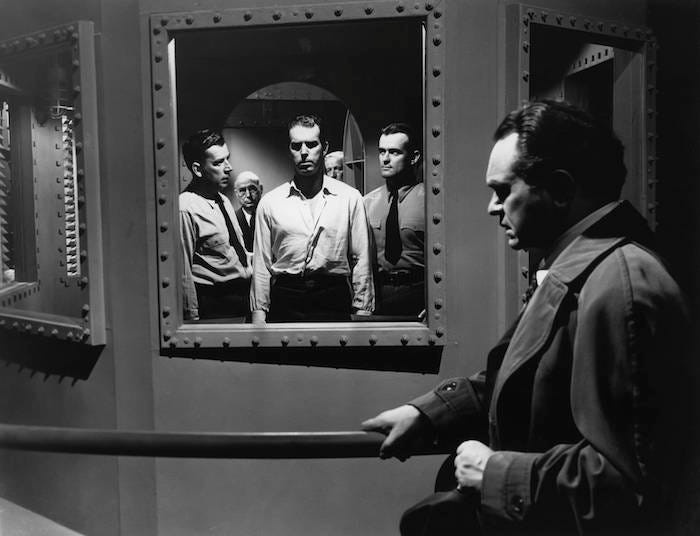
I’ve written about the alternate ending before, but it’s great to read Wilder’s in-depth explanation for why he excised the gas chamber scene. Here are the only known production stills of that scene:
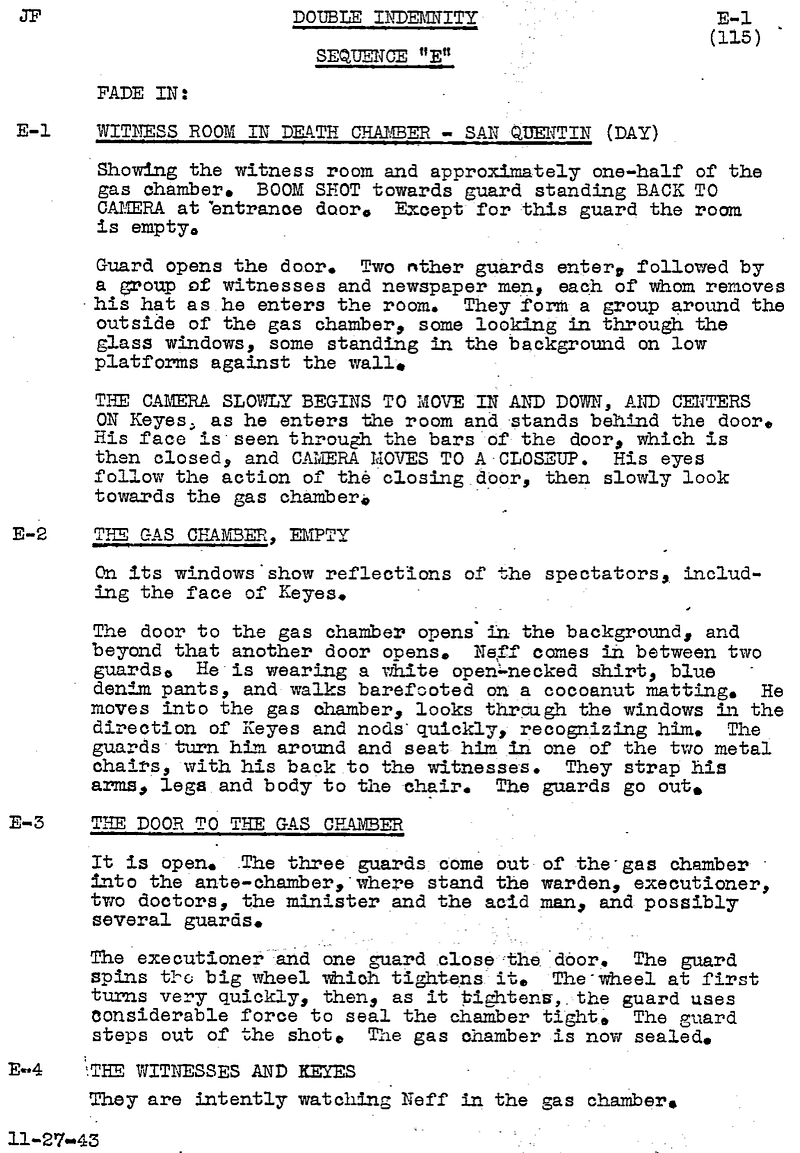
As far as the script goes, the scene is called Sequence E and is three pages long. There is only one side of dialogue, that from a Guard — “That’s all, gentlemen. Vacate the chamber, please” — directed toward the witnesses after Neff (MacMurray) has been found to be dead by the medical authorities.
In his comments above, Wilder talks about the “wonderful look between the two” — Neff and Keyes (Robinson), but in the script the only time they acknowledge each other is when Neff enters the gas chamber: “He moves into the gas chamber, looks through the window in the direction of Keyes and nods quickly, recognizing him.” That’s it. So the “wonderful look” must have been something Wilder went for in directing the actors on set.
Here is the ending of the sequence as described in the shooting script:

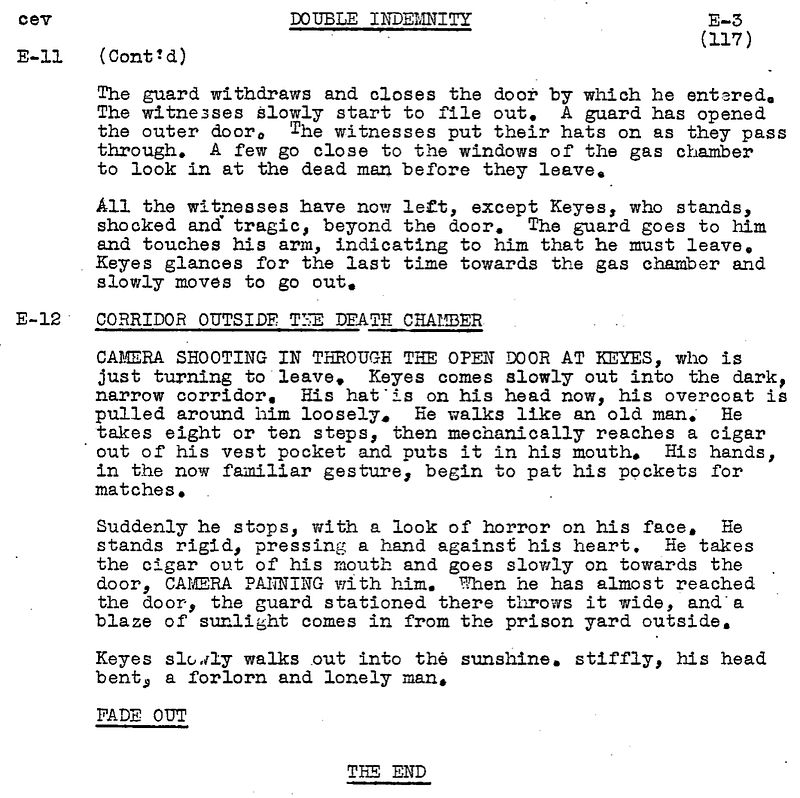
Compare to the movie version of the ending:
Check out the movie’s last three lines of dialogue:
Neff: Know why you couldn’t figure this one, Keyes? I’ll tell ya. ’Cause the guy you were looking for was too close. Right across the desk from ya’.
Keyes: Closer than that, Walter.
Neff: I love you, too.
As Wilder says: “The story was between the two guys… It was moving — but the other scene, the previous scene, was moving in itself… It was a very good scene. But we’d said it.”
Again with Wilder, it comes down to characters. He could have gone for the “shocking ending” — the gas chamber — but the interchange between Neff and Keyes says it all about the bromance between these two characters. Capped off by the lighting of the match, a runner throughout the movie in which Neff would light Keyes’ cigar… only here Keyes lights Neff’s cigarette.
This moment says everything that needs to be said about these two characters and their tight-knit relationship. And in this moment, we can already see the “forlorn and lonely man” emerging in Keyes’ face as he watches his friend Neff wasting away in front of his eyes.
Tomorrow: More “Conversations with Wilder.” If you have any observations or thoughts, please head to comments.
For the entire series, go here.