“Conversations With Wilder”: Part 25
Billy Wilder. Cameron Crowe. Conversation and creative insight.

Billy Wilder. Cameron Crowe. Conversation and creative insight.
Billy Wilder is my all-time favorite filmmaker. Consider just some of his movies: Double Indemnity (1944), Sunset Blvd. (1950), Ace in the Hole (1951), Stalag 17 (1953), Witness for the Prosecution (1957), Some Like It Hot (1959), The Apartment (1960), an oeuvre that demonstrates an incredible range in a filmmaking career that went from 1929 to 1981.
One of the best books on filmmaking and storytelling is “Conversations With Wilder” in which Cameron Crowe, a fantastic filmmaker in his own right (Say Anything, Singles, Jerry Maguire, Almost Famous) sat down with Wilder for multiple hours and they talked movies.
Every Monday through Friday for the next several weeks, I’m going to post excerpts from the book, add a few thoughts, and invite your comments. I trust this will be a good learning experience for each of us. And while we’re at it, why don’t watch some Wilder movies to remind ourselves what a great writer and director he was.
Today’s excerpt comes from P. 221–222 in which Wilder talks about two cross-dressing movies — Tootsie and Some Like It Hot:
CC: What did you think of Tootsie (1982)?
BW: There was an interview in the New York Times with Mr. [Sydney] Pollack where he said, “I developed something that is kind of brand-new. When Dustin Hoffman decides to become a woman, we did not do that dull thing, you know, where he goes and borrows a dress here, and tries the hairdo, and he slowly becomes Tootsie.” He said, “I just cut and there was Tootsie.” [Wilder, who is not prone to such credit taking, feels strongly about this one cut. He continues, earnestly. He wishes it on the record.] I did that in Some Like It Hot. I had that years ago. In other words, when Tony Curtis says over the phone, already mimicking the voice of a woman, that he and his friend are open for the touring date…the next cut we see the two dressed as women. The two guys decide to go with the ladies’ band, because that’s the only job they can get. They’re gonna be dames. And I cut, and there they were. Wherever they got the dresses — from a girlfriend who forgot to put it back on, whatever — we just omitted that. We just had a sharp cut, and big laugh, once we see the two of them dressed as women, coming down the train platform. Walking. And we had such big laughs with the walks…We had, like, two or three railroad cars on the MGM lot, maybe they’re still there. So we cut and we saw the two walking, and the laughs kept coming and coming. They were bigger and bigger, so that I went back and I used the beads and the shoes and the stuff, always cheating, because we only had three wagons.
CC: A very modern cut.
BW: That was a modern cut, because there was no dissolve, no nothing, just bang — cut. From the two big heads in the telephone booth to the shot of their legs walking along the railroad platform. Not one word. It could have been so dull, you know. “Let’s see whether we can do a hairdo.” Nothing. We did nothing. We just cut when the guys are on the phone, and when Mr. Curtis says to the agent that he’s a woman, you know? And now the problem is solved. And they are women.
Tootsie is very good, but they tried to make it a little too serious with that element of actors looking for parts and not getting them, or whatever.
Here is the cut in Some Like It Hot from Tony Curtis, mimicking a woman on the phone with the agent, to he and Lemmon dressed as women for the first time in the movie:
I can’t find a video clip of the same cut in Tootsie, but here is an image of it — same thing, Michael immediately transforms into Dorothy, and we see her walking along as woman for the first time:
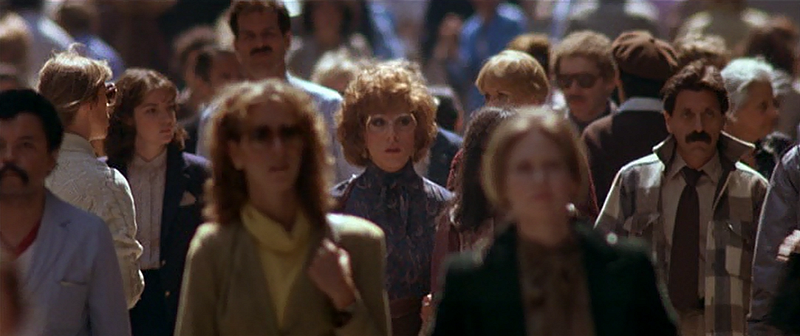
Not to diminish Tootsie — it is a brilliant film — but Pollack didn’t do anything new with the transition from male to female. He totally copped what Wilder did in Some Like It Hot.
Takeaway:
- Hitchcock said, “Movies are life with the dull parts cut out.” Wilder subscribed to this theory. Of the many considerations he had in the story choices he made, economy was definitely one of them. Why show Tony Curtis and Jack Lemmon transitioning into becoming women when a more efficient — and as Wilder notes funny — transition is the ‘modern’ cut. They talk about it. Then there they are: Women.
- We can do this in our own writing. Move things along. Contemporary audiences need less exposition. They want the story to zip along. Whenever you can omit a scene and still make a transition work, do that. Sometimes… oftentimes… less is more.
Tomorrow: More “Conversations with Wilder.” If you have any observations or thoughts, please head to comments.
For the entire series, go here.d