“Conversations With Wilder”: Part 24
Billy Wilder. Cameron Crowe. Conversation and creative insight.
Billy Wilder. Cameron Crowe. Conversation and creative insight.
Billy Wilder is my all-time favorite filmmaker. Consider just some of his movies: Double Indemnity (1944), Sunset Blvd. (1950), Ace in the Hole (1951), Stalag 17 (1953), Witness for the Prosecution (1957), Some Like It Hot (1959), The Apartment (1960), an oeuvre that demonstrates an incredible range in a filmmaking career that went from 1929 to 1981.
One of the best books on filmmaking and storytelling is “Conversations With Wilder” in which Cameron Crowe, a fantastic filmmaker in his own right (Say Anything, Singles, Jerry Maguire, Almost Famous) sat down with Wilder for multiple hours and they talked movies.
Every Monday through Friday for the next several weeks, I’m going to post excerpts from the book, add a few thoughts, and invite your comments. I trust this will be a good learning experience for each of us. And while we’re at it, why don’t watch some Wilder movies to remind ourselves what a great writer and director he was.
Today’s excerpt comes from P. 205 in which Wilder talks about one of the most famous shots in his movies:
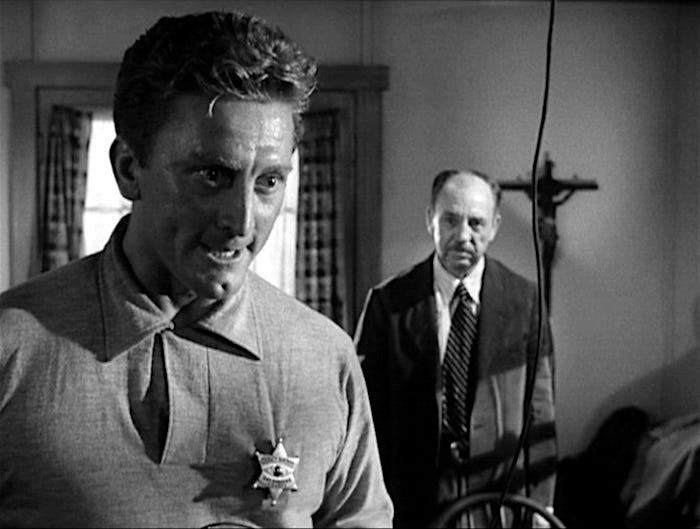
CC: One of your greatest shots, the most bravura shot in all your films, is the final shot of Ace in the Hole. Kirk Douglas, stabbed with a pair of scissors, falls dead on the floor into a close-up. Spike Lee, who did an homage to the shot in Malcolm X, asks how you came up with that.
BW: [Smiles] I like Spike Lee. He’s a good, lively filmmaker. The shot was always in my mind, but it wasn’t part of the script. I never put much camera direction into the screenplays. We dug a hole and put the camera there. We were sure he was going to end up in the hole himself. We knew he was gonna die. How he was going to die — that came in the writing of the thing. The shot we had as we wrote the script. The camera is down low because something’s gonna happen. It’s gonna pay off. And then Kirk Douglas falls into the close-up. I wanted something powerful, and that was one of the few times I went for a bold shot like that. I needed it, but I never based a scene around a shot. Never an outré shot. That was outlandish. Never to astonish people. It was logical there. Instead of — he falls down in a long shot, then we cut to the close-up. No. I didn’t want to do that.
Here is Spike Lee introducing Ace in the Hole on TCM with host Robert Osborne. At the very end of the clip [3:47], Lee talks about the movie’s last image, calling it “one of the greatest final shots in cinema”:
Here is the final camera shot from Ace in the Hole:
It is, indeed, a “powerful” shot and unlike Wilder in some ways in that he rarely featured such “bravura” visuals. He was always character and story first.
But we see in his comments, this is not a director wanting to show off his cinematic chops, rather it is a storyteller. The shot services the plot. It works within the internal logic of the scene. And it is a fitting and dramatic visual ending to the Kirk Douglas character.
The current screenplay style is to avoid camera shots and directing jargon, but that doesn’t mean we can’t “direct” the action in our scene description. We can be literary and visual. However we would be wise to follow Wilder’s lead: The visuals should support character and plot.
Tomorrow: More “Conversations with Wilder.” If you have any observations or thoughts, please head to comments.
For the entire series, go here.