“Conversations With Wilder”: Part 22
Billy Wilder. Cameron Crowe. Conversation and creative insight.
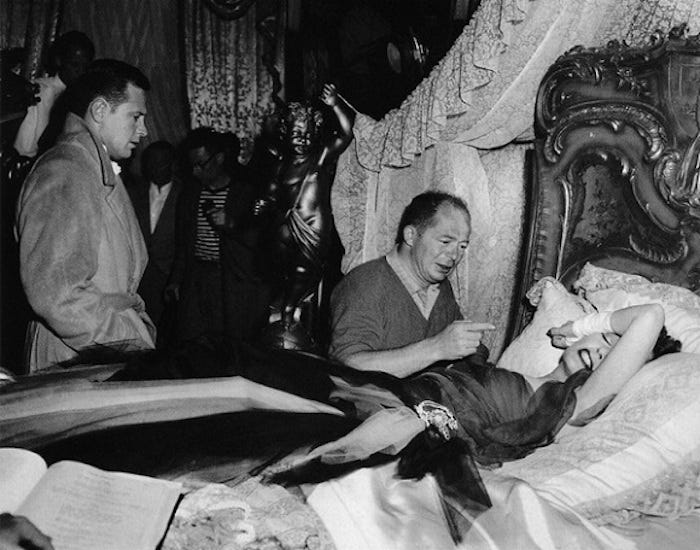
Billy Wilder. Cameron Crowe. Conversation and creative insight.
Billy Wilder is my all-time favorite filmmaker. Consider just some of his movies: Double Indemnity (1944), Sunset Blvd. (1950), Ace in the Hole (1951), Stalag 17 (1953), Witness for the Prosecution (1957), Some Like It Hot (1959), The Apartment (1960), an oeuvre that demonstrates an incredible range in a filmmaking career that went from 1929 to 1981.
One of the best books on filmmaking and storytelling is “Conversations With Wilder” in which Cameron Crowe, a fantastic filmmaker in his own right (Say Anything, Singles, Jerry Maguire, Almost Famous) sat down with Wilder for multiple hours and they talked movies.
Every Monday through Friday for the next several weeks, I’m going to post excerpts from the book, add a few thoughts, and invite your comments. I trust this will be a good learning experience for each of us. And while we’re at it, why don’t watch some Wilder movies to remind ourselves what a great writer and director he was.
Today’s excerpt comes from P. 168 in which Crowe asks Wilder about some of Wilder’s quotes on the craft of writing:
CC: A few of your statements about writing, I’d love to throw some of them back at you right now for your comments. “The audience is fickle. Get at their throat and keep them the entire movie.”
BW: Yeah. That’s a line of mine. You grab them by the throat, their heart is beating, and you never let go. You just apply more and more pressure. Then at the end, as they’re going for the last gasp, you let them go, it’s over, and the circulation starts again.
CC: “The more subtle and elegant you are in hiding your plot points, that’s how good you are as a writer.”
BW: Yeah. I just think that you have to be very, very careful so that you smuggle in a very important piece of action, or dialogue, whatever, so they don’t know when they’ve swallowed the premise. So, you know, no premise. You just catch them in the theater, you’ve got them, now you’ve got to keep them. You don’t want people to get and say, ‘I’ve seen that trick before.’ Yeah, the structure is very, very important because everything you build up in act one comes back to haunt you in act three. If you do something for which you don’t have payoffs in the third act, then you’ve failed.
You have probably seen this list of 10 tips on screenwriting attributed to Wilder:
1. The audience is fickle.
2. Grab ’em by the throat and never let ’em go.
3. Develop a clean line of action for your leading character.
4. Know where you’re going.
5. The more subtle and elegant you are in hiding your plot points, the better you are as a writer.
6. If you have a problem with the third act, the real problem is in the first act.
7. A tip from Lubitsch: Let the audience add up two plus two. They’ll love you forever.
8. In doing voice-overs, be careful not to describe what the audience already sees. Add to what they’re seeing.
9. The event that occurs at the second act curtain triggers the end of the movie.
10. The third act must build, build, build in tempo and action until the last event, and then — that’s it. Don’t hang around.
In the interview with Crowe, Wilder alludes to four from the list: 1, 2, 5, and 6.
The first two are more about pace, the importance of making a connection with the audience immediately, then sustaining that thread scene to scene to keep their attention.
The second two are more about structure. About #5, Wilder uses a most interesting word: “smuggle”. Whatever narrative bit of business you want to pull off in any given scene, it’s best to “smuggle” it into the action so the audience doesn’t recognize what you’re trying to accomplish with your writing.
Re #6, Wilder drives home a point we all need to recognize: The direct connection between what happens at the end of a script having its roots in the first act. One big reason why we must make sure every aspect of our story setup works.
Tomorrow: More “Conversations with Wilder. If you have any observations or thoughts, please head to comments.
For the entire series, go here.