“Conversations With Wilder”: Part 18
Billy Wilder. Cameron Crowe. Conversation and creative insight.
Billy Wilder. Cameron Crowe. Conversation and creative insight.
Billy Wilder is my all-time favorite filmmaker. Consider just some of his movies: Double Indemnity (1944), Sunset Blvd. (1950), Ace in the Hole (1951), Stalag 17 (1953), Witness for the Prosecution (1957), Some Like It Hot (1959), The Apartment (1960), an oeuvre that demonstrates an incredible range in a filmmaking career that went from 1929 to 1981.
One of the best books on filmmaking and storytelling is “Conversations With Wilder” in which Cameron Crowe, a fantastic filmmaker in his own right (Say Anything, Singles, Jerry Maguire, Almost Famous) sat down with Wilder for multiple hours and they talked movies.
Today’s excerpt comes from P. 129–130 in which Wilder discusses directing it on the page:
CC: Is a lot of the directing done in your head, as you write it?
BW: Yeah, if I write it. I’m never stuck because I have an empty exit of a character who comes to talk to somebody sitting at the desk, and he leaves. I always have enough dialogue to cover an exit. Not a lot of dead air. There are no long explanations [in my scripts]. I just have a scene — scene 73, the scene plays in somebody’s house. That’s it. The last thing I do is divide it then into shots, into camera moves. The last thing I do is to figure out, where do I put the camera? First you have to have it on paper.
CC: How did you feel about adding moments of visual poetry, or putting more lyrical elements in?
BW: I was very serious about it. That’s the way it had to be, that’s the way it was. The words must come to life.
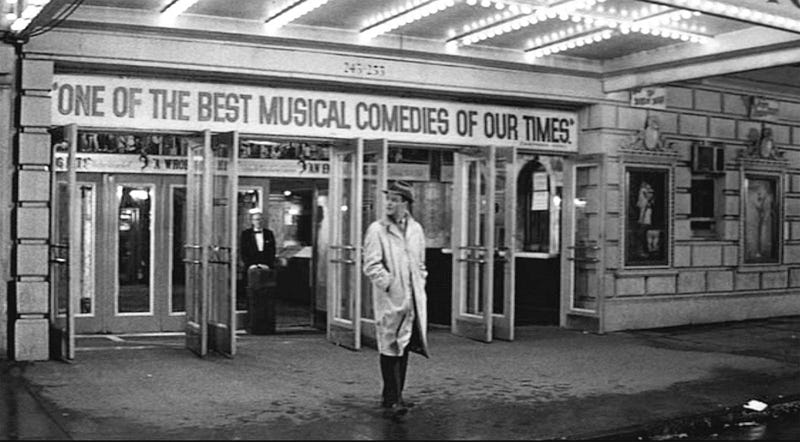
CC: Because there are moments, even though the scripts were all tight, there are still the moments where you let the movie breathe a little bit. Where you see the long shot of Lemmon standing outside the theater waiting for Shirley MacLaine to show up for the movie date in The Apartment.
BW: Yes, of course. Even that moment told part of the story — that she was not there, she didn’t show up, she was with her boss. A little poetry. There must have been a reaction from Lemmon, that she didn’t show up, so he was alone. Naturally that was a little bit of a heartbreak, like a normal human being would feel.
As usual, several takeaways:
- Notice how the first thing Wilder discusses when talking about the script is transitions between scenes. Spoken like a director who has an intimate knowledge of editing which Wilder did, often involved in editing movies while shooting them [they did a final edit of The Apartment in one week]. So we, as writers, would do well to think about ways to handle scene transitions through visuals, dialogue, or a combination of both.
- The words must come to life. Even as someone who directed what he wrote, Wilder was aware that the script pages had to have a vitality to them, they needed to evoke the playing out of the scene on the page.
- Notice how when Crowe broaches the subject of “visual poetry,” Wilder grounds his response about the example from The Apartment in character, how Baxter (Lemmon) was feeling outside the theater, stood up by the young woman he had a crush on. “A little bit of heartbreak, like a normal human being would feel.” Wilder never strayed far from writing scenes that created an emotional connection with the audience and he consistently did that through his characters.
Finally this: “First you have to have it on paper.” A quote worth remembering for our own writing.
Tomorrow: More “Conversations with Wilder. If you have any observations or thoughts, please head to comments.
For the entire series, go here.