“Conversations With Wilder”: Part 17
Billy Wilder. Cameron Crowe. Conversation and creative insight.
Billy Wilder. Cameron Crowe. Conversation and creative insight.
Billy Wilder is my all-time favorite filmmaker. Consider just some of his movies: Double Indemnity (1944), Sunset Blvd. (1950), Ace in the Hole (1951), Stalag 17 (1953), Witness for the Prosecution (1957), Some Like It Hot (1959), The Apartment (1960), an oeuvre that demonstrates an incredible range in a filmmaking career that went from 1929 to 1981.
One of the best books on filmmaking and storytelling is “Conversations With Wilder” in which Cameron Crowe, a fantastic filmmaker in his own right (Say Anything, Singles, Jerry Maguire, Almost Famous) sat down with Wilder for multiple hours and they talked movies.
Every Monday through Friday for the next several weeks, I’m going to post excerpts from the book, add a few thoughts, and invite your comments. I trust this will be a good learning experience for each of us. And while we’re at it, why don’t watch some Wilder movies to remind ourselves what a great writer and director he was.
Today’s excerpt comes from P.129–130 in which Wilder talks about the importance getting it down in the script before directing it:
BW: From the beginning I was a very quick shooter. I was making pictures in forty-five, fifty days. Sunset Boulevard, maybe sixty days. But I did not pull much [many scenes] out of the movies. Nor did I cut scenes out as I shots. I took the beginning of Sunset Boulevard out, and the end of Double Indemnity. Very rarely. So those were the two major operations I did.
CC: So the scripts were tight.
BW: Very tight. Always. Never setups, the positions of the characters, only when necessary. I am aware where they are, but I just don’t sit on it in the script. I just touched it as lightly as possible.
CC: Did you know all your shots at the beginning of the day? Did you come prepared, or did you decide on the day?
BW: More or less. But always I sit down and I say, “All right, this scene.” We read it once, and I say, “Okay, let’s play this scene.” The actors play the scene until they feel comfortable. And I just say, “Well, how would it be if you did not walk there, if you stayed here, and then the other character comes in…?” — this and that. And then we say where the camera is going to be, and then that’s it.
CC: Is a lot of the directing done in your head as you write it?
BW: Yeah, if I write it. I’m never stuck because I have an empty exit of a character who comes to talk to somebody sitting at the desk, and he leaves. I always have enough dialogue to cover an exit. Not a lot of dead air. There are no long explanations [in my scripts]. I just have a scene — scene 73, the scene plays in somebody’s house. That’s it. The last thing I do is divide it then into shots, into camera moves. The last I do is to figure out, where do I put the camera? First you have to have it on paper.
CC: How did you feel about adding moments of visual poetry, or putting more lyrical elements in?
BW: I was very serious about it. That’s the way it had to be, that’s the way it was. The words must come to life.
It’s a curious phrase: “I just don’t sit on it in the script.” Since Cameron Crowe didn’t follow up about that line, we can’t know for sure what Wilder meant. However based on everything I know about Wilder and his affinity for economy of everything — words, shots, budgets — my guess is he’s talking about how much the writer conveys / gives away in the script. He would rather it be less than more.
And yet, there’s this: “The words must come to life.” So when pressed about using “visual poetry” or “lyrical elements,” Wilder acknowledged the importance of that, too.
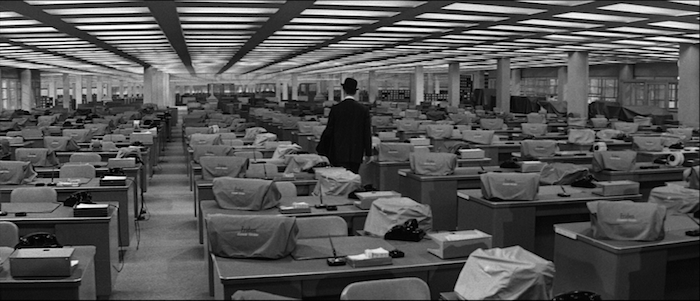
Look at some of the scene description from the beginning pages of The Apartment:


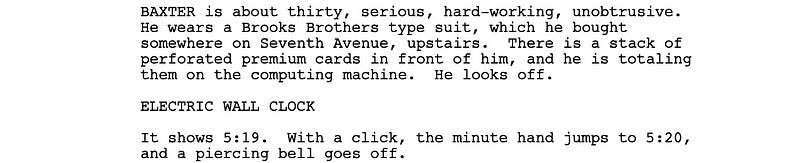

Or consider how Wilder and co-writer I.A.L. Diamond introduce Frank Kubelik (Shirley MacClaine) in the script.

If you read Wilder scripts, you see this dynamic tension — less is more / words must come to life — throughout the pages. These dual instincts aren’t at odds in the description, rather they work together to engender images and evoke emotion while doing so in an economic way. And we see this translated from script to screen over and over again in Wilder movies.
How did Wilder and his co-writers manage that? Part of it derives from his instinct as a filmmaker. But a big part of it, as he acknowledges, comes from his deep immersion in the world of cinema. Watching and analyzing movies. Reading and breaking down stories. And writing tens of thousands of pages. That is a lesson for all of us.
Tomorrow: More “Conversations with Wilder. If you have any observations or thoughts, please head to comments.
For the entire series, go here.