“Conversations With Wilder”: Part 13
Billy Wilder. Cameron Crowe. Conversation and creative insight.

Billy Wilder. Cameron Crowe. Conversation and creative insight.
Billy Wilder is my all-time favorite filmmaker. Consider just some of his movies: Double Indemnity (1944), Sunset Blvd. (1950), Ace in the Hole (1951), Stalag 17 (1953), Witness for the Prosecution (1957), Some Like It Hot (1959), The Apartment (1960), an oeuvre that demonstrates an incredible range in a filmmaking career that went from 1929 to 1981.
One of the best books on filmmaking and storytelling is “Conversations With Wilder” in which Cameron Crowe, a fantastic filmmaker in his own right (Say Anything, Singles, Jerry Maguire, Almost Famous) sat down with Wilder for multiple hours and they talked movies.
Every Monday through Friday for the next several weeks, I’m going to post excerpts from the book, add a few thoughts, and invite your comments. I trust this will be a good learning experience for each of us. And while we’re at it, why don’t watch some Wilder movies to remind ourselves what a great writer and director he was.
Today’s excerpt comes from P. 69–70 in which Wilder shares what he thought of working with Raymond Chandler:
BW: I had made two grim pictures, Double Indemnity and Lost Weekend. Double Indemnity was so grim, by the way, that [Charles] Brackett kind of ducked out. He says, “No, it’s too grim for me.” So that’s how I got [Raymond] Chandler. Mr. Raymond Chandler, from whom I learned in the very beginning, you know, what real dialogue is. Because that’s all he could write. That, and descriptions. “Out of his ears grew hair long enough to catch a moth”…or the other I loved: “Nothing is as empty as an empty swimming pool.” But he could not construct.
He was about sixty when we worked together. He was a dilettante. He did not like the structure of a screenplay, wasn’t used to it. he was a mess, but he could write a beautiful sentence. “There is nothing as empty as an empty swimming pool.” That is a great line, a great one. After a while I was able to write like Chandler…I would take what he wrote, and structure it, and we would work on it. He hated James Cain [the Double Indemnity novelist]. I loved the story, but he did not care for Cain. I tried to get Cain, but he was busy making a movie…
CC: Over the years, it appears you’ve upgraded your estimations of… Chandler.
BW: Sure, the anger gets washed, gets watery. You know, you forget about it. That’s a very good thing. That’s the only thing. Sure. I cannot forgive Mr. Hitler, but I certainly can forgive… Mr. Chandler. That’s a different story. [Pause] But the… there was a lot of Hitler in Chandler.
CC: [Laughs] In what way?
BW: In the way he talked behind my back. And the way he quit writing with me and then came back the same day. Because I had told him to close that window, a Venetian blind in the office, and I didn’t say “please.”
CC: You had the stick too, right? The riding crop. And you said, “Shut the window.”
BW: Yeah, I had the stick. I had the stick, and I had three martinis before lunch, and I called girls — six girls. One of them took fifteen minutes for me to get off the phone…and he was just outraged. He just could not take it, because he was impotent, I guess. And he had a wife who was much older than he was, and he was in AA, Alcoholics Anonymous — an unnecessary thing, because he got to be a drunkard again when we finished. [Wilder is poker-faced.]
CC: So it must have driven him crazy to see you having a martini.
BW: Yes, and I had one more martini than I should have had…because of him!
I have covered the infamous relationship between Wilder and Chandler before, such as here and here. It’s easy to watch an interview with Wilder and come away thinking he’s a sort of good-natured grandfatherly type, but in this excerpt from “Conversations,” we get a nice dose of his edge — comparing Chandler to Hitler, his annoying behavior with Chandler while working on Double Indemnity. But Wilder movies wouldn’t have been nearly as successful had he not had that bite in his personality.
Beyond that as far as writing takeaway is concerned, two things:
- Even if he loathed Chandler, Wilder appreciated the novelist’s ability to write dialogue and scene description. When this interview was conducted, it was literally 50 years since he and Chandler had worked together, yet Wilder still remembers that line about an “empty swimming pool”. Wilder was attuned to great lines, memorable lines. It’s a standard we would do well to hold ourselves to in our own writing.
- No matter how well Chandler could churn out great lines, Wilder knew that this was secondary to structure when writing a screenplay. William Goldman has said, “Screenplays are structure,” and Wilder would seem to subscribe to that opinion as well. Screenplays are not novels, an adjustment Chandler seems to have had a difficult time making, even going so far as to disparage the narrative form. But there is no way around it: A screenplay is the foundation for the production of a movie. Therefore its structure has to be spot on in order to have any chance of making a good movie.
How to handle screenplay structure? You may well have seen this before, but the list of 10 screenwriting tips from Wilder is worth considering one more time:
1. Grab ’em by the throat and never let go.
2. Develop a clean line of action for your leading character.
3.The more subtle and elegant you are in hiding your plot points, the better you are as a writer.
4. If you have a problem with the third act, the real problem is in the first act.
5. Tip from Ernst Lubitsch: Let the audience add up two plus two. They’ll love you forever.
6. The audience is fickle. Know where you’re going.
7. In doing voice-overs, be careful not to describe what the audience already sees. Add to what they are seeing.
8. The event that occurs at the second act curtain triggers the end of the movie.
9. The 3rd act must build, build, build in tempo until the last event, and then…
10. …that’s it. Don’t hang around.
Honestly, you don’t need one of those screenplay formulas floating around. That can lead to formulaic writing. Rather follow these 10 tips, immerse yourself in the lives of your story’s characters, and the screenplay’s structure will naturally emerge.
By the way, Wilder evidently got along well enough with Raymond Chandler to include him in one shot in Double Indemnity. This one:
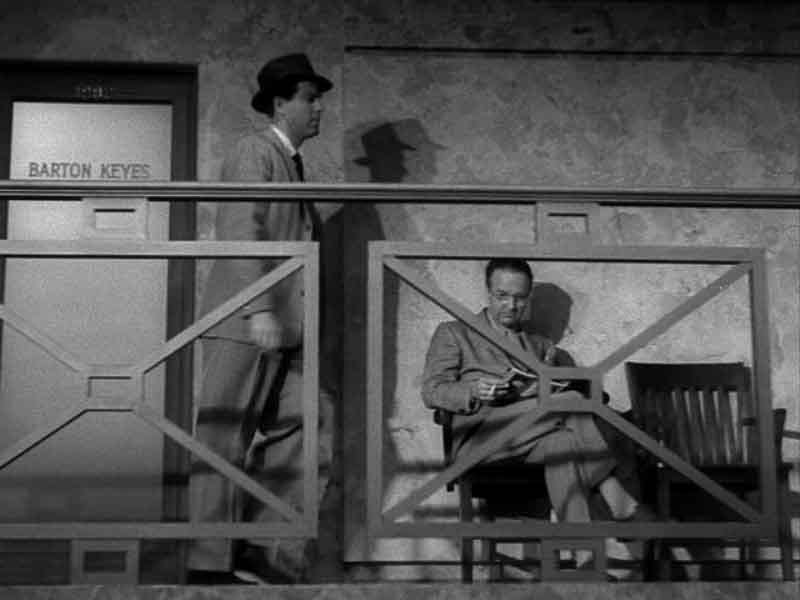
That’s Walter Neff (Fred MacMurray) on the left, Chandler seated in the chair as Neff passes by him. In other words, Chandler appears in the movie about 5 seconds… which is probably about 4 seconds too long for Wilder!
Tomorrow: More “Conversations with Wilder. If you have any observations or thoughts, please head to comments.
For the entire series, go here.