“Conversations With Wilder”: Part 1
Billy Wilder is my all-time favorite filmmaker. Consider just some of his movies: Double Indemnity (1944), Sunset Blvd. (1950), Stalag 17…
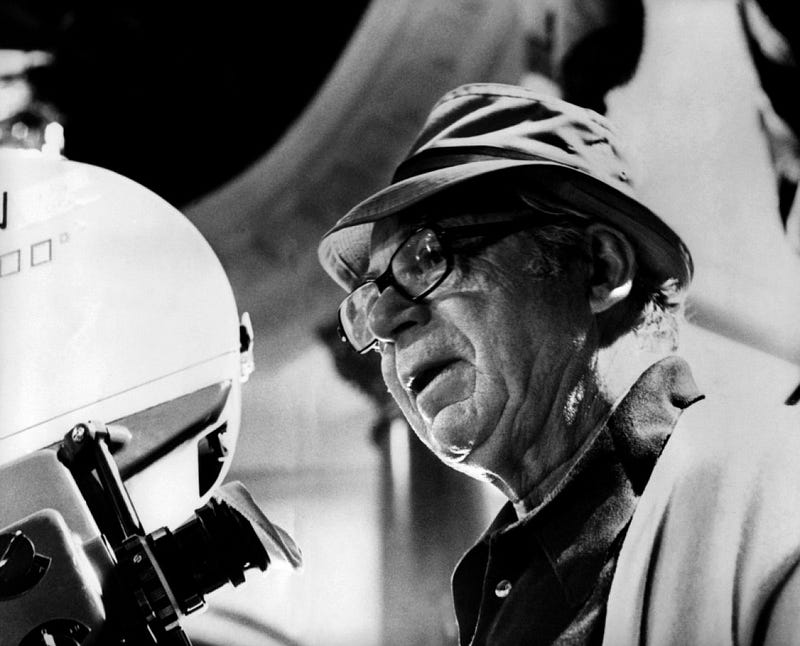
Billy Wilder is my all-time favorite filmmaker. Consider just some of his movies: Double Indemnity (1944), Sunset Blvd. (1950), Stalag 17 (1953), Witness for the Prosecution (1957), Some Like It Hot (1959), The Apartment (1960), an oeuvre that demonstrates an incredible range in a filmmaking career that went from 1929 to 1981.
One of the best books on filmmaking and storytelling is Conversations With Wilder in which Cameron Crowe, a fantastic filmmaker in his own right (Say Anything, Singles, Jerry Maguire, Almost Famous) sat down with Wilder for multiple hours and they talked movies.
Every Monday-Friday for the next several weeks, I’m going to post excerpts from the book, add a few thoughts, and invite your comments.
Today’s excerpt comes from PP. 7–9: The Cockroach Anecdote.
CC: The language and rhythms of your scripts are so specific, did you often give actors line readings?
BW: We sat around in a circle and we read. Is that what you mean?
CC: No — let’s say the performance wasn’t right on the line, wasn’t the way you heard it in your head. Would you perform the line for the actor, the way you wanted to hear it?
BW: Yeah, but I am not a Strasberg man. I am not an actor. I’m not even a born director. I became a director because so many of our scripts had been screwed up.
The idea was that we [Wilder and collaborator Charles Brackett] were under contract to Paramount, and had to deliver eleven pages every Thursday, on yellow paper. Eleven pages. Why eleven, I do not know. And then the script. We were not allowed to be on the set. We were supposed to be upstairs on the fourth floor writing the script. So they would chase us off, and [Mitchell] Leisen was the worst one. Mitch Leisen.
I remember one episode. Leisen was directing Hold Back the Dawn [1941]. We were already writing the next script, and not allowed on the set. Policemen! Policemen were on the set to say, “No, no, no!” That was the situation we had then. In pictures, in those days, they didn’t even let you watch what you wrote.
So we had written a scene in Hold Back the Dawn where the hero — actually, he’s a gigolo — Charles Boyer, is lying there in that dirty Hotel Esperanza, across the border. It was for the first third of the picture, he’s stranded in Mexico. He hasn’t got the papers to get in, but he would like to get to America. He lies there in bed all dressed, and there is a cockroach that is crawling up the wall and the cockroach wants to get onto the broken, dirty mirror. And Boyer was to imitate a border guard, with a stick in his hand, and say to the cockroach [officiously], “Hey, where you going? What are you doing? Have you got a visa?…What, no visa?! How can you travel without a passport!! You can’t!” That was the scene, meant to appear in the first act. They are shooting the picture, and Brackett and I are going for lunch to Lucy’s — that was the restaurant across the street from Paramount. Now we are finished with lunch, and we passed a table where Mr. Boyer had a nice French lunch with the napkin tucked in here, and a little bottle of red wine. “Hi, Charles, how are you” “How are you boys?” “What are you shooting today?” “We are shooting the scene with the cockroach.” “Oh, yeah, that’s a good scene, isn’t it?” He says, “We changed it a little bit.” [Wilder’s eyes widen.] “What do you mean, you changed it?” He says, “We changed it because it’s idiotic — why would I talk to a cockroach if a cockroach can’t answer me?” I say, “Yeah yeah yeah, but just the same, we would like you to do it.” “No no no,” say Boyer, “we talked and I convinced Mr. Liesen, I’m not talking to a cockroach.” So it was nothing. The scene became flat, nothing.
So now we were upstairs writing the end to this picture, Hold Back the Dawn, the last ten pages. I say to Brackett, “If that son of a bitch doesn’t talk to a cockroach, he ain’t talking to nobody! Cross out his dialogue!” [Laughs] We won…kind of.
Great anecdote and much to glean from it.
First off, Wilder is a great story-teller. He’s efficient in setting up the story, moves into the middle, which is where the conflict arises with Boyer, slipping in and out of the conversation from both sides, then wraps it up with a nifty ending. Beginning, Middle, Ending, boom-boom-boom.
Any writer worth their salt should be able to recognize the value of the cockroach bit of business. The Protagonist has suffered at the hands of the border authorities. What is his reaction to that? Obviously, he has feelings, but since this is a movie which is an externalized reality, we can only know what those emotions are if we see and/or hear them. Hence, the cockroach: Georges (the Protagonist) gets to voice his feelings in his exchange with the bug. The point is not a conversation with the cockroach, but rather an opportunity to peer into the Protagonist’s inner world through his dialogue.
Even though writers could grasp this fact, Boyer (an actor) could not. And he managed to convince the director to change the scene. While the movie was nominated for six Academy Awards, including Best Picture and Best Writing, Screenplay, it’s probably most notable for this fact: It was the last movie Wilder wrote that he didn’t direct.
In other words, this exchange about the cockroach scene is likely the straw that broke the camel’s back. I guess we should be thankful for how obtuse Charles Boyer was because it led to Wilder’s great career as a writer-director.
Interestingly, Wilder always looked at directing as a way of protecting his stories. He was not a flashy filmmaker. He’s set the camera and let the actors act. It was always about the characters within the context of the scene and the scene’s relationship to the overall narrative.
Finally, there’s this. Watch Billy Wilder’s speech accepting the Irving Thalberg Award at the 1987 Academy Awards:
Again a great story. Now compare to the setup for the plot of Hold Back the Dawn:
Georges Iscovescu (Boyer) recounts his story to a Hollywood film director at Paramount. He is a Romanian-born gigolo who arrived in a Mexican border town seeking entry to the US. He endures a waiting period to obtain a quota number of up to eight years with other hopeful immigrants in the Esperanza Hotel.
Wilder took a powerful event from his own life-experience and used it as a starting point for this movie. Truly, this is a case of “write what you know.”
Next week, more stories and storytelling wisdom from “Conversations with Wilder”.
For the entire series, go here.