Character Introductions: Part 4
Think there’s nothing to introducing characters in a script? Think again!

Think there’s nothing to introducing characters in a script? Think again!
Over the next few weeks, I’m doing a deep dive into the subject of character introductions. Why the hell would I do that?
Read Part 1 for background.
Part 2 here.
Part 3 here.
Part 4: Character and Core Essence (cont’d)
In The King’s Speech [written by David Seidler], the Protagonist is the Duke of York, second son of King George V, who at the time ruled over a quarter of the world’s population. Bertie, as the Duke is known, is a good and kind man, described in the script as “handsome, sensitive.” Too sensitive as it turns out, an intensely private individual forced into the limelight, pulled toward monarchical responsibility, yet rebelling against that possibility with every inch of his being.
How does the screenwriter introduce him? On the occasion of Bertie’s inaugural radio broadcast staged at Wembley Stadium in front of tens of thousands of loyal British subjects, his coming out party as it were [P. 3]:
Here again a memorable distillation of the Protagonist’s core essence: the man who would be King… who doesn’t want to be King, symbolized powerfully by his stuttering and inability to recite words necessary for anyone who might wear the crown.
In the script Unforgiven [written by David Webb Peoples], the Protagonist is Bill Munny. A retired Old West gunslinger, he is trying to make a go of it as a farmer, the contrast of these two aspects of his persona conveying much of his core essence.
How does the screenwriter introduce him? Here on P. 9 of the script:
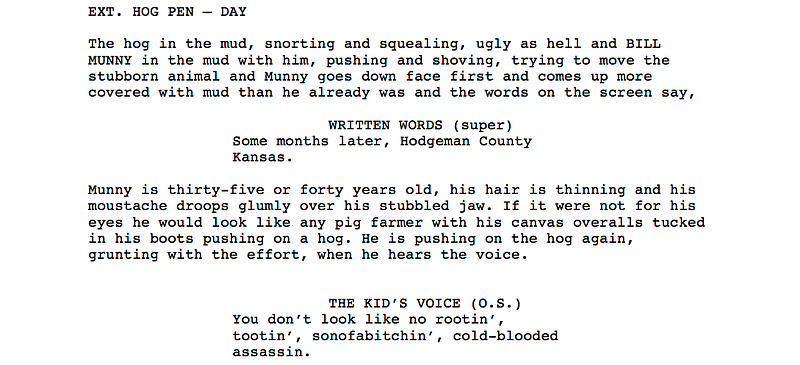
Everything about this introductory moment suggests that Munny is no farmer, rather at his core he still has the essence of a gunslinger, a truth the rest of the story proves out.
Determining the core essence of a character not only helps in constructing an effective introduction, it also gives the writer a clear understanding of that individual and their particular function in relation to the overall narrative. Whether it’s Will Shakespeare, a writer who has yet to find his unique creative identity, Bertie, a private soul thrust into a public role, or Bill Munny, a gunslinger waiting to be called back to action, thumbnail sketches such as these provide a thematic touchstone for a writer they can come back to again and again in the writing process — to remind them what that character is fundamentally about and help steer the course of the narrative .
Summary
A character’s core essence is critical in understanding an individual and in laying the groundwork for their introduction.
Also, I encourage you to look at your own story characters. For example, take the Protagonist. Ask yourself those questions from above: What is driving this character? What do they want? What do they need? What is it they fear most? What lies at the base of who they are? See if you can identify that character’s core essence, then brainstorm an interesting way to suggest that to a reader in an introduction.
Tomorrow, we examine the potential for using a character’s physicality to convey their personality as well as consider primary characters, secondary characters and tertiary characters.