Character Introductions: Part 1
Think there’s nothing to introducing characters in a script? Think again!
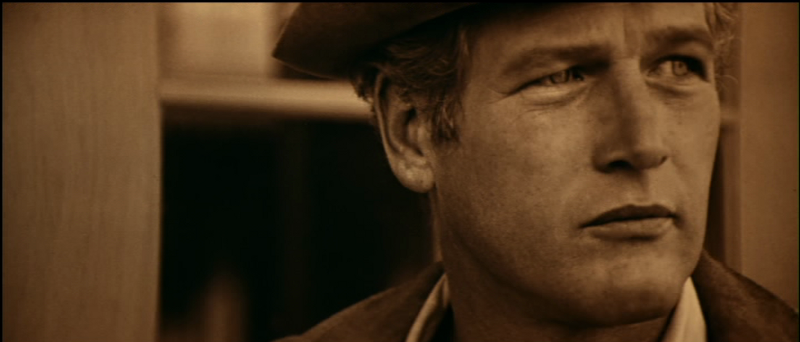
Think there’s nothing to introducing characters in a script? Think again!
Every afternoon, I tweet something about the screenwriting craft which hopefully provides a bit of inspiration and insight into the writing process. Recently, I was reminded of an online conversation I had a few years back after tweeting this:
Innocent enough, I thought. Wrong! Several folks took umbrage at it, their basic point being that internal character should only be revealed through action and dialogue. Some even suggested that using scene description to comment on a character’s inner thoughts or feelings is weak writing.
While I certainly agree that movies are primarily an externalized reality and, thus, action and dialogue are the dominant means by which characters express who they are and how they navigate their way through scenes, the reality is this: For decades, screenwriters have commented on characters to express to readers something the writers felt was important, interesting, and/or entertaining about that character’s personality.
In the Twitter conversation which ensued, I linked to a 2009 post I’d written on this subject featuring actual excerpts from movie scripts written by William Goldman (Butch Cassidy and the Sundance Kid), Ron Shelton (Bull Durham), and James L. Brooks (As Good As It Gets) in which they did precisely what I was talking about: When introducing a character, they focused more on their psychological nature and personality.
Here is how Goldman introduces Butch Cassidy:
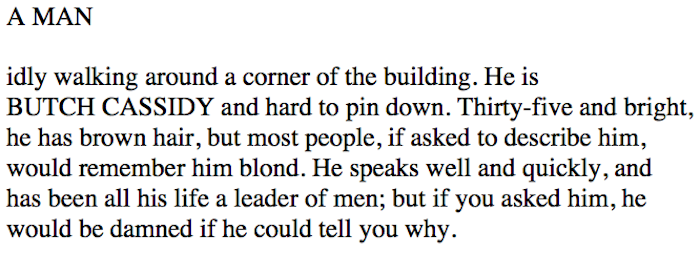
Goldman uses novelistic license in order to get at some of the core personality of this key character. “Hard to pin down… brown hair… most people… would remember him blond… a leader of men… he would be damned if he could tell you why.”
The only physical description of the character is this: He’s thirty-five and he has brown hair. Everything else in that introduction speaks to Butch Cassidy’s personality.
This is 1969. I can cite examples like this stretching back into the 50s. It’s a practice which continues to this day.
Indeed, I would go so far as to say that in today’s Hollywood, people who read scripts for a living expect writers to provide something to describe the essence of a character’s psychological makeup when introduced into the story. Answer this question: They’re the kind of person who…
This is only the tip of the proverbial iceberg on the subject of how screenwriters can introduce characters. There are, in fact, several narrative approaches we can use which can go a long way in helping someone reading a script sort out the roster of individuals and settle into the story.
Here’s why this is important: You may know your characters, but a development exec does not. In reading the first act of a script, when most of the characters are introduced, a reader spends much of their time assembling the roster of the script’s individuals. Introducing a character in such a way that the writer creates for the reader a kind of lens through which to perceive that character goes a long way to help the reader differentiate the inhabitants of the story universe.
Thus, here we are with Part 1 of what projects to be a two week-long series on a subject which may seem rather mundane — Character Introductions — but for a variety of reasons is actually an important one.
Part 1: Editorializing and Narrative Voice
5, 10, 15, 20, 25. No, you have not mistakenly signed up for an online remedial math class. Rather these represent the potential number of characters in a feature-length screenplay. Some stories may have as few as five, even less. More frequently scripts have 25 or more characters.
Consider you are writing a script which has 25 characters. You think about each of their backstories, as you should. You ponder their personalities and the way they talk, also as you should. You consider their respective narrative functions, how they look, how they interact, how they oppose or help each other, how they live, love or die. All of that is good and a necessary aspect of the character development process.
However, here is something many writers do not think about enough or at all: If at the end of the day someone is about to read your script, how are they going to keep straight 25 characters, juggle all these new names, personality types, and agendas?
Even if the script has 15 or only 10 characters, that is still a lot of individuals you are asking a reader to assimilate:
- They have to distinguish between each of them.
- They have to get a feel for each of them.
- They have to remember each of them.
A lazy writer may think, “No problem. After a few pages spending time with this character or that, the reader will get a sense of them.”
To which I would respond, “Really. This is what you want. Someone reading your script, forced to flip back and forth between pages to confirm precisely who this character is. Or the worst case scenario: They see a character whose name is not capitalized, but they don’t remember them having been introduced.”
Have I met this guy? If so, where? Or is this the character’s introduction and the writer forgot to capitalize their name? I’m confused!
At this point, frustration sets in. This is the mood a writer wants a professional reader to be developing within the first fifteen pages or so of their script?
No, what you want is to pull the reader into your story universe as quickly and deftly as you can, then keep them there… not flipping back and forth between pages to confirm who this character is, rather moving straight through the script, having a clear sense of each character based upon how they are introduced. Hence this blog series!
Character Introductions: Making a Strong First Impression
Each time you introduce a character, you face a fork-in-the-road. One path is loaded with bumps and roadblocks where through carelessness, the writer creates an obstacle course in the mind of the reader, a morass of characters that seem to bleed into and overlap each other. The alternate path is a straight line through the narrative, marked by imaginative, informative and entertaining character introductions that present a clear roster of the story’s characters, each distinct, each memorable.
One key is to make a strong first impression. By fixing a clear image of a character in the mind of a reader, you not only distinguish each of the story’s players from the other, you provide a lens through which the reader can interpret those characters.
Here is an example of a strong first impression from Moneyball, screenplay by two of Hollywood’s best writers, Steve Zaillian and Aaron Sorkin:
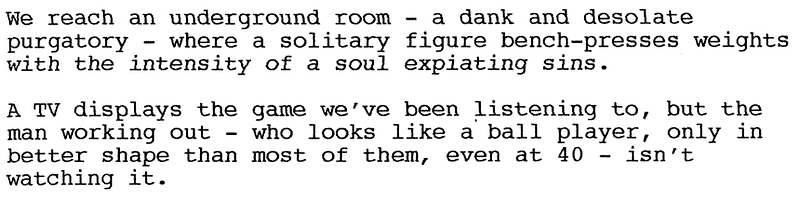
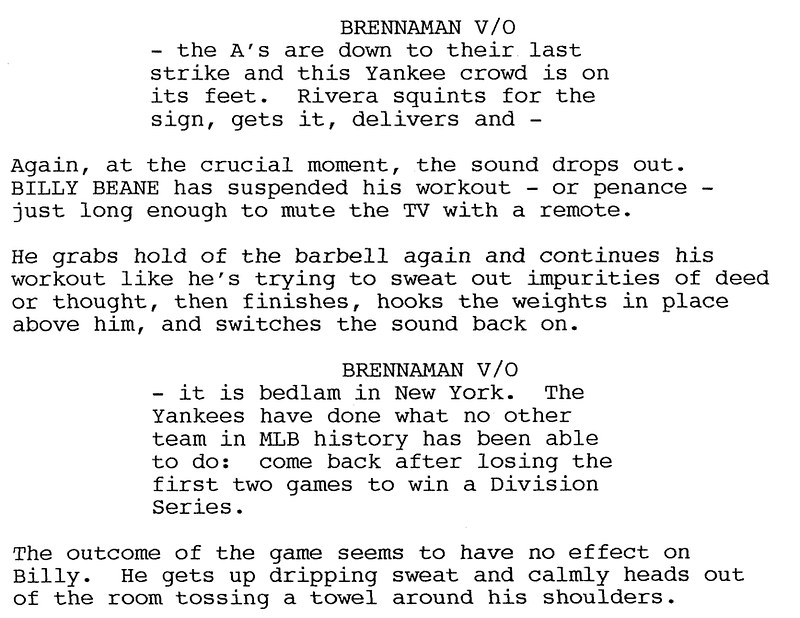
Why does this introduction of the story’s Protagonist Billy Beane make such a strong first impression? There are many reasons. Let’s focus on a single factor: The writer editorializes about the character, a subject we will pick up on Part 2 of this series.
Tomorrow: An introduction to editorializing in screenwriting.