Breaking the 4th Wall in Scene Description
To everyone who claims there’s a screenwriting rule asserting we can’t include so-called ‘unfilmables’ in scene description, read this!

To everyone who claims there’s a screenwriting rule asserting we can’t include so-called ‘unfilmables’ in scene description, read this!
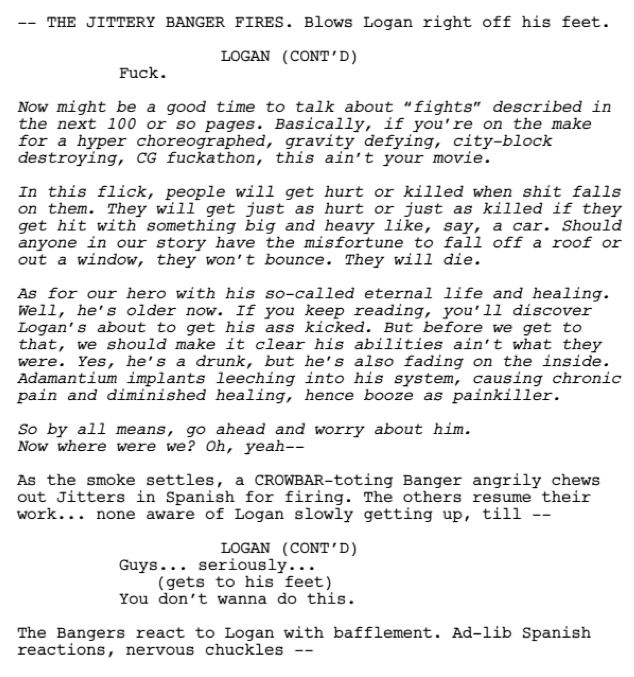
This is an excerpt from the screenplay for Logan, screenplay by Scott Frank & James Mangold and Michael Green, story by James Mangold. Reading it, you may ask yourself, “What is the purpose of a section like that? It is not on the screen.”
Indeed. In fact, there is unfilmable after unfilmable after unfilmable in the scene description.
What about the so-called ‘rule’: No unfilmables!
My response to any of these assertions is the same: Read movie scripts. Screenplays written by professional screenwriters. Just like this excerpt from the movie script for Logan. Unfilmables. Breaking the 4th wall.
Who you gonna believe: What you can see with your own eyes or some unconfirmed ‘rule’ arising from some unknown source?
The legalists among you may say, “But… but… this is a production draft. Writers can get away with that kind of thing for production.”
True. But writers can also use ‘that kind of thing’ to help sell the script. Whether to get the project set up in the first place, attract financing, woo talent, perhaps our single most important job is to entertain the reader. Re-read the scene description above. Now be honest…

The legalists may retort, “But… but… this is James Mangold… Scott Frank… Michael Green. They’re A-list writers. They have more freedom to break the rules than unproven writers.”
Maybe. But if the Hollywood acquisition and development process is a zero sum game, that means we are competing against the James Mangolds, the Scott Franks, and the Michael Greens of the world. Does it make sense to deny ourselves the use of tools they have at their ready disposal? Why disadvantage ourselves like that?
The legalists may respond, “But… but… it feels like they’re just being cute by breaking the fourth wall and commenting on the action.”
Wrong. What the writers are doing is stopping the action and making sure the reader knows precisely what is laid out in the scene description: This ain’t your typical superhero movie. It’s gritty. It’s raw. It’s real.
This choice to speak directly to the reader is not just about action. It’s about the nature of Logan’s character and his psychological journey. He is a deeply messed-up individual. Flawed. Broken. Sickly. He is NOT your typical superhero. He is a dying man deep into a state of Disunity at the beginning of the movie.
This excerpt — commenting on the moment and breaking the 4th wall — grabs hold of the reader and makes absolutely damn sure they understand the tone of the piece from the get-go.
This writing is NOT about the writer being cute. This is about orienting the reader’s POV from the start of the story.
Takeaway: We have the right to write so-called ‘unfilmables,’ no matter what the legalists say. Yes, we have to be judicious. Movies are essentially an externalized reality — action and dialogue. Yet, we can comment on moments from time to time. We can even break the 4th wall. But as the excerpt above demonstrates, we have to do it with THE STORY in mind, not just to show off or be cute. And again, we have to be judicious.
Just. Be. Smart. About. It.
UPDATE: Don’t listen to me. Listen to the co-writer of Toy Story 4.
For a 15-part series on so-called screenwriting ‘rules,’ go here.