Black List writers on the craft: Story Prep (Part 5)
“Usually I’ll start with a one page synopsis, just the basic beats of the story. Then I go to note cards, and then I go to a full outline.”
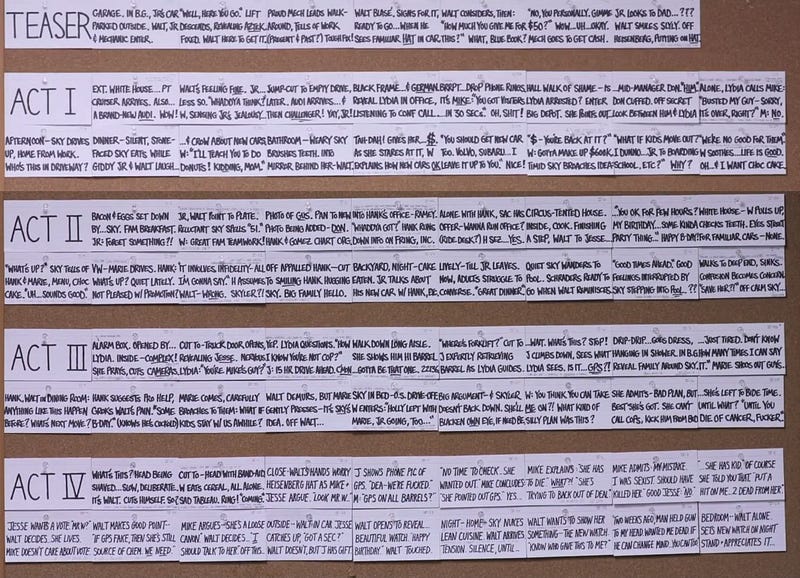
“Usually I’ll start with a one page synopsis, just the basic beats of the story. Then I go to note cards, and then I go to a full outline.”
Over the years, I have interviewed 50+ Black List screenwriters. Over the next four weeks, I am running a series featuring one topic per week related to the craft of writing.
This week: What aspects of story prep do you devote the most time and focus to?
I often say this: There’s no right way to write. Every writer is different. Every story is different. Going through these interviews, I doubt there is an area of the story-crafting process where this statement is more apt than in relation to story prep. As we will see this week, there is a big divide between Black List writers who embrace working up a comprehensive outline and those who take a considerably less formalized approach.
This week, I’ve been presenting an array of takes from Black List writers about outlines. On Wednesday, we heard from writers who have an active aversion to outlines. Yesterday, we learned how some writers work from a minimal ‘preliminary’ type of outline. Today, writers who embrace the idea of working with an extensive outline:
Julia Hart: “Outlining. I tried to write something without an outline and my husband [producer Jordan Horowitz] just laughed at me. I find that outlining is just so incredibly important.”
Joshua Golden: “Tying each character’s journey in a way to what the overall story is about, whether it’s the importance of imagination or identity, that’s where I’d start from. Then I will usually do a pretty thorough outline, beat by beat of what’s happening in the story. When I first started, I would jump into a script without that. I don’t think staring at that blank page helped my anxiety. So, going forward, it’s a pretty thorough outlining process.”
Spenser Cohen: “I feel like most of the work happens before you actually start writing… You really have to know where you’re going, and I think the more you do up front the better the process is going to be going through the first draft.”
Ashleigh Powell: “Usually I’ll start with a one page synopsis, just the basic beats of the story. Then I go to note cards, and then I go to a full outline. What I’ve discovered recently, now that I’m able to collaborate with people on projects and I’m not just writing in a bubble, is that the outlining process can be very, very, extensive. It can take months and it can involve a 10 to 20 page beat sheet where every single moment is right there on the page. Whereas if I’m writing a spec and working it out on my own, then I might stop after a 4–5 page basic outline of the story and then just dive in and start writing and make discoveries in the draft as I’m going through.”
Scott Rothman: “To answer your question, yeah, we both believe in a very thorough outline, of really cracking the story. I think that’s where you make your money. That’s where the thing either dies on the vine or becomes something special. If you can break it there…you’re going to have surprises when you go to write the draft, but to me if you don’t have the underlying structure of the thing, you’re just running around in circles.”
Nick Palmer: “I think we really learned to appreciate prep coming off the first script we wrote together and we now dedicate a huge portion of our work time, probably close to fifty percent, to prep of one kind or another. When you have a writing partner, the most important thing is that you’re both telling the same story at every step of the way. The more you invest in prep at the top, the smoother and faster the actual writing will go. For us, it’s really crucial that we map out every scene, every beat really, before we ever sit down to write.”
Jeremiah Friedman: “We formalize it and write it all down because we need to make sure we’re on the same page about who these people were before they show up on page one. Once we’ve got those down, we head into a pretty extensive outline and then we break down the script on a board using index cards so we can kind of see the entire movie and visualize the structure. We also devote a couple of days to studying whatever genre we’re working in, which helps us get a sense of the rules and conventions and also helps us talk about tone, which is pretty huge for us.”
Justin Marks: “I’m a huge proponent of outlining and note cards. I use Scrivener to pull together story structure, and annotate it, if there’s research. Eventually, I’ll resort to hard note cards that I can post on a bulletin board. I also use a Dry Erase board to gather thoughts. Organizationally, it really just depends on the project. There have also been scripts where I just dive right in, and I just actually try to write a couple scenes, knowing full well that I shouldn’t be doing it. Then, eventually I pull myself out, and I go to the outline.”
Takeaways:
- These writers appear to share the belief that outlining is not only necessary, it is important. That without that work, their creative process will be stymied.
- A comprehensive outline may involve 10, 20, or more pages, a beat-for-beat accounting of the story in full.
- Index cards are some of these writers’ best friends, an important tool in the plotting process and in helping to visualize the story’s structure when pinned up on a wall, laid out on a table, stretched out across the floor, etc.
All in all, these writers seem to be saying that prep-writing is every bit as important as page-writing, indeed the more time spent breaking the story, the easier it is to write the script.
Then there’s this:
Scott Rothman: “I spend a ton of time in prep-writing, but that’s mostly because that’s just the way things work these days. If you’re pretty much anything but an A-list writer (and sometimes even then), you’ll end up having to generate a detailed treatment explaining every aspect of what you’re going to do between pretty much every step of the process. You’re rarely allowed to commence anything without a detailed plan that outlines what the draft is going to look like in excruciating detail.”
I brought this up in comments the other day. If you’re writing on spec and want to dive into page-writing with little or not prep work, go for it. It’s your dime and time. However, if you have aspirations to work on assignment in Hollywood, you will become quite familiar, if not friendly with outlines and treatments.
This is pretty much all about the comfort level of the buyers, the studios, the producers, the financiers. To minimize the possibility of not being on the same page with writers, they want to see the whole story laid out for them. So if you hate outlining, you’re going to have to come to terms with this part of the process, like it or not.
How about you? Do you work up extensive outlines? What does that process look like?
For Part 1 of the series on story prep, go here.
Part 2, here.
Part 3, here.
Part 4, here.
Tomorrow, we continue our survey of Black List writers as we visit with those who have a comprehensive prep process.