Black List writers on the craft: Story Prep (Part 4)
“I get a general idea of what the beginning, the middle and the end will be. Then I want to plow through the first draft as quickly as…
“I get a general idea of what the beginning, the middle and the end will be. Then I want to plow through the first draft as quickly as possible, knowing full well that very little of it will survive. But I need something to work with.”
Over the years, I have interviewed 50+ Black List screenwriters. Over the next four weeks, I am running a series featuring one topic per week related to the craft of writing.
This week: What aspects of story prep do you devote the most time and focus to?
I often say this: There’s no right way to write. Every writer is different. Every story is different. Going through these interviews, I doubt there is an area of the story-crafting process where this statement is more apt than in relation to story prep. As we will see this week, there is a big divide between Black List writers who embrace working up a comprehensive outline and those who take a considerably less formalized approach.
Over the next few days, I’m going to present an array of takes from Black List writers about outlines. Yesterday we heard from writers who don’t do outlines. Today we explore the thoughts of writers who work up “preliminary” outlines as part of their story prep process:
Stephanie Shannon: “ Then I did a preliminary outline. I didn’t get too detailed into it. This was my first feature I had completed, so I wasn’t sure exactly the correct process. I just did whatever I thought necessary to organize my thoughts. I think what really helped me was actually just sitting down and writing. Once I typed “fade in,” it was like all of a sudden it just started coming together. I think it’s important for me to at some point just start and then adjust the structure as I go.”
Chris Roessner: “I get a general idea of what the beginning, the middle and the end will be. Then I want to plow through the first draft as quickly as possible, knowing full well that very little of it will survive. But I need something to work with.”
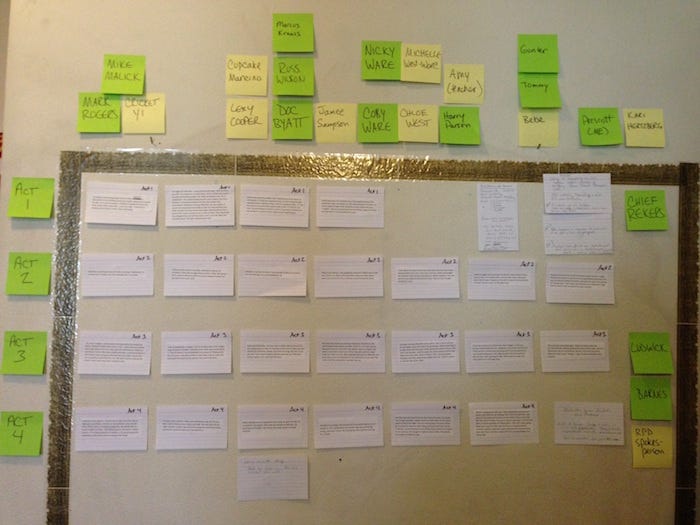
Chris McCoy: “If I’m writing a spec, my outline is looser than it would be if I was writing an assignment. Because you have to pitch to get studio jobs, it means that you’ve extensively worked out the beats of what you’re going to do, so you’ve got this long, in-depth document to use as a reference. But if I’m just at home fiddling around with an idea, I like giving myself some room to explore. What I typically do is have an outline with the big plot points — the inciting event, where we’ll be at the end of the first act, some of the second act rising action beats, the impossible situation at the end of the second act and what the climax will look like. And then I try to find the most creative path between those big moments. My feeling is that if I can surprise myself when I’m connecting these dots, then hopefully I’ll surprise the reader. If I’m just putting words on the page, I’ll always have a couple of weird ideas that pop into my head that I probably wouldn’t have gotten had I just been putting index cards up on a wall.”
Chris Borrelli: “I won’t set out unless I have a general idea of the three‑act structure. If I’m working with somebody, they’ll have at least a three‑page, two‑, three‑page outline.”
Aaron Guzikowski: “I usually write some kind of an outline, and I’ll spend a couple of weeks on that just trying to get everything figured out, but just enough so I know where everything ends up.”
F. Scott Frazier: “The first note cards I’ll ever put up on the wall are the end of act one and the end of act two. I like to know basically where I’m headed before I start writing the script, but my outlines are usually pretty light when I get into a rough draft. I’ll have a vague sense of what kinds of characters I need for the story — who the protagonist is, who the antagonist is — but I usually don’t plan anything beyond that. I also like to plan my set pieces pretty well in advance. So for something like LINE OF SIGHT, I brainstormed 100 different beats that I thought would be cool from a POV perspective. During the brainstorming phase (which I usually don’t spend more than a week on) I’ll also have random bits of dialogue, random scene descriptions, random character moments, random action beats written down on note cards or on a whiteboard to use as kind of like a road map through the rough draft.”
Takeaways:
- These writers want to have worked out the spine of the story’s plot before typing FADE IN. Whether that means four major plot points — Beginning, Act One end, Act Two End, Ending — or some additional key beats such as the inciting incident, this at least provides some sense of the narrative’s direction.
- For writers such as these, a ‘preliminary’ outline provides a basic foundation for the story while allowing the freedom to explore the narrative in the actual writing process.
Here are a couple of variations on theme:
David Guggenheim: “If I have a really clean set up, I feel confident that I can just go ahead and start writing it. That’s all I really need is that clean set up, because I think in action movies that’s what is the most important thing.”
All David needs is a “clean set up,” then he’s off to the races. And how about this:
Declan O’Dwyer: “I tend to write my end first… Get my nemesis sorted, or my nemesis’ arc sorted, and where I want the story to end… I try and get their story sorted, so they’re a proper nemesis, not someone that you don’t fully believe. I just want to make them as real as possible.”
Write the end first including as a key part of that the Nemesis arc.
Again my point: There is no right way to write. While some writers can’t work from an outline, this group represents writers who need a bit more structure before going to draft, a ‘preliminary’ outline, a clean set up, or a clear ending.
How about you? Do you work out major plot points / three act structure before you commence the page-writing part of the process?
For Part 1 of the series on story prep, go here.
Part 2, here.
Part 3, here.
Tomorrow we’ll hear from Black List writers who have adopted a kind of “preliminary” outline approach to their prep-writing.