Begin with character. End with character. Find the story in between.
The Preface from my book The Protagonist’s Journey: An Introduction to Character-Driven Screenwriting and Storytelling.

The Preface from my book The Protagonist’s Journey: An Introduction to Character-Driven Screenwriting and Storytelling.
I never intended to write a book about screenwriting. I figured there were already so many out there. Why add another one?
Then the good people at Palgrave Macmillan encouraged me to research what books film schools were using to teach the craft.
I did.
I was shocked to learn that there were almost no books focusing on what I have been teaching for over a decade: character-driven storytelling.
So, I agreed to write something to fill that void.
I took a leave from DePaul University and holed up in my brother’s cabin in northern Minnesota. There, I nailed down the book’s outline.
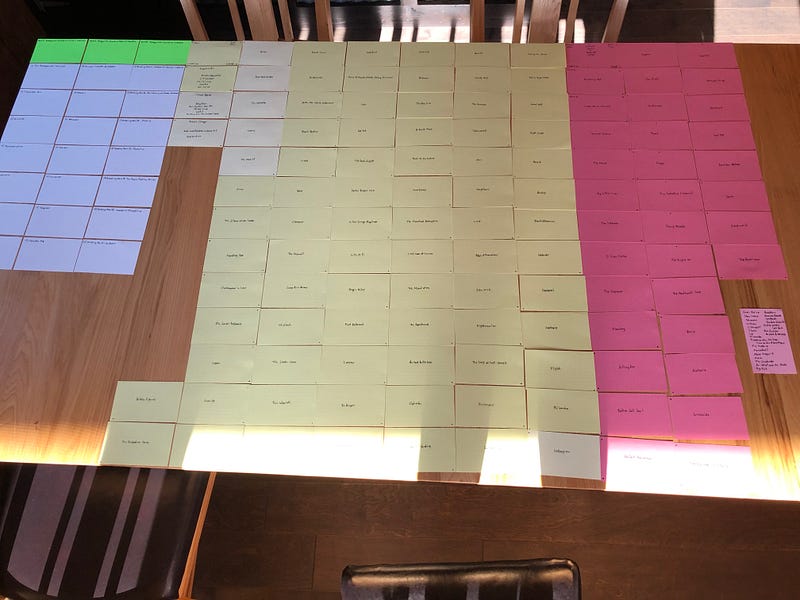
It took me twenty-one months to write and revise The Protagonist’s Journey: An Introduction to Character-Driven Screenwriting and Storytelling.
Here is my book’s Preface.
This book is the result of over three decades of my work as a screenwriter and educator. Since 1987 when the spec script K-9, which I co-write, sold to Universal Studios, going on to become a hit movie with two sequels, I have written over thirty film and television projects for nearly every major Hollywood studio and broadcast network. Through my blog GoIntoTheStory.com, named Best of the Best Scriptwriting Website by Writers’ Digest, I have interviewed hundreds of professionals in the film and television business and interfaced with thousands of writers. After teaching screenwriting as a hobby since 2002, I am now an assistant professor at the film school at DePaul University. During that time, I have taught countless writers from beginners to advanced, undergraduate and graduate students. Based upon my experience as a writer and educator, here is what I have discovered: The best writing is character-driven writing.
The Protagonist’s Journey: An Introduction to Character-Driven Screenwriting and Storytelling is aimed at students of the craft who want to go beyond formulaic approaches which reduce story structure to plot. Plot is essential, but it is only half the story. For it is the world of characters and their inner lives which gives meaning to the events they experience. Indeed, it is by engaging characters, getting curious about them, and following their lead that plot comes to life. In the words of that age-old adage: Character equals plot. I believe that to be true.
This book is divided into three parts. Part I explores story as Narrative Imperative, how there is a profound connection between the psychological state of the Protagonist and the unfolding plot. The journey the Protagonist takes is the journey they need to take. Part II examines the Family of Characters, five archetypes seen with great frequency in movies and television series — Protagonist, Nemesis, Attractor, Mentor, Trickster — and how this assembly of a story’s characters exists to support the Protagonist’s physical and psychological journey. Part III presents a proven professional approach to Breaking Story through a series of character development and plotting exercises resulting in a scene-by-scene outline.
Theories explored here are influenced by Aristotle, Joseph Campbell, and Carl Jung, but are also grounded in my many years of experience as a working writer and teacher. The content in these pages has been road-tested in multiple workshops in the United States and Europe, as well as what I have learned as a mentor at more than a dozen feature writer labs under the auspices of the Black List in Los Angeles. In addition, the principles and practices detailed here served as the inspiration for story development classes in the B.F.A. and M.F.A. programs in screenwriting at DePaul University.
As I often remind students and writers, there is no right way to write. Every writer is different. Every story is different. It is incumbent for each individual to find their own way into who they are as a writer and how to best navigate the story-crafting process. That said, a character-driven approach engages the writer with the very individuals whose story it is: the Protagonist and the characters with whom they intersect.
Thus, we start our journey in these pages with a mantra I coined many years ago: Begin with character. End with character. Find the story in between.
Chicago, Illinois (June 2021)
It is no coincidence that forty professional screenwriters, best-selling novelists, and accomplished academics have endorsed The Protagonist’s Journey. They know how critical characters are in the story-crafting process.
“We’ve seen so many books on screenwriting being framed through the lens of structure, and it’s refreshing to see someone tackle it from the most fundamental part of story: Character.” — Scott Beck and Bryan Woods (A Quiet Place)
“Scott provides a concrete set of tools — a clear, concise methodology for the craft and effective ways to use character, emotion, human behavior to build story.” — Tom Benedek (Cocoon)
“Scott Myers holds an unwavering lens on character, then leads us through an actionable framework for creating transformational plots. The result is an essential read.” — Ryan Woldruff, Associate Professor, Central Methodist University
“The Protagonist’s Journey gives you the tools to craft emotional, character-driven stories that are the bread and butter of any professional screenwriter.” — Stephany Folsom (Toy Story 4, Lord of the Rings: The Rings of Power)
“The Protagonist’s Journey is an excellent resource for writers seeking to create more multilayered, evocative characters in their storytelling process.” — Scott Derrickson (Dr. Strange, The Black Phone)
“Scott has unlocked a whole new way of telling stories by focusing on characters and the psychological forces that drive them to action.” — Mickey Fisher (Jack Ryan)
“The chicken or the egg equivalent for screenwriters (and all storytellers) is what comes first: Plot or character. What should come first is reading Scott Myers’ book.” — Keith Giglio, screenwriter, professor, S.I. Newhouse School, Syracuse University
“Action is character. Scott takes a very simple and often-overlooked aspect of dramatic writing and skillfully turns it into a tour de force tutorial that is compelling, inspirational and practical.” — Arash Amel (Rise)
“Just finished @GoIntoTheStory’s amazing book The Protagonist’s Journey. I’m a premise-driven screenwriter so this deep dive into character-driven story structure was a breath of fresh air. Highly recommended.” — Bob DeRosa (Killers, The Air I Breathe)
“Scott’s book gives clear and valuable guidelines to develop organic stories that are driven by complex, empathetic characters. This is a much-needed book in a field that has long been centered on plot.” — Alireza Khatami (Oblivion Verses)
“I can’t think of anyone more qualified in this field than Scott. His expertise and ability to break down character and story can serve as a guiding light to the next generation of screenwriters.” — Charlie Wachtel, Academy Award (BlacKkKlansman)
“When Scott Myers talks about screenwriting, I listen. So many writing guides focus on structure, but Scott persuasively preaches that well-drawn characters drive our best stories.” — Greg Garrett, Professor, Baylor University
“Scott has pulled off a remarkable feat. He’s made a complete compendium of the screenwriting craft while continuing to encourage the antithesis of formulaic writing.” — Peter Craig (The Batman, Top Gun: Maverick)
The book was the most challenging writing project I have ever undertaken. Twenty-one months, most of them during the height of the pandemic.
I vowed to write a book that was academically sound, yet an enjoyable read. To that end, I slaved over every line.
I am glad I wrote The Protagonist’s Journey. I believe it offers an alternative approach to the innumerable “how to” screenwriting books.
My book is a why to book: Why to focus on characters.
Hence, the mantra which begins the book in my Preface and ends it at the conclusion of Chapter Twenty-One.
Begin with character. End with character. Find the story in between.
The Protagonist’s Journey: An Introduction to Character-Driven Screenwriting and Storytelling is a #1 Best Seller in Film and Television. It is 5-star rated on Amazon with 100 reviews.
To purchase a copy of the book, go here.
If you would like an autographed copy, go here.