An Object Lesson in Visual Storytelling
A comparison of scenes from the movies Heat and Den of Thieves reminds us that movies are primarily a visual medium.
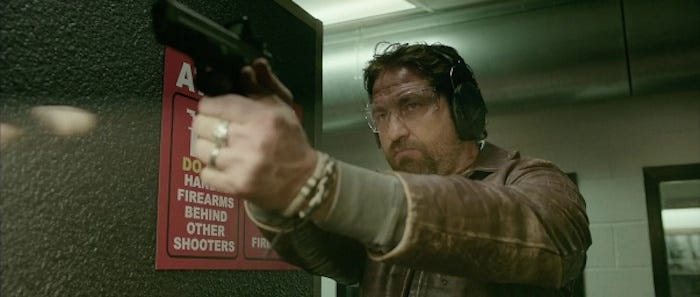
A comparison of scenes from the movies Heat and Den of Thieves reminds us that movies are primarily a visual medium.
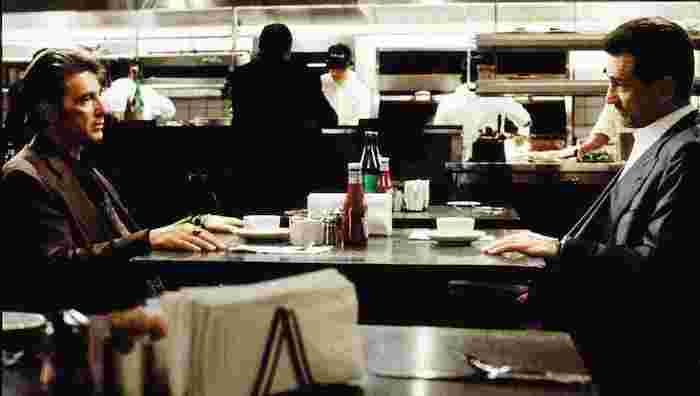
I am currently teaching a one-week Scene-Writing Workshop online course and in it, I asked for suggestions for some great movie scenes. Which led to this discussion. First, me:
Gee, if only there were a website which had a Great Scene series featuring not only links to some memorable movie scenes online… not only script excerpts to compare to the movie scenes… but also analysis of each scene.
Hm. Wait a second. I host that blog! Go Into The Story! And here is the link to my Great Scenes series.
GREAT SCENES
If you have a suggestion for a Great Scene to add to the series, feel free to post the movie and scene here, and why you think it’s great.
Then one of the writers in class David Davis responded with this:
The other night I caught “Den of Thieves,” on cable with Gerard Butler. It came out last year and I missed it in the theater, though I had wanted to see it since the crime/heist genre is my favorite. IMDB description is as follows: “A gritty crime saga which follows the lives of an elite unit of the LA County Sheriff’s Dept. and the state’s most successful bank robbery crew as the outlaws plan a seemingly impossible heist on the Federal Reserve Bank.
Fans of “Heat” will notice some definite similarities in scope and plot. And like “Heat”, the movie explores both the “good guys” and “bad guys” with the premise being that professionals, regardless of which side they’re on, all deal with the same types of issues outside of “work”. And like “Heat”, “Den of Thieves” is overly long as it tries to balance these two sides.
When I looked over the list of “great scenes”, sure enough there listed was the scene in “Heat” when DeNiro’s character and Pacino’s character sit across from each other in a diner and go on about what “regular” guys they are and what each of them has to do to stop the other. Before watching Heat 100 times on cable, I saw it in theater and even then I remember the dialogue in the scene being a little too “on the nose” (and that was before I knew what “on the nose” meant). I think what makes this scene a “classic” has more to do with the scene being DeNiro and Pacino’s first ever together.
While I think “Heat” is far superior to “Den of Thieves” as movie, one scene I thought was more effective in “Den of Thieves” was a similar “sit down” scene between Butler, who is the leader of the elite unit, and Pablo Schreiber, who is the leader of the robbery crew. In this scene, Butler’s character is tailing Schreiber’s character and they end up at a shooting range. With each one taking turns shooting at their target, they try to one up each other, both in terms of the speed and accuracy of their shots.
Script, Part 1:
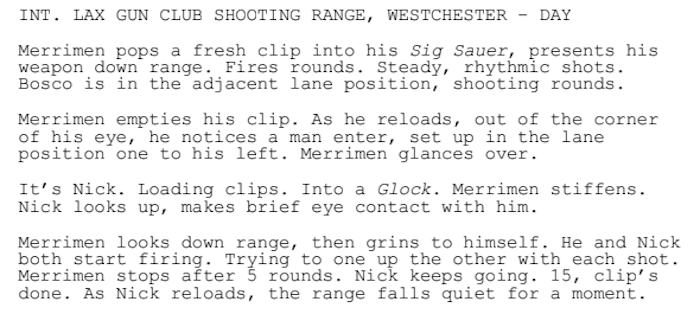
Script, Part 2:
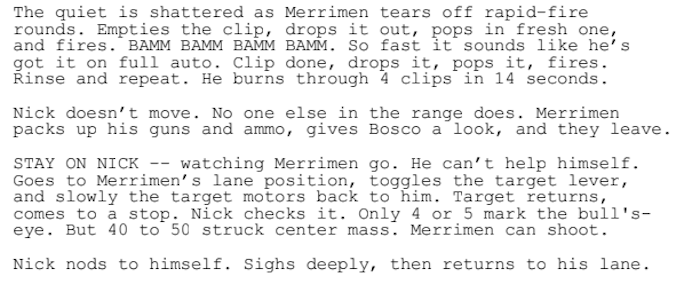
Movie version of the scene:
David continues with his analysis of the scene:
In this 2+ minute scene, the conflict is spelled out quite clearly without a word of dialogue. The structural goal is that Butler and his crew is now on to Shreiber and his crew. The psychological goal is that the audience knows it’s not going to end well for one or both of the characters.
For me, this scene is more effective than the DeNiro/Pacino sit down scene since the writer (and director) move it from “just two guys talking”, which I don’t find very dynamic, to a setting (gun range!) that is both dynamic and generates inherent conflict.
My response:
That’s an excellent scene, David. I never saw the movie, but even if I were dropped into it on this scene, I’d pretty much know what’s going on in the story… and without any dialogue! The script is really solid, too. The narrative voice exhibited in scene description really supports the genre, the style is gritty and bathed in action. In fact, I think I like the scripted version better as its pace is quicker, more compressed (the film version takes over 2 minutes).
The BOB (Bit Of Business) is the target practice. That’s the Plotline. The Themeline is the ‘dick-measuring contest’ between the two characters. The scene also serves to elevate the stakes as Nick learns even more viscerally via Merriman’s marksmanship that this guy is one tough mofo.
That is a well-crafted scene.
I agree with you re the sit-down scene in Heat. The dialogue feels heavy-handed, but then I wonder what else would the guys talk about? It’s a memorable scene because — as you point out — it’s these two wonderful actors in a scene together for the first time. Not my favorite scene in the movie, but I consider it great because it is so memorable.
Here is that scene:
I continued with this:
A fun thought experiment: What could we do with that scene in Heat if we played it like the scene in Den of Thieves? That is, Hanna stops by where McCauley is doing something. What might that BOB be? It could be something as simple as rejiggering the sitdown scene, only no dialogue.
McCauley in a bar. Sipping a whiskey. Door opens. He doesn’t look up. Figure silhouetted by the light outside. Door closes. It’s Hanna. Footsteps clump across the wooden floor. Hanna sits down two bar stools away from McCauley. Flags down the waiter. Motions to what McCauley is drinking. Bartender serves him up. The two swap glances. Look away. Stare into their drinks. Hanna turns toward McCauley. McCauley takes a sip — not looking at Hanna. Hanna keeps staring. McCauley keeps not staring. McCauley downs his drink in one gulp. Screeches his bar stool back. Gathers himself. Turns toward the exit. Sidles right by Hanna. Not even a side eye glance. Hanna’s gaze locked on McCauley as he shoulders open the door. Gone. Hanna blinks. Drinks. Silence.
It’s got some similar gamesmanship that the Den of Thieves scene has in McCauley acting like Hanna isn’t worth even a second of his time or attention. And Hanna’s stare suggests he’s got his eye on McCauley.
David’s response:
I like your version. I was actually trying to think of a way to do it as well and thought that Hanna and his wife could “run into” McCauley and Eady on one of their low-key “dates” and have the same sort of discussion in front of the better halves. Everybody but Eady would know what McCauley really does, which could create some interesting subtext (if I get time, maybe I’ll give it a go). One challenge with coming up with something is that Pacino’s character is smart, slick and competent, basically Rickey Roma with a badge, so getting under his skin is not as easy as it is to do with Butler’s character in Den of Thieves. Love Heat, though.
So where do we end up with this? Heat is a great movie. Michael Mann is a master filmmaker. Obviously, if you can get Al Pacino and Robert De Niro together for the first time, you’ve got to give them some dialogue to work with. But…
Do you really need dialogue to measure two characters’ metaphorical dicks?
Again, movies are primarily a visual medium. That should be a screenwriter’s default mode. This scene from Den of Thieves which barely saw the light of box office day? No matter the movie’s theatrical performance, the scene just flat out works. All visuals. No dialogue.
It’s a good object lesson and reminder that a picture is, indeed, worth a thousand words.
Thoughts?