An Argument Against Screenplay Formulas (Part 5): Times have changed and so have expectations for…
“Almost all of the most influential screenwriting gurus developed their screenplay formulas in the 1980s. While they may have tweaked…
An Argument Against Screenplay Formulas (Part 5): Times have changed and so have expectations for a screenplay
“Almost all of the most influential screenwriting gurus developed their screenplay formulas in the 1980s and 1990s. While they may have tweaked their ideas, the core of what they promulgate has it roots in movies as they were over 30 years ago.”
I’ve not only been writing screenplays since 1986, I have been a student of the craft. Along the way, it’s been fascinating to look at the emergence of movies as narrative through through the lens of screenwriting. In fact, I have taught a university level course called “History of American Screenwriting,” a decade by decade survey beginning in the 1890s all the way up to the present.
One thing I have learned in my research: Screenplay structure, format and style are ever evolving. I posted something on this very subject here. Bottom line: Screenplays today are far different than screenplays of yesteryear.
Given the fact that the narrative form we call a ‘screenplay’ is an organic entity, constantly changing, consider this: Almost all of the most influential screenwriting gurus developed their screenplay formulas in the 1980s. While they may have tweaked their ideas over time, the core of what they promulgate has it roots in movies as they were over 30 years ago.
Times have changed. Expectations have as well.
For example, if you watch almost any mainstream commercial movie from the 1980s, you will likely note how damn long it takes for the plot to ‘get going’.
In Back to the Future (1985), Marty McFly doesn’t end up in the 1950s until minute 33.
In Witness (1985), John Book doesn’t reach the Amish farm until minute 36.
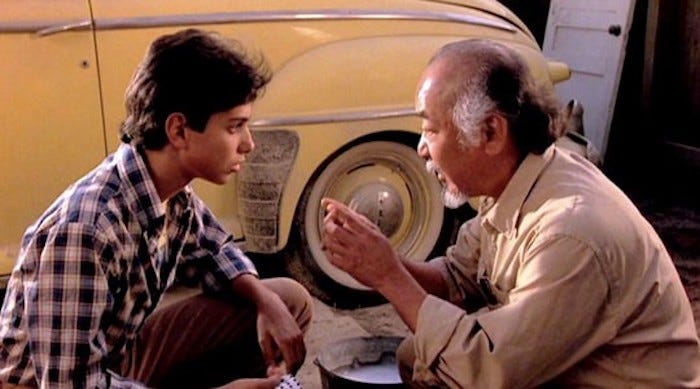
In The Karate Kid (1984), Miyagi doesn’t start teaching Daniel karate until minute 55.
Minute 55!
Personally, I have no problem with stories unfolding at a more leisurely pace, taking ample time to set up all of the characters so we get a solid sense who they are. That would seem to be the best way to make us care enough about them to be emotionally invested in their adventure. Then again, I’m an old dude and not representative of Hollywood’s target audience which is much younger.
My take is contemporary moviegoers want to get into the action quicker. It figures since each of them will have seen, heard or read on average 10,000 stories by the time they get out of college, so a lot of their knowledge about narrative structure is intuitive at this point. They don’t need as much exposition. They don’t need as much setup. As a result, what in the 80s screenwriters would consider to be the end of Act One is now more likely to be the middle of the first act.
The success of the movie Lucy is instructive. We meet the Protagonist (Lucy) in the movie’s first frame, hear her have a conversation for a couple of minutes with a guy she knows well enough to have partied with a few times, but not much more than that. She agrees to do something, then WHAM! Five minutes into the movie and we are on our way, Lucy swept up into an action thriller. Hardly any exposition, any backstory about her character. Five minutes, we’re off and running.

So when I say what used to be the end of Act One — the Protagonist venturing forth from their Old World into the New World — is now more often positioned as the middle of the first act, who knows? Maybe that’s changing and we’ll be witness to even more time-compression for story setups.
Here are some more changes in screenwriting since the 80s:
- Whereas the length of an average scene in the 80s was around 2 pages, my sense is that today, it is 1 1/2 pages, this a reflection of the post-MTV / YouTube / jump cut generation. Obviously that number can vary per genre, story and type of scene, but I think it’s fair to say that most contemporary scripts feature more and shorter scenes than decades past.
- Whereas the rule-of-thumb in the 1980s was paragraphs of scene description should be no longer than 5 lines, today the norm appears to be 3 lines or less. Again this can vary from script to script, but for example, compare the scene description in the script for the 1988 movie Heathers to the script for the 2010 movie The American. If you read 20 scripts from the 80s and 20 scripts from this decade, you will notice a pronounced difference in the handling of scene description, more 1–2 line paragraphs to suggest individual camera shots and read less ‘blocky’.
- Whereas scripts used to clock in at 120 pages, we are more likely to see page counts of around 100–105 pages, even in the 90s for certain genres like Comedy and Family. You can read a post I wrote in 2009 about this phenomenon.
All of these shifts have an effect on story structure and how we tell a story. Do you really want to be relying on screenplay formulas whose perspective is grounded in conventions common to movies three decades ago?
Look, if there’s one thing you take away from this five-part series, please let it be this: Embrace the fact that story structure is not best served by adhering to a preset screenplay formula. Instead, respect the organic nature of Story by engaging your characters. Immerse yourself in their lives. Interview them. Listen to them via their monologues. Do biographies. Character sit-downs. Reflect on what you learn about who they are. Through that process, the story structure will emerge naturally. Plus you will have a collection of vibrant, multidimensional characters to tell their story.
Next week I will post something that acknowledges a certain kind of value — extremely limited in my view — in studying these screenplay formulas.
For Part 1 of the series “An Argument Against Screenplay Formulas: They are selling you a lie” — go here.
For Part 2 of the series “An Argument Against Screenplay Formulas: Formula leads to formulaic writing” — go here.
For Part 3 of the series “An Argument Against Screenplay Formulas: They diminish the craft of screenwriting — go here.
For Part 4 of the series “An Argument Against Screenplay Formulas: They make the job of a screenwriter more difficult” — go here.
I welcome your comments and thoughts.
UPDATE: Just to be clear, I’m including my update from Part 2 drawing a distinction between formula and structure.
I’ve gotten emails from several writers a bit frantic in tone, so let me make this clear: There is a difference between formula and structure. When William Goldman famously says, “Screenplays are structure,” at a fundamental level, that is true. The ultimate end point for a screenplay is the production of a movie and because of certain limitations and conventions common to movies, the structure of a script is intimately tied to the actual nuts and bolts process of making a film.
So let me be clear: I am not saying structure is bad. On the contrary, story structure is critical to the success of a screenplay.
The problem is equating formula with structure.
First off, as discussed, there is no one single formula to craft a screenplay’s structure. Stories are organic. Formulas are not. So the very premise that this screenwriting guru or that can make some claim as to the universality of their formula is false on the face of it. There are endless possibilities for stories and story structure.
Second, from what I’ve seen in the countless scripts I’ve read from writers who have been influenced by screenplay formulas, clearly their focus in the writing has been with Plot, as if Plot is the sum of story structure. It is not. A screenplay’s universe has two dimensions: The External World, what I call the Plotline, the domain of Action and Dialogue, and the Internal World, what I call the Themeline, the domain of Intention and Subtext. The former is where we see and hear the story’s Physical Journey. The latter is where we interpret and intuit the story’s Psychological Journey. Without the Internal World, a story is essentially without any meaning or emotional resonance. Therefore if the preponderance of focus in a screenplay formula is on the makeup of the External World, that is only serving one part of the story’s structure. Story structure properly understood involves both domains: External World (Plotline) and Internal World (Themeline).
Third, and perhaps most importantly, whatever story structure you end up with, one of the major points of emphasis in my teaching is how you get there. This goes back to outside-in writing, as described in Part 2, versus inside-out writing. I believe you are much more likely to find an authentic story structure, not a formulaic one, through the inside-out approach, starting with characters, immersing yourself in their lives, engaging in an active, dynamic process in which both the Plotline and Themeline emerge.
So when I call into question screenplay formula, please understand, this is not the same thing as story structure. In a sense, screenplays are structure, but that structure involves both Plotline and Themeline… and it’s critical how you go about crafting that structure.
Outside-In / Formula = No!
Inside-Out / Characters = Yes!