Action Writing in a Screenplay
“More and more, we see an embrace of action writing where the writer in effect directs the action through lines and paragraphs.”
“More and more, we see an embrace of action writing where the writer in effect directs the action through lines and paragraphs.”
We may think of action writing as what a writer does when they work on an action script. There is a broader interpretation: Action Writing referring to the writing we do when we describe any movement in our script. That movement can be seen through the influence of physical events, either manmade (e.g., traffic, air flight) or natural (e.g., earthquakes, quicksand), or the activities of characters.
Action Writing also carries with it an awareness that movies by and large are a visual medium. One way to augment a story’s visuality is to put people on the move. The old saying “show it, don’t say it” is still in use today in Hollywood development circles because there is an inherent truth to it. Whenever we can carry the story ahead through action rather than dialogue, almost invariably that is a preferable choice.
Obviously, if you write dialogue like Aaron Sorkin, you can play to your strength and use dialogue perhaps more than mere mortal writers. Yet it’s instructive that the director of Sorkin’s script for The Social Network David Fincher says he shot the movie “like an action film.” Accompanying all that scintillating rapid-fire dialogue are characters in almost constant movement. It’s like nobody walks in the movie — they run, stagger, hustle, and jump. Even when they are seated as in the all those deposition scenes, they shift in their seats, lean forward, fall back, point fingers, chop the air with their hands.
So properly understood from our perspective, Action Writing not only refers to writing about any movement, it also embraces the visual nature of movies and how movement is a key contributor to the visuality of the story we tell.
Here are three touchstones for effective action writing:
- Lines
- Shots
- Direction
Lines: This is Narrative Voice breaking down action into individual beats.
Paragraphs: This is Narrative Voice describing a cumulative set of action beats.
Direction: This is Narrative Voice guiding the reader’s imagination through the action.
Thus, when we consider action writing, we can think of Narrative Voice as, what else — a director. This runs counter to the current edict per screenplay style that a writer should not direct a script. In fact, we direct the script every step of the way through the multitude of choices we make, everything from a scene’s point of attack to transitions to each line of scene description.
The point is not about directing the script, rather it’s to avoid letting the reader see we’re directing the script. Lose the directing lingo. The jargon. Say goodbye to CLOSE UP and ZOOM IN. No more SMASH CUT TO or ANGLE ON. We say no to that. But we say yes to approaching screenplay style as a director, bringing our visual sense of how the action plays out on the script page.
Here are three examples from movie scripts written in the last decade.
Action writing in True Grit
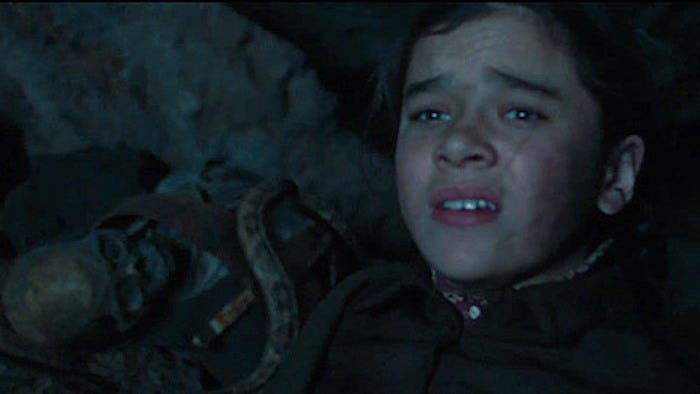
The Coen brothers have an inspired visual sensibility enhanced by their approach to action writing. In this scene from their adaptation of the novel True Grit, we see how they use movement within a scene that is by necessity a ‘static’ moment: Mattie has fallen down a pit and is stranded there, her leg broken and tangled in some roots:
Mattie surveys the body. Her attention is caught by something:
The skeletal remains are still clothed and there seems to be something held by a bandolier strapped across the chest, over the body’s decomposing blue shirt but beneath a tattered vest. A sheath is just visible high on the strap, near the corpse’s shoulder. The butt-end of a knife juts out.
Mattie stretches, reaching.
She can just get to a boot.
She pulls.
The man’s remains seem to be fairly light. They drag across earth, raising dust, tending to slide away with the grade of the pit.
Mattie reels the body in, careful not to let go and lose it down the hill. She pulls shoe, pants cuff, pants knee, belt. The bandolier is close.
Her fingers curl around shirt, and pull.
The shirt’s buttons softly pop and fiber dust drifts up as the fabric falls to pieces. Rib cage is exposed beneath.
Mattie hastily reaches and curls fingers around ribs. She pulls. She is about to get the knife when —
A glistening something inside the rib cage — guts? — starts to slowly move. But it can’t be guts: it is gliding, coiling, under its own power.
A faint rattle.
Mattie screams as the ball of waking snakes quickens. One snake starts to slowly emerge, and she bats the body away.
Notice how the Coens use single lines to suggest camera shots of individual beats: Mattie stretches, reaching / She can just get to a boot / She pulls.
Note, too, how they use paragraphs to handle an accumulation of action beats: The shirt’s buttons softly pop and fiber dust drifts up as the fabric falls to pieces. Rib cage is exposed beneath / Mattie hastily reaches and curls fingers around ribs. She pulls. She is about to get the knife when — / A glistening something inside the rib cage — guts? — starts to slowly move. But it can’t be guts: it is gliding, coiling, under its own power.
Each line and each paragraph directs the reader through the action — all without any use of camera lingo.
Action writing in The King’s Speech
Here is another ‘static’ scene where the screenwriter David Seidler uses lines and paragraphs to generate movement and direct the action:
The red light in the booth flashes.
The red light flashes for the second time.
Bertie concentrates.
The red light flashes for the third time.
The red light now goes steady red.
Lionel opens his arms wide and mouths, “Breathe!”.
On Air.
Bertie’s hands begin to shake, the pages of his speech rattle
like dry leaves, his throat muscles constrict, the Adam’s
apple bulges, his lips tighten…all the old symptoms
reappear.
Several seconds have elapsed. It seems an eternity.
Each line conveys an individual beat: The red light now goes steady red / Lionel opens his arms wide and mouths, “Breathe!” / On Air.
And the paragraph describes a cumulative set of beats: Bertie’s hands begin to shake, the pages of his speech rattle like dry leaves, his throat muscles constrict, the Adam’s apple bulges, his lips tighten…all the old symptoms reappear. The focus is on Bertie, staying with him to visualize the entirety of his reaction at this most critical moment.
All combine to direct the action — again without any directing jargon.

Action writing in Winter’s Bone
We can see a similar stylistic sensibility in this script written by Debra Granik & Anne Rosellini, based on the novel by Daniel Woodrell.
Ree walks across the yard towards Thump Milton’s house.
The door opens and Merab comes out carrying a steaming mug. She hurls the liquid at Ree, then hits her in the face with the mug as ALICE and TILLY, Merab’s sisters, emerge from the house.
Ree cries out and falls to the ground.
MERAB
I done told you to leave him be.
Merab and Alice grab Ree and drag her to the barn with Tilly leading the way. Ree resists with all her strength.
MERAB
Get her, Alice!
ALICE
(to Ree)
No, you don’t!
The sisters get a tighter hold on her and force her inside the barn.
MERAB
That’s what you get for not
listening.
Ree’s screams pierce the air as the barn door lowers.
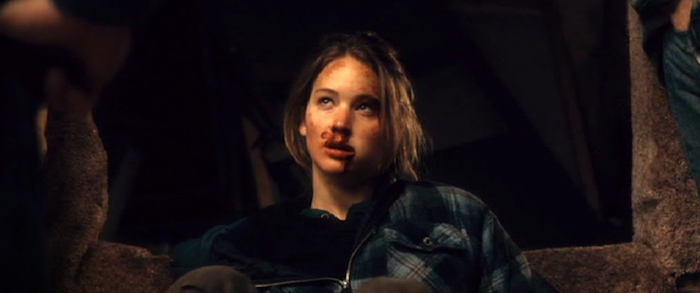
The lines signify an individual beat: Ree walks across the yard towards Thump Milton’s house / Ree cries out and falls to the ground / Ree’s screams pierce the air as the barn door lowers.
The paragraphs describe an aggregation of beats: The door opens and Merab comes out carrying a steaming mug. She hurls the liquid at Ree, then hits her in the face with the mug as ALICE and TILLY, Merab’s sisters, emerge from the house / Merab and Alice grab Ree and drag her to the barn with Tilly leading the way. Ree resists with all her strength.
Yet again action writing that directs the reader through the movement within the scene — and no director in sight on the written page.
These three scripts are examples of some of the most recent writing by professional screenwriters and current style sensibilities. Are there writers who abide by the old conventional wisdom — action within paragraphs, none longer than 5 lines? Yes. But more and more, we see an embrace of action writing as exhibited in these three scripts, where the writer in effect directs the action through lines and paragraphs.