A Story Idea Each Day for a Month — Day 9
This is the 13th year in a row I’ve run this series in April. Why a story idea each day for the month? Several reasons which I’ll work my…
This is the 13th year in a row I’ve run this series in April. Why a story idea each day for the month? Several reasons which I’ll work my through during this series of posts.
Initially, I provided a daily explanation about why you should make it a habit to be generating story ideas. This week, I’ll give you some tips on how to come up with stories.
Tip: Look at news sites.
I’ve been demonstrating that in this series, every idea from a news article. While you can surely keep an eye out when reading the NY Times or LA Times, you’d better believe there are plenty of writers already eyeballing those pages. So troll smaller newspapers. Offbeat news sites. Have you ever checked out Weekly World News? I used to subscribe to the print version way back when and actually wrote a spec based on one of their articles: “Couple Adopts the Child From Hell.” Unfortunately, the spec script “Problem Child” beat us by 2 weeks: same premise.
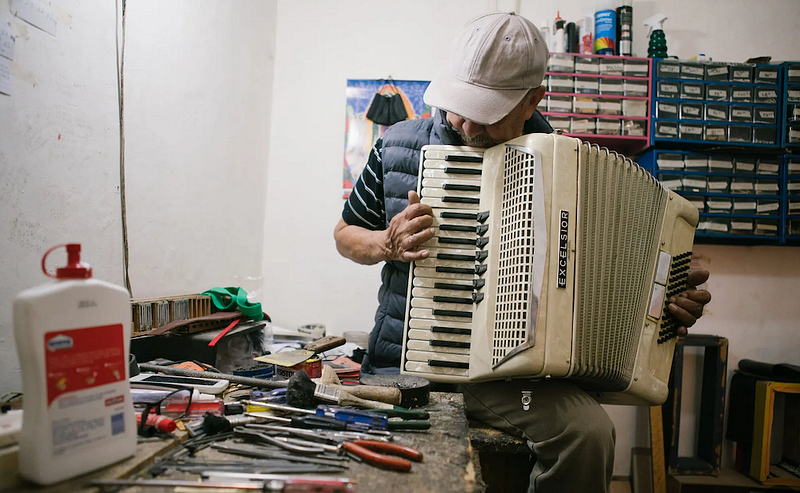
Today’s story: He’s the Brusque Mr. Fix-It for Mexico City’s Accordions.
MEXICO CITY — “Your accordion is a piece of garbage.” Francisco Luis Ramírez shook his head. The old man was carefully inspecting the dusty instrument that I’d brought to his workshop, and he had seen enough. “Una porquería! I cannot fix this. Well, I could, but it would make more sense for you to buy a better one.”
He put down his cigarette and picked up another accordion that was sitting on his wooden worktable. It was large and white and shiny. “Now, this is an accordion. Italian-made. Listen.”
He began to play, and suddenly, thick-sounding notes filled the small, dark room. I looked around: All along the white walls were shelves crammed with skeletons from the past half-century of his work: wood casings, sagging bellows, and mangled keyboards that looked like irreparably crooked teeth. The room itself smelled like a mix of cigarette smoke, musty wood and drying glue.
Here — in a side office, up the stairs of an unmarked building hidden away on a block of the city center jammed with flashy music stores that used thumping loudspeakers to attract customers — was the workshop of one of this city’s oldest and most venerated accordion repairmen.
“Everything I do is to improve the sound,” Ramírez, now 76, likes to say of his work. “I’m a technician, always refining, always refining.”
Day after day, for nearly 50 years, he has been visited by musicians — mariachis and norteños, buskers and maestros — gently cradling their injured instruments like small children. He has done repairs for performers as famous as Los Ángeles Azules, Los Rieleros del Norte, Los Tigres del Norte and Mon Laferte, among many others.
Sometimes a story begins with a character. That’s what caught my attention when I ran across this New York times article:
- Ramirez as a no-nonsense, hard-nosed old guy, but clearly he has passion and romance in his soul witnessed by his love of music.
- Accordions are an interesting musical instrument spanning several musical genres.
- The subculture of mariachi music.
What to do with this kind of character as the starting point in the story-crafting process? My mind connected with an idea detailed in the article: Family business.
What if our Protagonist (Ramirez) sees the end of his days at the job he has held down for over a half-century. His eyesight is fading. His fingers are debilitated by arthritis. He is tired. Lonely (his wife of four decades died some years previous). And the state of music nowadays? Don’t get him started on how things have deteriorated on that front.
And yet the prospect of simply folding up his shop and shutting it down fills him with dread. It’s his legacy. Once it’s gone and forgotten … won’t he be next? What will his life have amounted to? Perhaps nothing?
His two adult daughters have families and, of course, being girls, he never considered them as potential heirs to the business. But after his daughters bore six grandchildren — all girls — they finally had a boy: Miguel. The son Ramirez never had.
As a child, Miguel loved to visit his papi in the shop. Ramirez lights up at the many memories he has, teaching the boy about the inner workings of accordions … giving impromptu music lessons to Miguel. Those times together were rare moments where Ramirez would smile, even laugh. Two amigos bonding together.
Then Miguel became an adolescent and turned away from music, accordions, and his grandfather. A slow painful process for Ramirez. The situation compounded by Miguel turning toward a life of crime, at least that was the word on the street.
This is where the story begins. The inciting incident: Late one night, Miguel shows up unexpectedly at Ramirez’s doorstep. The boy, now twenty years old, looks terrible. Sallow skin, greasy hair, and worse, cuts and bruises across his face and torso. He is desperate and has nowhere else to go. His mother has forbid him to come to their family home until Miguel cleans up his act. Now it appears to be too late. The young man has gotten in over his head with a local gang. His life is in jeopardy. He needs his grandfather’s help.
Despite the hurt Ramirez feels at his grandson’s turning away over the years, he must do what he must do: Family is family. The old man arranges a meeting with the gang leader. Ramirez is presented with a deal: He must “buy” his grandson’s freedom. How? Illicit activities out of his accordion shop.
That’s the setup as the old man finds himself pulled into the criminal world in an attempt to save his estranged grandson’s life. He has to figure out a way to best the gang leader and his cronies while avoiding harm coming to Miguel, his mother, the other grandchildren.
There you go, my 9th story idea this month. If you like it, do with it what you will. It’s YOURS. And it’s free!
Day 1
Day 2
Day 3
Day 4
Day 5
Day 6
Day 7
Day 8
Each day in April, I invite you to join me in comments to do some brainstorming. Take each day’s story idea and see what it can become when we play around with it. These are valuable skills for a writer to develop.