A Story Idea Each Day for a Month — Day 7
This is the 11th year in a row I’ve run this series in April. Why a story idea each day for the month? Several reasons which I’ll work my…
This is the 11th year in a row I’ve run this series in April. Why a story idea each day for the month? Several reasons which I’ll work my through during this series of posts. Here’s another one:
The story idea is how everyone in Hollywood short-hands your script.
From the first moment your script enters into submission process, where it’s covered and at the very top there is a logline, through the marketing of your movie, where posters, newsprint, radio, TV spots, and web content all derive from it, your story idea is the touchstone for everything that happens.
So over time, I think it is fair to say that story ideas have become the lifeblood of Hollywood, what people traffic in all day long. The more you can think like that, play to the way Hollywood people interact with stories, the better your chances of success in the business.
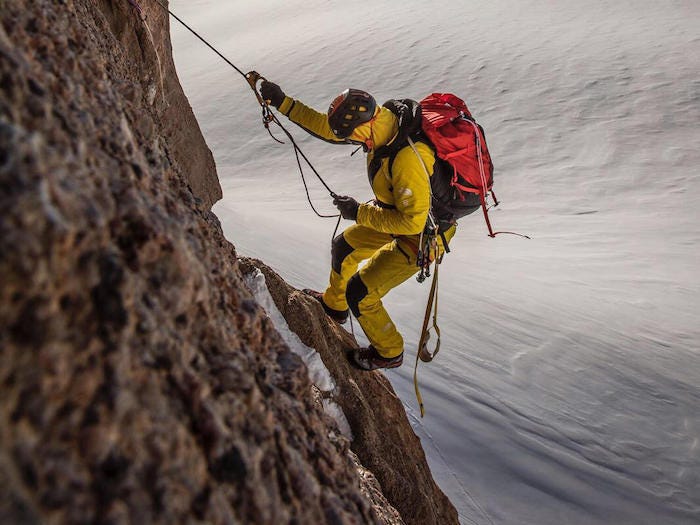
Today’s story idea: Survivor’s Guilt in the Mountains.
Alpinists are intimately familiar with death and grief. A therapist thinks he can address the unique needs of these élite athletes.
In mountain towns, an early-autumn snowstorm is a nuisance and a lure. It runs some people out of the high country but draws others in. During the first week of October, 2017, a foot or more of snow fell in the peaks south of Bozeman, Montana. Before dawn on the fifth, a group set off from a parking lot in Hyalite Canyon, a popular outdoor playground, just outside town. The man at the head of the group was spooked by the new snow. To minimize exposure to avalanches, he made sure that everyone ascended with caution, keeping to the ridgelines and bare patches, away from the loaded gullies. This was Conrad Anker, the famous American alpinist. It is often said that there are old climbers and there are bold climbers, but there are no old bold climbers. So far, Anker, at fifty-four, was an exception.
There was nothing intrepid, really, about this particular outing. It was basically a hike up a minor mountain formerly known as Peak 10031 (for its unremarkable altitude of 10,031 feet), which had been rechristened in 2005 in honor of the late climber and Bozeman idol Alex Lowe. The group was headed to Alex Lowe Peak to spread Alex Lowe’s ashes. Anker recognized that it would be cosmically stupid to kick off an avalanche on the way.
Lowe died in 1999, at the age of forty, during an ascent of Shishapangma, in the Himalayas. At the time, he was considered by many to be the world’s preëminent alpinist, and, even in a pursuit where untimely death is almost routine, his came as a shock. He was game for anything yet prudent, in his way — more dervish than daredevil. Still, snow is water, and it aims downhill. On Shishapangma, a massive avalanche entombed two climbers, Lowe and the cameraman David Bridges, under tons of frozen debris. A third, Anker, who’d fled in another direction, got flattened and engulfed by the blast, but after the air cleared he found himself stumbling through an altered landscape, alive and alone.
Lowe’s wife, Jennifer, back in Bozeman, got the call from base camp twelve hours later. Through the static of the satellite connection, Anker confirmed that her husband was gone. She’d had premonitions and dreams about this trip and — uncharacteristically, because she’d been a climber, too, and a supporter of her husband’s exploits — had begged Lowe not to go. But he’d felt obliged, both to his climbing partners and to the North Face and NBC Sports, which were underwriting the expedition. “It’s my job,” he’d told her. “It’s a work trip.” She and Lowe had three sons, aged ten, seven, and three.
Lowe’s peers had admired him not only for his exploits on rock and ice but for his attentiveness as a husband and father, though it says something about the mountaineer mind-set that a man who spent several months of the year away from home was considered a dutiful dad. “We were all in awe of him because he was able to climb and be a father,” Anker told me. Anker and Lowe were best friends, kindred spirits, and regular partners. Anker took it on himself to look after Jenni and the boys, spending more and more time in Bozeman with them, doing what he could to help them muddle through, and also to find a purpose for himself — a reason to live. Less than two years after Alex’s death, Anker and Jenni were married. Anker adopted the boys, and Lowe-Anker, as Jenni now called herself, had another world-class climber for a mate, with all the glory, anxiety, and exasperation that entails.
In 2016, while in Nepal, Anker got one of those calls where, as he puts it, you know what the news will be before you even put the phone to your ear. It was from his friend and colleague David Göttler, who was climbing on Shishapangma. He’d come across some old North Face gear, and after some digging had uncovered what appeared to be the bodies of David Bridges and Alex Lowe. Their corpses had melted out of the glacier sooner than anyone had expected — climate change. A couple of months later, Anker, Lowe-Anker, and the three boys travelled to the Himalayas to recover the bodies.
For the boys, the trip was proof that their father was indeed dead, that there was no chance of a miraculous return, something that Max, the eldest, had fantasized about as a child. Anker, for his part, had had a recurring dream in which Lowe showed up to reclaim his brood. “It was all super heavy-duty for me,” Anker told me. “Here’s his wedding band, here’s his camera, here’s my water bottle in his daypack.” Lowe was found on his back, arms crossed over his chest. “He had his hand with his wedding ring curled against his heart,” Lowe-Anker said. It was hard work to dig out the bodies, wrap them up, and haul them down to base camp, including a rappel off a cliff. They’d lugged in a cord of wood and some accelerant. There is no real template for an encounter, in the high alpine, with the frozen corpses of a father, husband, and friend. “We looked at them for a day,” Anker said. “And then we wrapped them and cremated them.”
These were the ashes that the family brought up to Alex Lowe Peak, a year later. At the top, they scattered the remains and said their farewells — closure, of a kind, eighteen years to the day after Lowe disappeared under the snow. It was dark when they got back to the car.
The New Yorker article is a fascinating read, a deep dive into the subculture of mountain-climbing and the compulsion of men and women, many of them with families of their own, to put their lives at risk every time they pursue the passion.
And what of those who survive a tragedy? Whose companions perish, but they live? In some ways, that may be more of a personal challenge than scaling a thirty thousand foot high mountain. Enter this guy:

Timothy Tate, a psychotherapist with some decidedly unusual therapeutic practices. Steeped in Jungian psychology, the world of archetypes, and Native American shamanism, Tate lives in Montana, home to many of the world’s most notable mountain climbers.
How to take some of these narrative elements and craft a story worthy of a movie? Let’s start with Wendy, a world class climber. It’s not only her passion, it’s her business, charging top dollar to guide millionaires to some of the most arduous peaks. Like most climbers, she has decidedly mixed feelings about this type of work, the commercialization of a sport which at its heart is about the purity of a human being in a relationship with a mountain. Each climb a different challenge in its own way. But with a husband and two kids to feed back in Colorado, it is what it is. The summer gig allows her family to live where and how they want, spending more time outside engaged with nature than inside.
The story opens with just such a climb, Wendy with her business partner Tyler, escorting seven wealthy types up a mountain. As climbs go, this one is pretty pedestrian by expert standards, but the dream of a lifetime for these rich folks. A sudden storm brews. Tough call, so close to the peak. Can they make it up and back before things get gnarly?
Of course, the millionaires not knowing any better push to continue. They paid upward to six figures each and they want their money to pay off.
They make the peak, but now have to hustle down amidst a growing storm. Then disaster strikes when one of the amateur climbers, the biggest of the loudmouths, tumbles down the side of the mountain, dangling by his. Tyler heads to him, managing to pull the guy to safety, but then he plummets down a deep crevasse to a certain death.
Cut to Colorado. Wendy at home. In body, but not spirit. Wracked with survivor’s guilt, her mood swings and behavior create major conflict with her husband and even children. When she goes into town and ends up in a drunken brawl, it’s clear she needs help.
The only therapist within 100 miles is Robyn, known to locals as a bit of kook. She moved to the mountain community as a hippie back in the early 70s which means she’s old. Very old. But she doesn’t look it. Always tan, even in the winter.
There’s your setup. It’s a drama. It’s Into Thin Air meets Ordinary People.
There you go, my 7th story idea of the month. And it’s yours. Free! What would YOU do with it?
Day 1
Day 2
Day 3
Day 4
Day 5
Day 6
Each day in April, I invite you to join me in comments to do some brainstorming. Take each day’s story idea and see what it can become when we play around with it. These are valuable skills for a writer to develop.
See you in RESPONSES to hear YOUR take on this story idea. And come back tomorrow for another Story Idea Each Day For A Month.