A Story Idea Each Day for a Month — Day 29
This is the 15th year in a row I’ve run this series in April. Why a story idea each day for the month? Because the best way to come up with…

This is the 15th year in a row I’ve run this series in April. Why a story idea each day for the month? Because the best way to come up with a great story idea is to come up with a lot of ideas. And the best way to come up with a lot of ideas is to be proactive in sourcing story ideas.
Today’s story: “I was shunned growing up in Utah. It destroyed me mentally. The practice is alive and well.”
These days, when most people think of “shunning”, they probably think of religions or cults cutting off their ex-members, like former Jehovah’s Witnesses and Scientologists frequently report: the practice of a group isolating its members by making turning away too painful and isolated to bear. It’s designed to keep you in, to trap you so you don’t escape.
In my case, it was something a little different. I was a non-Mormon in Utah, and I was shunned growing up by the Mormons around me. The practice left me deeply traumatized in ways I’m still struggling to grasp (let alone heal), and something distressing to me is how very little information is out there about this form of cruelty and abuse. Even more distressing is the knowledge that this practice is still being inflicted on children in Utah to this day.
This will probably be a long read. I apologize in advance. Maybe take a break and come back to it from time to time; it took me decades to live it, I won’t be offended if it takes you more than a single afternoon to read about it.
I used to hesitate to describe what I went through as “shunning” in the past. It always felt like a very dramatic word to use, but over the years it’s become plain as day that no other word fits quite so well. Instead, I have discovered almost the opposite: people hear the word and rather than think I’m exaggerating or being dramatic, they don’t seem to fully grasp just what it means to be shunned from childhood, how total it is and how devastating. Even I didn’t really get it until I was seeing a therapist who, after hearing the story of my youth, responded, “That’s child abuse. I’ve never seen a community abuse a child like that instead of the family, but it’s absolutely abusive behavior.”
I had a loving home life, with parents who treasured me, showered me with unconditional love and support, and treated me with dignity and respect. In contrast to many abused children, who look for any reason to avoid going home and dread the moment they reach their own front door, I was the inverse: I dreaded leaving our apartment to go anywhere but a different relative’s home. At school, I was unwelcome and unwanted. Other kids refused to speak to me unless they absolutely had to, would refuse to look at me, play with me, or interact with me.
If we were broken up into groups to work on something, I was ignored. Any time I spoke up, the rest of the group stared silently until I finished talking, then resumed their own discussions as though I had never said anything in the first place. I spent my recesses alone, at first unwillingly and desperately trying to join in on other games, but always excluded. If the game had a way to force a player “out”, I was always targeted and driven “out” first. If no such option to eject me existed (such as with basketball), I was simply ignored and played around, like an obstacle on the field.
I vividly recall finally making friends, briefly, with a new girl to our school. She and I hit it off, had a lot of fun together, and she invited me to her upcoming birthday party, the very first (and last) one I would ever attend. These were mythical events to me: I’d heard about other kids having birthday parties from relatives’ stories about their own childhoods, as well as from TV and movies and the like, but I’d never gotten to go to another kid’s birthday before…well, except for my little brother’s, of course. The party itself was everything I’d hoped for: cake, other kids, lots of games, a goody bag from the parents with candy and toys, honest-to-God TOYS in it, just free for the taking (the concept of anyone getting presents besides the birthday boy or girl blew my mind). When it was my turn to get my goody bag, the girl’s parents greeted me with wide smiles and excited voices.
“Well, hello there! I don’t think we’ve seen you around before. Did you just move here?”
“No, we’ve lived here for a long time.”
“Oh? Well, we haven’t seen you at the ward (Mormon for “church”) before.”
“I don’t go to the ward, we’re not Mormon. I go to the Lutheran church.”
“Oh! How nice! Well, here’s your goody bag.” I smiled and said “thank you”, they smiled and said “you’re welcome”.
The next day at school, their daughter refused to even look at me. Literally, she would not speak to me, would not acknowledge me, and turned her face away from me if I tried to talk to her. We never played together again, and I never went to another party.
Imagine yourself in this situation: “Any time I spoke up, the rest of the group stared silently until I finished talking, then resumed their own discussions as though I had never said anything in the first place.”
I don’t have an obvious take into the story conceit of shunning, but it’s a great title: Shunned.
- Is the Protagonist a former cult member
- Are they a newcomer to a tight-knit cult-type group
- Are they a different ethnicity than the predominant local group
- Is the shunning an attempt to drive someone crazy or maybe this:
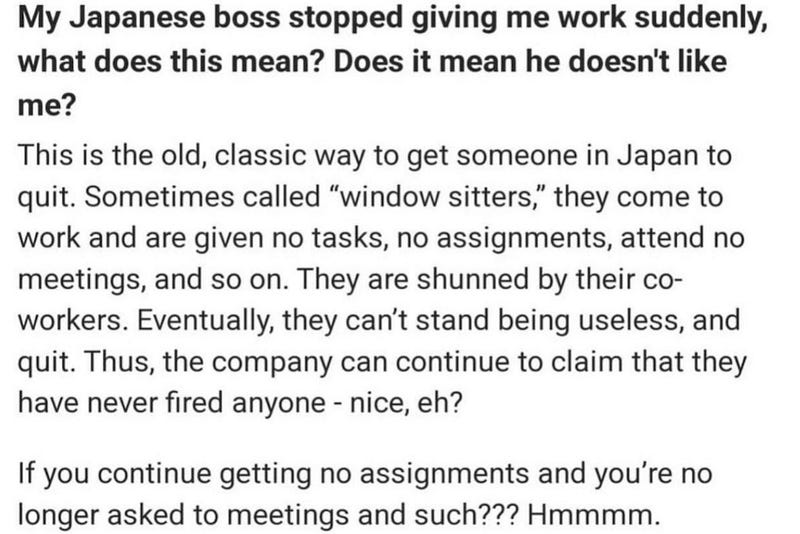
Whatever the angle into the story is, the actual experience of a character being shunned sounds like an interesting angle into a movie.
There you go. My 29th story this month. Free for you to take and write.
Previous articles in this year’s series:
Day 1
Day 2
Day 3
Day 4
Day 5
Day 6
Day 7
Day 8
Day 9
Day 10
Day 11
Day 12
Day 13
Day 14
Day 15
Day 16
Day 17
Day 18
Day 19
Day 20
Day 21
Day 22
Day 23
Day 24
Day 25
Day 26
Day 27
Day 28
Each day in April, I invite you to join me in comments to do some brainstorming. Take each day’s story idea and see what it can become when we play around with it. These are valuable skills for a writer to develop.
See you in RESPONSES to hear YOUR take on this story idea.
Let’s say you’ve found a story concept from an article in this series. Or you have an idea of your own, but you’re at the very beginning of the story-crafting process.
How to develop, then write it as a screenplay?
May I humbly recommend my book The Protagonist’s Journey: An Introduction to Character-Driven Screenwriting and Storytelling.
Hundreds of people have sent photos of my book. Here’s one.
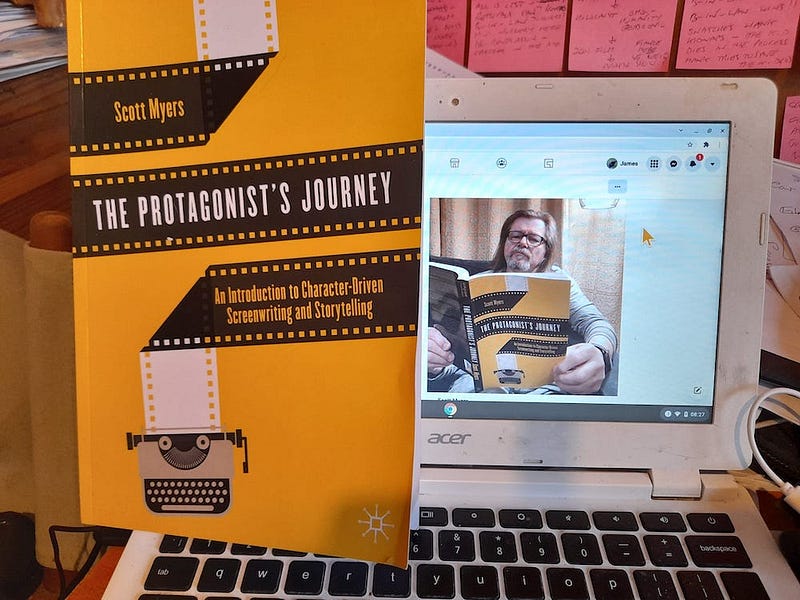
The book is structured to provide writers an approach to the story-crafting process grounded in immersing oneself in the lives of the characters (Parts I and II). Then Part III presents a stage by stage approach to break story: from concept to outline.
Go here to read endorsements from dozens of professional screenwriters, authors, and academics.
You may purchase The Protagonist’s Journey here:
Come back tomorrow for another Story Idea Each Day For A Month.