A Story Idea Each Day for a Month — Day 26
This is the 13th year in a row I’ve run this series in April. Why a story idea each day for the month? Because the best way to come up…
This is the 13th year in a row I’ve run this series in April. Why a story idea each day for the month? Because the best way to come up with a great story idea is to come up with a lot of ideas. And the best way to come up with a lot of ideas is to be proactive in sourcing story ideas.
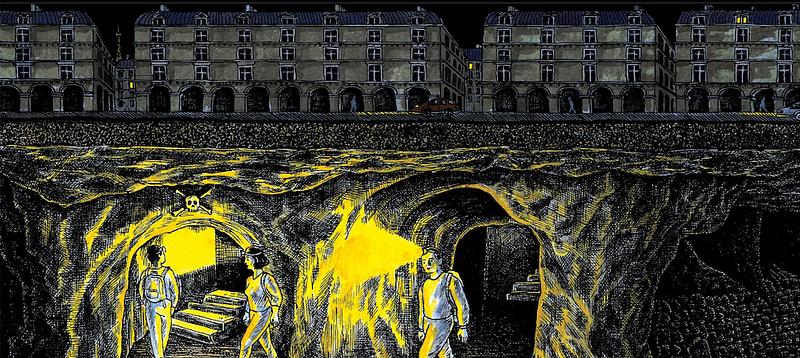
Today’s story: The Invisible City Beneath Paris.
Under the southern portion of the city exists its negative image: a network of more than two hundred miles of galleries, rooms, and chambers.
The map runs to sixteen laminated foolscap pages, or about ten square feet, when I tile the pages together. I have been given it on the condition that I do not pass it on. It is not like any map I have ever seen, and I have seen some strange maps in my time. The plan of the above-ground city is traced carefully in pale silver-gray ink, such that, if you read only for the gray, you can discern the faint footprints of apartment blocks and embassies, parks and ornamental gardens, boulevards and streets, the churches, the railway lines and the train stations, all hovering there, intricate and immaterial.
The map’s real content — the topography it inks in black and blue and orange and red — is the invisible city, the realm out of which, over centuries, the upper city has been hewn and drawn, block by block. This invisible city follows different laws of planning to its surface counterpart. Its tunnelled streets often kink and wriggle, or run to dead ends. Some of them curl back on themselves like whips. At junctions, three or four tunnel-streets might spray out. There are slender highways running almost the length of the tiled map, from southwest to northeast. There are inexplicably broken grids of streets, or hubs where the spokes of different tunnels meet. Coming off some of the tunnels are chambers, irregular in their outlines and with dozens of small connecting rooms.
The map’s place names traverse a range of cultural registers, from the classical to the surreal to the military-industrial. The Room of Cubes. The Boutique of Psychosis. Crossroads of the Dead. The Medusa. Bunker Under the Mountain. The Monastery of the Bears. Ossa Arida. Room Z. Affordance is specified on the map in handwritten cursive words: “Low,” “Quite low,” “Very low,” “Tight,” “Flooded,” “Impracticable,” “Impassable.” More detail is occasionally given: “Humid and unstable region (sometimes flooded)”; “Beautiful gallery, vaulted and corbelled.” “Chatières” — cat-flaps — mark a point of lateral transition between tunnel and tunnel, or between tunnel and chamber. Other captions gloss contact sites between the upper city and the invisible city (“Hole to the sky”) or between levels (“Tiny hole in the ground debouching into a dangerous lower level”). Scattered around the map are little inked skulls-and-crossbones and laconic warnings of danger: “Cave-in”; “Open well: dangerous”; “Collapsing ceiling.”
Here and there, boxed-out cartouches offer stories of individual sites. A blue compass rose with an orange northward arrow is laid over an empty section of each page, and each page is given a district name. The typeface is a fine, seriffed font that I do not recognize. The over-all aesthetic is coolly contemporary, the cartography itself an elegant compression. Authorship is attributed only to a collective called Nexus — “the connection or connections between the parts of a system or a group of entities.” I admire the work of its anonymous makers.
I don’t know what to do with this as a story conceit, but what a setting! I mean, check out this image written by the author of the article describing part of their underworld journey:
I am in a vertical shaft, and above me is a suspended wall of clay and earth, perhaps ten feet high, into which hundreds of human bones are embedded: skulls, ribs, and limbs. In the belly of the well below are hundreds more fallen bones. It is a point where a burial ground has begun to disgorge its contents down through a breach in the tunnel network. The rough limestone from which the shaft has been hewn is also visibly thick with bodies — whelks and spiral shells that are embedded, uncrushed, in the stone’s sediment — and I have a sudden sense of both cities, upper and lower, as a single necropolis.
Certainly, the setting lends itself to a horror story: A group of amateur spelunkers awaken undead bone creatures. Or perhaps a thriller: The explorers get trapped by an underwater flood and have to be rescued.
I kind of like the idea of drama: A teenager (Marietta) feels alienated. Probably the product of a divorced family. She has all the creature comforts she needs (her single parent is wealthy), but Marietta despises the shallow interests of her private schoolmates. She is a reflective soul, a loner who wanders the streets of Paris, lost and friendless.
Then she meets a group of young people who live under the city. They are part of a unique subculture who survive on the fringes of society. They befriend Marietta. Perhaps an echo of the Lost Boys from the Peter Pan stories.
Where to go with this? Are they like a cult who lure Marietta in, but when life turns dark and she determines to leave, they don’t let her? Does the story take a supernatural turn? Is there a Fagin-type leader who rules as a kind of despot among this group of lost youth?
There’s something there…
There you go, my 26th story in this month’s series. What would YOU do with it? Other stories in this year’s A Story Idea Each Day for a Month:
Day 1
Day 2
Day 3
Day 4
Day 5
Day 6
Day 7
Day 8
Day 9
Day 10
Day 11
Day 12
Day 13
Day 14
Day 15
Day 16
Day 17
Day 18
Day 19
Day 20
Day 21
Day 22
Day 23
Day 24
Day 25
Each day in April, I invite you to join me in comments to do some brainstorming. Take each day’s story idea and see what it can become when we play around with it. These are valuable skills for a writer to develop.