A Story Idea Each Day for a Month — Day 23
This is the 15th year in a row I’ve run this series in April.
This is the 15th year in a row I’ve run this series in April.
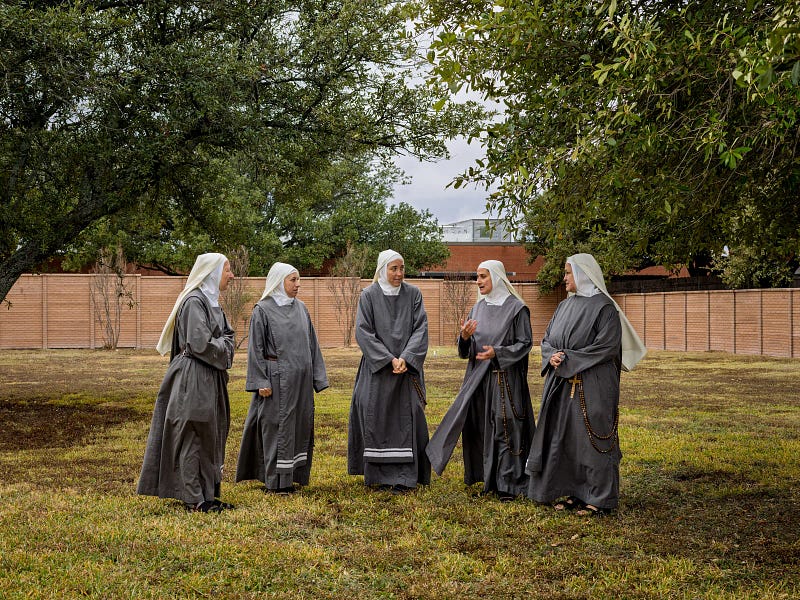
Today’s story idea: “The Nuns Trying to Save the Women on Texas’s Death Row.”
Gatesville, Texas, a prison town a hundred miles north of Austin, has six correctional facilities, five of them housing female inmates. On the widely spaced campuses, each surrounded by towering chain-link fences topped with razor wire, women in white uniforms can be seen mowing grass. In the spring, nearby pastures fill with wildflowers unseen by the inmates. On a nice day, you might hear the guards taking target practice.
The Patrick L. O’Daniel Unit is a single-story red brick complex set on a hundred acres. It used to be called Mountain View, for the modest green hills on the horizon. In the fall of 2014, Ronnie Lastovica, a Catholic deacon, assisted in a Mass for the prison’s general population. Afterward, an officer told him, “There’s an offender on death row who would like to take Communion.”
The officer led Ronnie to a building that contains an area where suicidal or mentally ill inmates are kept under observation. There are also two wings housing all the condemned women of Texas.
A prisoner named Linda Carty, wearing a white tunic and baggy trousers, was brought into a bleak white common room with four round tables and chairs, all bolted to the floor. Her gray-streaked black hair was pulled back. It was like being in a black-and-white movie. She was fifty-six and had been on the row for twelve years.
Linda, who was convicted of stealing a baby and murdering the mother in the process, maintains her innocence. Like most people condemned in Texas, Linda is Black and poor. Born in the West Indies, Linda is a British national entitled to support from the British consulate; no attorney ever told her this, though. After her conviction, the British government, which opposes capital punishment, asked a Houston firm to pursue appeals. All failed.
After the Communion ritual, Ronnie and Linda spoke for about an hour. He began returning to see her weekly. Linda often told Ronnie about imminent breaks in her case — “I’m going home,” she’d say — but they never actually arrived. He didn’t argue with her, but he also didn’t encourage fantasies. “We have to be honest with our expectations of this place,” he told me. He wasn’t her lawyer. His assignment was to help her live until she had to die.
It was a turbulent time for the row: the state had recently executed Lisa Coleman, the sixth woman to be killed in Texas after the U.S. Supreme Court’s reinstatement of the death penalty, in 1976. In February, 2015, Linda mentioned that another woman wanted to meet with him. “Tell me about her,” Ronnie said. Melissa Lucio was housed in a wing reserved for “non-work-capable” inmates — women who broke rules or who had medical restrictions or safety concerns. The wing also offered an unofficial refuge for individuals who needed time alone, and provided a way to keep the peace in a group of violent offenders. Like Linda, Melissa was near the end of her legal journey. She’d been convicted of killing her two-year-old daughter, Mariah, one of her twelve children.
Initially, Ronnie wasn’t allowed to see Melissa in the common room, so he stood outside her cell. All the cells are six feet by fourteen feet — “about the size of a parking spot at H-E-B,” he said, naming a Texas grocery chain. Each cell has a barred window coated in a film that has yellowed over time, casting a dim golden glow.
The wire grate on Melissa’s barred door was so fine that only fingertips could touch through it. Her black hair was a helmet framing a full face, and her brown eyes reflected years of drug abuse. She appeared totally defeated. Melissa told Ronnie that she’d been sexually assaulted by various family members as a young child, and had married at sixteen. Her husband beat her, as did other men. Her life was impoverished and full of violence. She sought escape in cocaine. A psychological expert who examined her said that she met the criteria for P.T.S.D. and trauma-induced depression.
Over the next few years, the deacon’s ministry on death row expanded. “One became two, and two became three,” Ronnie recalled. The next woman to be included was Brittany Holberg. A former sex worker, she’d murdered an eighty-year-old man in Amarillo. She was followed by Darlie Routier, who was convicted of killing two of her children and then staging an attack on herself. Then came Kimberly Cargill; she had set a babysitter on fire. Finally, there was Erica Sheppard, who had assisted in the murder of a Houston woman while stealing her car. This was three decades ago, when Erica was nineteen. Each of the women had been sentenced to death, but until that day came they were condemned to live with one another. They didn’t know how to get along. “They were like feral cats,” Ronnie told me.
Do you remember the movie Dead Man Walking (1995).
Story summary: A nun, while comforting a convicted killer on death row, empathizes with both the killer and his victim’s families.
It’s a powerful film. When I read this article, I thought it could be an interesting “similar but different” story. The fact that it’s nuns working with females is intriguing. It also offers an opportunity to explore the state of prisons in this country, socioeconomic impacts on people living near or below the poverty line, and put a human face on female prisoners.
There’s also the inner workings of the nunnery. Perhaps the Protagonist is a new initiate and she’s the one who presses the other nuns to become involved in prison ministry. Or they already have an established ministry and the newest member struggles to overcome her biases.
Both prison and religious subcultures. Interesting areas to explore.
There’s my 23rd story idea this month.
Previous articles in this year’s series:
Day 1
Day 2
Day 3
Day 4
Day 5
Day 6
Day 7
Day 8
Day 9
Day 10
Day 11
Day 12
Day 13
Day 14
Day 15
Day 16
Day 17
Day 18
Day 19
Day 20
Day 21
Day 22
Here are links to previous series:
A Story Idea Each Day for a Month (2017)
A Story Idea Each Day for a Month (2018)
A Story Idea Each Day for a Month (2019)
A Story Idea Each Day for a Month (2020)
A Story Idea Each Day for a Month (2021)
A Story Idea Each Day for a Month (2022)
A Story Idea Each Day for a Month (2023)
A Story Idea Each Day for a Month (2024)
Note: The articles from 2010–2016 have corrupted URLs. I am in the process of cleaning those up.
Each day in April, I invite you to join me in comments to do some brainstorming. Take each day’s story idea and see what it can become when we play around with it. These are valuable skills for a writer to develop.
See you in RESPONSES to hear YOUR take on this story idea. And come back tomorrow for another Story Idea Each Day For A Month.