A Story Idea Each Day for a Month — Day 21
This is the 13th year in a row I’ve run this series in April. Why a story idea each day for the month? Because the best way to come up…
This is the 13th year in a row I’ve run this series in April. Why a story idea each day for the month? Because the best way to come up with a great story idea is to come up with a lot of ideas. And the best way to come up with a lot of ideas is to be proactive in sourcing story ideas.
Today’s story: The Myth of the Megalith.
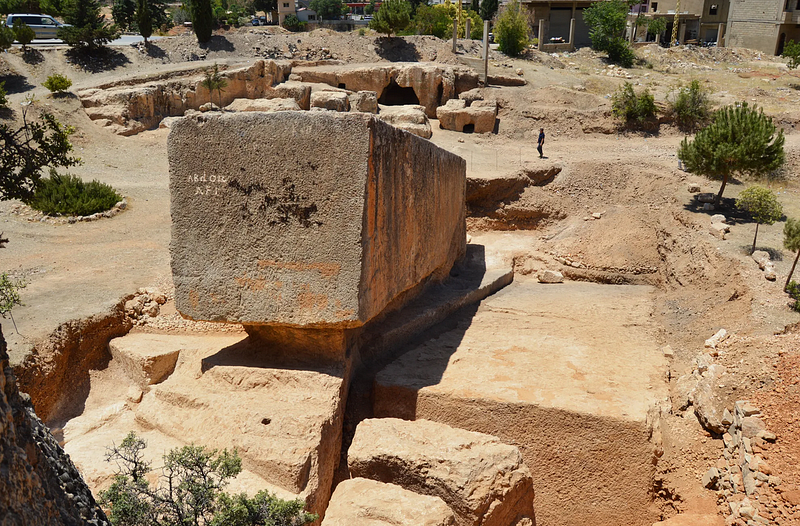
Baalbek, Lebanon, is the site of one of the most mysterious ruins of the Roman Empire, a monumental two-thousand-year-old temple to Jupiter that sits atop three thousand-ton stone blocks. (The pillars of Stonehenge weigh about a fortieth of that.) The blocks originated in a nearby limestone quarry, where a team from the German Archaeological Institute, in partnership with Jeanine Abdul Massih, of Lebanese University, recently discovered what they are calling the largest stone block from antiquity, weighing one thousand six hundred and fifty tons and matching those that support the temple. Its provenance is more shadowy than one might expect of a three-million-pound megalith. Nobody seems to know on whose orders it was cut, or why, or how it came to be abandoned.
Baalbek is named for Baal, the Phoenician deity, although the Romans knew the site by its Greek name, Heliopolis. The historian Dell Upton has noted the unusual lack of documentation regarding who might have commissioned, paid for, or designed the temple. For Upton, the site is a metaphor for the role of imaginative distortion in architectural history. In the absence of concrete information, he writes, Baalbek has become “a very accommodating screen upon which to project strikingly varied stories.” There are many local legends about the origin of the temple: Cain built it to hide from the wrath of God; giants built it, at Nimrod’s command, and it came to be called the Tower of Babel; Solomon built it, with djinns’ assistance, as a palace for the Queen of Sheba. (It is said that the reason some blocks were left in the quarry is that the djinns went on strike.)
Testimony to Baalbek’s flummoxing properties can be found in the 1860 diary of the Scottish traveller David Urquhart, whose mental capacities were “paralyzed” by “the impossibility of any solution.” Urquhart devotes several pages to the “riddles” posed by the giant stones — “so enormous, as to shut out every other thought, and yet to fill the mind only with trouble.” What, for example, was the point of cutting such enormous rocks? And why do it out there in the middle of nowhere, instead of in a capital or a port? Why were there no other sites that looked like Baalbek? And why had the work been abandoned midway? Urquhart concludes that the temple must have been built by contemporaries of Noah, using the same technological prowess that enabled the construction of the ark. Work was halted because of the flood, which swept away all the similar sites, leaving the enigma of Baalbek alone on the face of the earth.
Scholars today like to laugh at Urquhart, particularly at his alleged belief that mastodons transported the stones. (I didn’t see any reference to mastodons in his diary.) But archaeologists are still trying to solve the riddles that he posed. Margarete van Ess, a professor from the German Archaeological Institute, told me that the purpose of the investigation that turned up the new stone block was precisely to ascertain how the three temple blocks were transported, and why two others like them were left in the quarry. (One of these previously discovered megaliths, known as the Hajjar al-Hibla, or Stone of the Pregnant Woman, turned out to have a crack that would have impeded its transport.)
Van Ess added that the blocks were probably cut in much the same way as the masonry used in the Pont du Gard, a Roman aqueduct in southern France, with each piece split from a larger expanse of limestone along natural fissures between the rock strata. Too heavy to lift, the blocks would then have been dragged from the quarry, probably using a capstan, a kind of human-driven winch — though the possibility of a sledge is also under discussion.
Nothing puzzles archaeologists so much as impracticality, and although the karst topography of Baalbek demands strong foundation stones, and although one big stone is easier to move than many smaller stones, the pillars holding up the temple’s podium, van Ess says, are bigger than they need to be. In fact, Baalbek is one of a series of ancient projects that are under rigorous study by the Germans for being unnecessarily large. Van Ess and her colleagues are currently working to determine “the border between a ‘normal’ but expensive project” — a palace, for example — and a “giant one.”
I decided not to ask van Ess about an alternative theory that was proposed by the late author Zechariah Sitchin: that the podium at Baalbek had to be big enough to serve as an intergalactic landing pad, as documented in the Epic of Gilgamesh. I have found that archaeologists are seldom receptive to the notion of ancient astronauts — although one could argue that, when the archaeologists went looking for answers, all they managed to find was an even bigger and more mysterious stone block.
It doesn’t take much imagination to envision an interstellar alien story, the site not a temple to ancient Roman or Greek gods, but some sort of “landing pad” or even better — burial ground — for some neighbors from another planet. And it’s not a stretch to run with the idea that as humans mess with the site, that draws the aliens to Earth — or in the case of a cemetery — raise them from the dead (or sleeping state).
What does interest me is to play around with what’s going on with the humans in this scenario. Here, my mind goes to one of the most memorable science fiction movies from my youth: The Day the Earth Stood Still (1951).
Plot summary: An alien lands in Washington, D.C. and tells the people of Earth that they must live peacefully or be destroyed as a danger to other planets.
As compelling as this movie is, there are two narrative elements which can be exploited even more:
- The alien threat of destruction
- The behavior of humans which is decidedly un-peaceful
Which leads me to the setup: There is this mysterious temple featuring several megalith, most prominently a vertical column which is the largest one in the world. Gargantuan and utterly impossible to imagine how (A) humans transported the huge stone block to the site it occupies and (B) how these same humans managed to position it so that it stands vertically.
That is, of course, if the “temple” was created by mere mortals!
If the location of this famous archeological site is smack dab in the middle of the Middle East, home to the so-called decades long “Arab-Israeli” conflict, for purposes of our story, we have a visual way of activating this narrative element: humans at war with each other.
Now what if in the middle of the most recent militaristic events, the Really Really REALLY Big Monolith, the vertical one, gets destroyed by artillery fire. It has survived for centuries … until today. With its destruction, the tomb of “sleeping” aliens is broken open enabling the imprisoned creatures to escape.
And oh yeah. These aliens were put there because they are violent criminals, sent far far away from their home planet and buried on this speck of dust we call Earth to keep these Bad Guys away from the good folks back home.
This brings us to the second narrative element: threat of destruction. These aliens are not only Bad Guys, they are royally pissed off at having been entombed for centuries. They see Earth as not only a great opportunity to establish their own kingdom, but also to mete vengeance on anyone standing in their way.
Which happens. Like Gort, the doomsday robot in The Day the Earth Stood Still, the aliens possess a seemingly unstoppable destructive capability.
Now Arabs and Israelis, indeed, the entirety of the Earth’s nations must stand together and fight back against the alien hordes or else perish. Amidst the geopolitical storylines, there is the spunky archeologist (Cailee) who has devoted her life to cracking the mystery of this mysterious megalithic site.

While all this fighting on the surface of planet goes on, Cailee descends into the now uncovered catacombs of the alien “prison” site. And it’s there she discovers the secret to defeating the aliens…
But I’ll let you figure out that part!
That’s my 21st story in this month’s series. What would YOU do with this setup? Other stories in this year’s A Story Idea Each Day for a Month:
Day 1
Day 2
Day 3
Day 4
Day 5
Day 6
Day 7
Day 8
Day 9
Day 10
Day 11
Day 12
Day 13
Day 14
Day 15
Day 16
Day 17
Day 18
Day 19
Day 20
Each day in April, I invite you to join me in comments to do some brainstorming. Take each day’s story idea and see what it can become when we play around with it. These are valuable skills for a writer to develop.