A Story Idea Each Day for a Month — Day 20
This is the 15th year in a row I’ve run this series in April. Why a story idea each day for the month? Because the best way to come up…

This is the 15th year in a row I’ve run this series in April. Why a story idea each day for the month? Because the best way to come up with a great story idea is to come up with a lot of ideas. And the best way to come up with a lot of ideas is to be proactive in sourcing story ideas.
Today’s story: “Escape from the rabbit hole: the conspiracy theorist who abandoned his dangerous beliefs.”
For 15 years, Brent Lee spent hours each day consuming ‘truther’ content online. Then he logged off. Can he convince his former friends to question their worldview?
Brent Lee struggles to explain why he used to believe that a cabal of evil satanic paedophiles was working to establish a new world order. He pauses, looks sheepish, and says: “I cringe at all this now.”
For 15 years, Lee collected signs that so-called Illuminati overlords were controlling global events. He convinced himself that secret societies were running politics, banks, religious institutions and the entertainment industry, and that most terrorist attacks were actually government-organised ritual sacrifices.
He was also inclined to believe in UFOs, and that Stanley Kubrick staged and directed the filming of the moon landing. He saw satanic symbols in the London 2012 Olympics opening ceremony and spent most of his time discussing these theories with an online community of fellow believers. But in 2018 something shifted, and he began to find the new wave of conspiracy theories increasingly implausible. “I was sick of it. I felt, I can’t deal with hearing this any more because it’s no longer what I believe, so I just logged off the internet,” he says.
Now Lee is trying to help other conspiracy theorists to question their worldview. He will address a conference in Poland on disinformation in October, and has launched a podcast unpicking why he held these beliefs so fervently and why he was so deluded.
Amiable and articulate, Lee is disarmingly willing to admit that he got things spectacularly wrong, but it is still challenging to have a conversation with him about his abandoned belief system. Most of the theories seem so preposterous that the process of trying to understand them becomes exhausting. When I strain to follow the logic, he says: “Don’t try to get me to make it make sense because it doesn’t. This is why I get so embarrassed about what I believed. You just buy into this ideology and think that’s the way the world works.”
This subject is timely: a character or characters caught up in conspiracy theories. How to approach this as a movie:
- An individual’s slide into a conspiracy cult
- An individual who attempts to escape from the clutches of a conspiracy cult
- An FBI agent who goes undercover to learn about a violent conspiracy cult
- A conspiracy cult takes over a small town
I’m too busy today to give this more thought, but I’m sure we’ll be seeing movies or TV series in this arena.
There you go. My 19th story this month. Free for you to take and write.
Previous articles in this year’s series:
Day 1
Day 2
Day 3
Day 4
Day 5
Day 6
Day 7
Day 8
Day 9
Day 10
Day 11
Day 12
Day 13
Day 14
Day 15
Day 16
Day 17
Day 18
Day 19
Each day in April, I invite you to join me in comments to do some brainstorming. Take each day’s story idea and see what it can become when we play around with it. These are valuable skills for a writer to develop.
See you in RESPONSES to hear YOUR take on this story idea.
Let’s say you’ve found a story concept from an article in this series. Or you have an idea of your own, but you’re at the very beginning of the story-crafting process.
How to develop, then write it as a screenplay?
May I humbly recommend my book The Protagonist’s Journey: An Introduction to Character-Driven Screenwriting and Storytelling.
Hundreds of people have sent photos of my book. Here’s one.
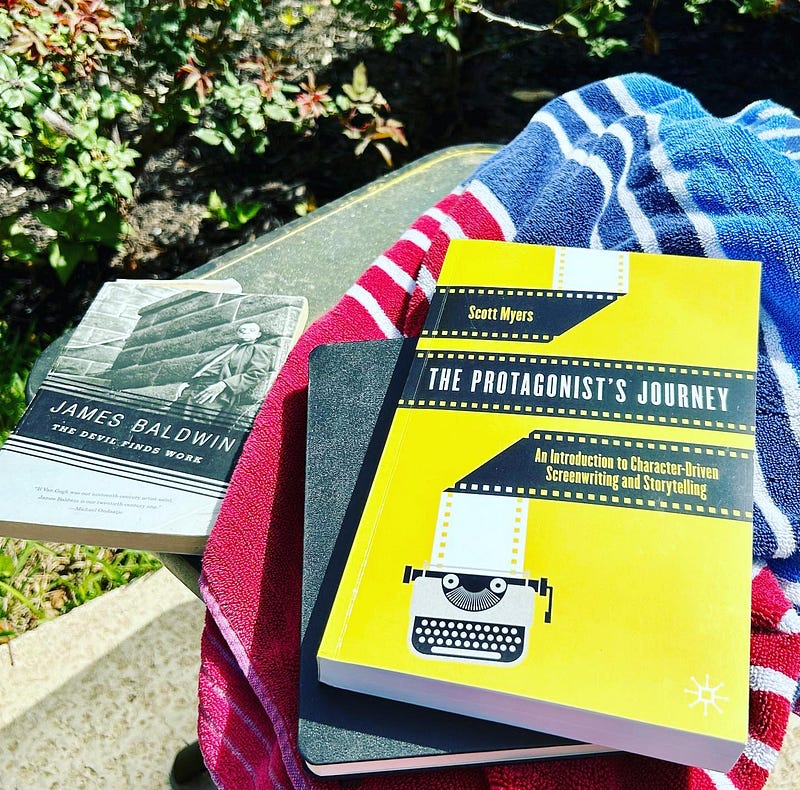
The book is structured to provide writers an approach to the story-crafting process grounded in immersing oneself in the lives of the characters (Parts I and II). Then Part III presents a stage by stage approach to break story: from concept to outline.
Go here to read endorsements from dozens of professional screenwriters, authors, and academics.
You may purchase The Protagonist’s Journey here:
Come back tomorrow for another Story Idea Each Day For A Month.