A Story Idea Each Day for a Month — Day 19
This is the 13th year in a row I’ve run this series in April. Why a story idea each day for the month? Because the best way to come up…
This is the 13th year in a row I’ve run this series in April. Why a story idea each day for the month? Because the best way to come up with a great story idea is to come up with a lot of ideas. And the best way to come up with a lot of ideas is to be proactive in sourcing story ideas.
Today’s story: Scientists Create Early Embryos That Are Part Human, Part Monkey.
For the first time, scientists have created embryos that are a mix of human and monkey cells.
The embryos, described Thursday in the journal Cell, were created in part to try to find new ways to produce organs for people who need transplants, said the international team of scientists who collaborated in the work. But the research raises a variety of concerns.
“My first question is: Why?” said Kirstin Matthews, a fellow for science and technology at Rice University’s Baker Institute. “I think the public is going to be concerned, and I am as well, that we’re just kind of pushing forward with science without having a proper conversation about what we should or should not do.”
Still, the scientists who conducted the research, and some other bioethicists defended the experiment.
“This is one of the major problems in medicine — organ transplantation,” said Juan Carlos Izpisua Belmonte, a professor in the Gene Expression Laboratory of the Salk Institute for Biological Sciences in La Jolla, Calif., and a co-author of the Cell study. “The demand for that is much higher than the supply.”
“I don’t see this type of research being ethically problematic,” said Insoo Hyun, a bioethicist at Case Western Reserve University and Harvard University. “It’s aimed at lofty humanitarian goals.”
Thousands of people die every year in the United States waiting for an organ transplant, Hyun noted. So, in recent years, some researchers in the U.S. and beyond have been injecting human stem cells into sheep and pig embryos to see if they might eventually grow human organs in such animals for transplantation.
But so far, that approach hasn’t worked. So Belmonte teamed up with scientists in China and elsewhere to try something different. The researchers injected 25 cells known as induced pluripotent stem cells from humans — commonly called iPS cells — into embryos from macaque monkeys, which are much more closely genetically related to humans than are sheep and pigs.
After one day, the researchers reported, they were able to detect human cells growing in 132 of the embryos and were able study the embryos for up to 19 days. That enabled the scientists to learn more about how animal cells and human cells communicate, an important step toward eventually helping researchers find new ways to grow organs for transplantation in other animals, Belmonte said.
“This knowledge will allow us to go back now and try to re-engineer these pathways that are successful for allowing appropriate development of human cells in these other animals,” Belmonte told NPR. “We are very, very excited.”
Such mixed-species embryos are known as chimeras, named for the fire-breathing creature from Greek mythology that is part lion, part goat and part snake.
“Our goal is not to generate any new organism, any monster,” Belmonte said. “And we are not doing anything like that. We are trying to understand how cells from different organisms communicate with one another.”
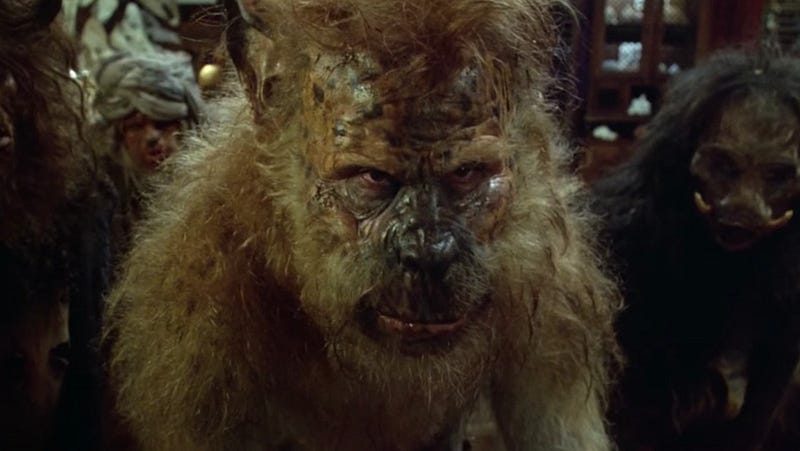
Oh, sure, that’s not science’s intention, but then you end up with something like this:
This is another story conceit which lends itself to several different genres:
Horror: It’s the Ape-Man from Hell!
Thriller: It’s the Ape-Man from Hell, only it’s more psychological terror.
Drama: It’s the misunderstood Ape-Man.
Comedy: It’s the Ape-Man who is the 2nd cousin of Teen Wolf.
Family: It’s the Ape-Man who befriends a bunch of kids.
No matter the genre, you pretty much figure the science establishment is going to be the Nemesis, although there’s likely one or two of them who see the Ape-Man more as a You than as an It.
As an aside, whenever I see stories about scientists engaging in head-shaking activities such as this, I’m reminded of the old joke.
Why does a dog lick its genitals? Because it can.
That’s pretty much science. Why do they engage in crazy experiments? Because they can.
That’s my 19th story in this month’s series. What would YOU do with this setup? Other stories in this year’s A Story Idea Each Day for a Month:
Day 1
Day 2
Day 3
Day 4
Day 5
Day 6
Day 7
Day 8
Day 9
Day 10
Day 11
Day 12
Day 13
Day 14
Day 15
Day 16
Day 17
Day 18
Each day in April, I invite you to join me in comments to do some brainstorming. Take each day’s story idea and see what it can become when we play around with it. These are valuable skills for a writer to develop.