A Story Idea Each Day for a Month — Day 17
This is the 15th year in a row I’ve run this series in April.
This is the 15th year in a row I’ve run this series in April.
Today’s story idea: “The Man Who Couldn’t Stop Going to College.”
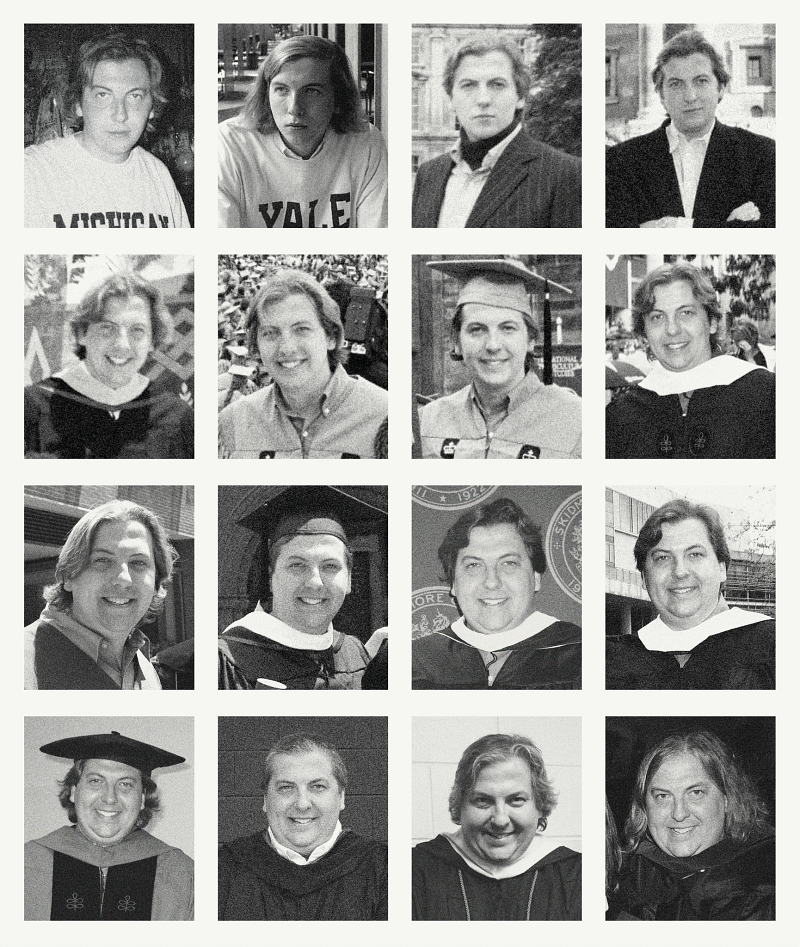
Benjamin B. Bolger has been to Harvard and Stanford and Yale. He has been to Columbia and Dartmouth and Oxford, and Cambridge, Brandeis and Brown. Over all, Bolger has 14 advanced degrees, plus an associate’s and a bachelor’s. Some of Bolger’s degrees took many years to complete, such as a doctorate from the Harvard Graduate School of Design. Others have required rather less commitment: low-residency M.F.A.s from Ashland University and the University of Tampa, for example.
Some produced microscopically specific research, like Bolger’s Harvard dissertation, “Deliberative Democratic Design: Participants’ Perception of Strategy Used for Deliberative Public Participation and the Types of Participant Satisfaction Generated From Deliberative Public Participation in the Design Process.” Others have been more of a grab bag, such as a 2004 master’s from Dartmouth, for which Bolger studied Iranian sociology and the poetry of Robert Frost.
He has degrees in international development, creative nonfiction and education. He has studied “conflict and coexistence” under Mari Fitzduff, the Irish policymaker who mediated during the Troubles, and American architecture under the eminent historian Gwendolyn Wright. He is currently working, remotely, toward a master’s in writing for performance from Cambridge.
Bolger is a broad man, with lank, whitish, chin-length hair and a dignified profile, like a figure from an antique coin. One of his favorite places is Walden Pond — he met his wife there, on one of his early-morning constitutionals — and as he expounds upon learning and nature, it is easy to imagine him back in Thoreau’s time, with all the other polymathic gentlemen, perhaps by lamplight, stroking their old-timey facial hair, considering propositions about a wide range of topics, advancing theories of the life well lived.
And there’s something almost anachronistically earnest, even romantic, about the reason he gives for spending the past 30-odd years pursuing college degrees. “I love learning,” he told me over lunch last year, without even a touch of irony. I had been pestering him for the better part of two days, from every angle I could imagine, to offer some deeper explanation for his life as a perpetual student. Every time I tried, and failed, I felt irredeemably 21st-century, like an extra in a historical production who has forgotten to remove his Apple Watch.
The obvious story is about a character who refuses to leave the safety and security of a university environment. Instead of “I love learning,” the rationale that Bolger (the featured individual in the NYT article), what could be at the core of our Protagonist’s obsession with higher education is something he cannot admit at first: He’s afraid of the real world.
Actually, what if we switched genders? What if the Protagonist is a woman (imagine Cate Blanchett)?
Again, the obvious angle would be to introduce a college freshman who falls under the sway of Cate. Actually, we could switch narrative roles: The first-year student is the Protagonist and Cate is the story’s Central Character. A similar relationship to that in the movie Zorba the Greek where Basil (Alan Bates) follows Zorba (Anthony Quinn) who he comes to think of as a Mentor, but actually is the story’s Trickster.
Is the Freshman a boy … or girl? What type of student might Cate seek that first week of the school year? To mentor. To provide an audience for Cate’s voluminous learning.
The article offers the possibility of another story: Cate as parent to her nine-year-old daughter Caitlyn. Raising Caitlyn as she (Cate) was raised, will Caitlyn rebel against the same path Cate followed from one graduate degree after another.
Two possible stories. Two possible Protagonists. Your choice.
There’s my 17th story idea this month.
Previous articles in this year’s series:
Day 1
Day 2
Day 3
Day 4
Day 5
Day 6
Day 7
Day 8
Day 9
Day 10
Day 11
Day 12
Day 13
Day 14
Day 15
Day 16
Here are links to previous series:
A Story Idea Each Day for a Month (2017)
A Story Idea Each Day for a Month (2018)
A Story Idea Each Day for a Month (2019)
A Story Idea Each Day for a Month (2020)
A Story Idea Each Day for a Month (2021)
A Story Idea Each Day for a Month (2022)
A Story Idea Each Day for a Month (2023)
A Story Idea Each Day for a Month (2024)
Note: The articles from 2010–2016 have corrupted URLs. I am in the process of cleaning those up.
Each day in April, I invite you to join me in comments to do some brainstorming. Take each day’s story idea and see what it can become when we play around with it. These are valuable skills for a writer to develop.
See you in RESPONSES to hear YOUR take on this story idea. And come back tomorrow for another Story Idea Each Day For A Month.