A Story Idea Each Day for a Month — Day 16
This is the 15th year in a row I’ve run this series in April. Why a story idea each day for the month? Because the best way to come up with…

This is the 15th year in a row I’ve run this series in April. Why a story idea each day for the month? Because the best way to come up with a great story idea is to come up with a lot of ideas. And the best way to come up with a lot of ideas is to be proactive in sourcing story ideas.
Today’s story: “Cats Filled the Prison. Then the Inmates Fell in Love.”
Some say they were first brought in to take out the rats. Others contend they wandered in on their own.
What everyone can agree on — including those who have lived or worked at Chile’s largest prison the longest — is that the cats were here first.
For decades, they have walked along the prison’s high walls, sunbathed on the metal roof and skittered between cells crowded with 10 men each. To prison officials, they were a peculiarity of sorts, and mostly ignored. The cats kept multiplying into the hundreds.
Then prison officials realized something else: The feline residents were not only good for the rat problem. They were also good for the inmates.
“They’re our companions,” said Carlos Nuñez, a balding prisoner showing off a 2-year-old tabby he named Feita, or Ugly, from behind prison bars. While caring for multiple cats during his 14-year sentence for home burglary, he said he discovered their special essence, compared with, say, a cellmate or even a dog.
“A cat makes you worry about it, feed it, take care of it, give it special attention,” he said. “When we were outside and free, we never did this. We discovered it in here.”
Known simply as “the Pen,” the 180-year-old main penitentiary in Santiago, Chile’s capital, has long been known as a place where men live in cages and cats roam free. What is now more clearly understood is the positive effect of the prison’s roughly 300 cats on the 5,600 human residents.
The felines’ presence “has changed the inmates’ mood, has regulated their behavior and has strengthened their sense of responsibility with their duties, especially caring for animals,” said the prison’s warden, Col. Helen Leal González, who has two cats of her own at home, Reina and Dante, and a collection of cat figurines on her desk.
“Prisons are hostile places,” she added in her office, wearing a tight bun, billy club and combat boots. “So of course, when you see there’s an animal giving affection and generating these positive feelings, it logically causes a change in behavior, a change in mindset.”
Here’s a take on this story concept. We meet our Protagonist (Lola) on her first day in prison. She’s hard core, a loner, and filled with a roiling rage.
It’s a tough transition and she’s not making it any easier on herself when she gets in a fight, which results in her being sent to solitary confinement.
That’s when Sundance enters her life.
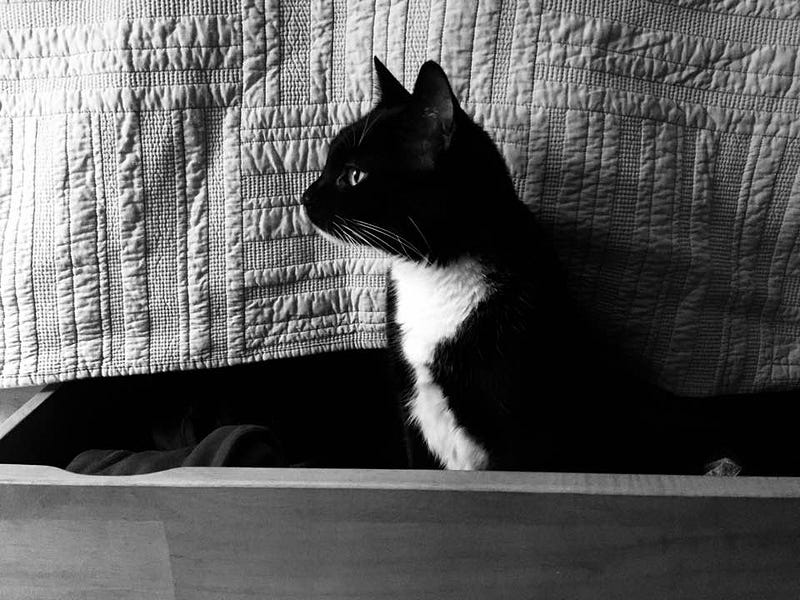
The cat somehow sneaks into the solitary confinement cell. Over the course of a few days, Lola and Sundance play a kind of “cat and mouse” game to test each other. By the end of Lola’s two-week stint in the “hole,” she has bonded with the cat.
The movie plays out with Lola more and more taking a role in the lives of the cat population in the prison. This piece in the New York Times article caught my attention:
Yet there was a time when the relationship was not so positive. A decade ago, the cat population was expanding uncontrolled and many cats were getting sick, including developing a contagious infection that left some cats blind. The situation “even stressed out the inmates themselves,” said Carla Contreras Sandoval, a prison social worker with two cat tattoos.
So in 2016, prison officials finally allowed volunteers to come care for the cats. A Chilean organization called the Felinnos Foundation has since worked with Humane Society International to systematically collect all of the cats to treat, spay and neuter them. They have now reached nearly every one.
Imagine Lola becoming an advocate for the stray cat population in the prison. Nemesis? The warden who believes the only way to treat prisoners is to make their penitentiary existence a living hell. In the warden’s mind, that’s the best way to ensure these prisoners won’t repeat their crimes once they are released.
But with Lola working with the cat population, helping to connect individual cats with various prisoners, Lola succeeds in creating a more humane existence in the prison.
Then there is the Lola-Sundance relationship, where the cat helps to humanize the human.
It’s The Shawshank Redemption … with cats.
There you go. My 16th story this month. Free for you to take and write.
Previous articles in this year’s series:
Day 1
Day 2
Day 3
Day 4
Day 5
Day 6
Day 7
Day 8
Day 9
Day 10
Day 11
Day 12
Day 13
Day 14
Day 15
Each day in April, I invite you to join me in comments to do some brainstorming. Take each day’s story idea and see what it can become when we play around with it. These are valuable skills for a writer to develop.
See you in RESPONSES to hear YOUR take on this story idea.
Let’s say you’ve found a story concept from an article in this series. Or you have an idea of your own, but you’re at the very beginning of the story-crafting process.
How to develop, then write it as a screenplay?
May I humbly recommend my book The Protagonist’s Journey: An Introduction to Character-Driven Screenwriting and Storytelling.
Hundreds of people have sent photos of my book. Here’s one.

The book is structured to provide writers an approach to the story-crafting process grounded in immersing oneself in the lives of the characters (Parts I and II). Then Part III presents a stage by stage approach to break story: from concept to outline.
Go here to read endorsements from dozens of professional screenwriters, authors, and academics.
You may purchase The Protagonist’s Journey here:
Come back tomorrow for another Story Idea Each Day For A Month.