A Story Idea Each Day for a Month — Day 15
This is the 12th year in a row I’ve run this series in April. Why a story idea each day for the month? Several reasons which I’ll work my…

This is the 12th year in a row I’ve run this series in April. Why a story idea each day for the month? Several reasons which I’ll work my through during this series of posts.
Last week, I provided a daily explanation about why you should make it a habit to generate story ideas. This week, I’ll give you some tips on how to come up with stories.
Tip: Public domain.
Laws vary from country to country, but if a person, event, book is considered to be in the public domain, then from a writer’s perspective, it is free content, you don’t need to secure any rights.
You want to adapt “Romeo and Juliet” into a contemporary gang shoot-em-up love story, you can do that.
You want to turn Abraham Lincoln into a vampire hunter, you can do that.
Straight adaptation, genre bend, gender bend, whatever you want to do, you can do it with a public domain entity. Plus, the added benefit: Pre-awareness. Hollywood likes that. A lot. It’s a plus for their marketing department.
Today’s story: A Mysterious Suicide Cluster.
Young people in a Missouri college town kept killing themselves. A parent of one victim is convinced that her son’s friend encouraged the deaths. Has a sinister figure been exposed, or is it a case of misplaced blame?
In an eight-month period that started in August, 2016, three members of a fraternity and a young man who was close to some of its members killed themselves. Truman State put out a notice stating that students with complex mental-health issues should consider going somewhere with more resources, as they “may not find the expertise or availability of services they need at Truman or in the Kirksville community.” Melissa Bottorff-Arey, the mother of Alex Mullins, the first of the students to die by suicide, told me she read the notice to mean, “If you’re suicidal, basically don’t come to us — we can’t help.”
It is well established that if one person in a community kills himself acquaintances sometimes follow suit, often using the same method. When three or more such deaths occur in short order, it is usually considered a “cluster.” In Palo Alto, California, six teen-agers died by suicide between 2009 and 2010, followed by four more between 2014 and 2015; most of the deaths occurred on a stretch of train tracks in the city. In 2019, there were three student suicides at Rowan University, in New Jersey, in a single semester.
In the past two decades, the suicide rate in the United States has risen by some thirty-five per cent, and the problem is especially acute among the young. According to the Centers for Disease Control and Prevention, by 2018 suicide had become the second most common cause of death among Americans between the ages of ten and twenty-four, exceeded only by accidental death. Experts describe as precipitating factors everything from mounting economic pressures to the broadcasting of distress on social media. At the University of Pennsylvania, more than a dozen students have died by suicide since 2013, and in late 2019 the director of the school’s mental-health services jumped from the seventeenth floor of a building.
I first became aware of the concept of “suicide clusters” when during two separate spans of time in the 80s and 90s, dozens of students committed suicide or died of heroin overdoses in the well-to-do suburb of Plano, Texas.
How to explain this phenomenon? Perhaps this story lends itself more to a documentary / podcast series. If one were to fictionalize it, the horror genre seems like an obvious choice.
In the case of the suicides in at Truman State in Missouri, as detailed in the New Yorker article, suspicion was aroused about a young man who intersected with each of the victims. To the point where:
On July 31, 2019, Gorovsky, on behalf of Bottorff-Arey and Thomas’s parents, filed a civil suit alleging that Alpha Kappa Lambda and Truman State had been negligent in their sons’ deaths, in part because they had known that Grossheim posed a threat to other students yet had done nothing to stop him as he “aided or encouraged the deaths of multiple young people.”
What if the story is set in a college? Small liberal arts university. Rural Ohio. There are hundreds of such schools across the country. One suicide happens. Then another. The lead characters are a group of college friends and they notice something. Each victim was an acquaintance of a fellow student: Lilith Mastema, an international student from the Middle East.
Doing some research into Lilith, the friends discover she has a rather murky background. She transferred into the college mid-year. It’s unclear what class she is in. Undeclared major, although the courses she is currently taking are primarily religious studies and psychology.
There is nothing suspicious about Lilith’s behavior. Apart from English being a second language and some cultural issues, she seems to be well-liked and friendly. However, one of the group of friends (Cate) senses something is off about this young woman. A private exchange between the two in which Lilith’s demeanor shifts for a moment elevates Cate’s concerns, especially when Lilith stops Cate in mid-sentence, places a hand on Cate’s shoulder, fixes her eye-to-eye and says, “You will understand.” With that, Lilith twirls away.
With students at the university increasingly unsettled due to the deaths of two of their colleagues, Cate convinces her boyfriend (Jayden) to “befriend” Lilith. “You want me to hit on her,” he asks, incredulous. “Not exactly, but… you know,” she responds. Find out what he can about Lilith.
Which is what Jayden does. They even go out on a date. Cate gets a date night call from Jayden well after midnight. She answers. She hears Jayden’s voice: “Don’t.” “Don’t what,” she asks. “Just… don’t.” Click.
The next morning, Jayden is found dead, apparently having leaped off the school’s administration building.
Later, students gather at the site of Jayden’s death, creating a monument of flowers and memorabilia for the popular young man. Tears, confusion, and fear fill the air. Cate huddles with her friends. She feels guilty, somehow responsible for Jayden’s death.
Just then, Lilith appears. She glides through the crowd and kneels at the base of spontaneous altar honoring Jayden. Cate watches her intently. Sees Lilith’s lips moving. She is saying something, perhaps a prayer… or something else.
Lilith places an object with the other items. As she stands, she turns and for a moment, her eyes meet Cate’s. Is that a hint of a smile on Lilith’s lips? Lilith disappears into the crowd.
Cate moves to see the object Lilith left behind. It is some twigs shaped to form a cross… only it has been placed upside down.
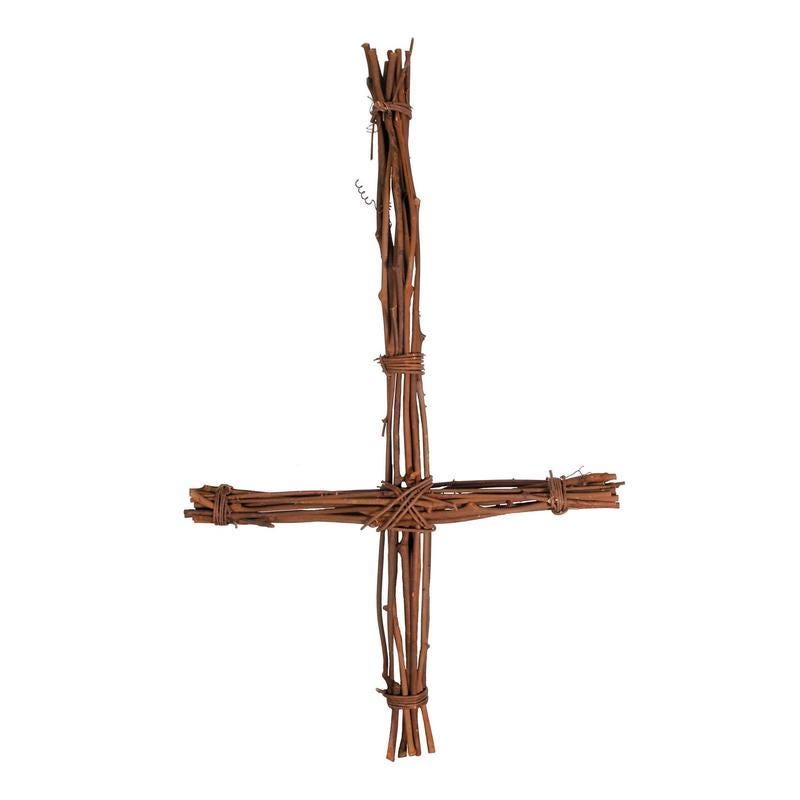
I would imagine Cate and her friends discover that Lilith has actually been a student at dozens of small colleges. That in itself is odd. What is really strange is they can trace her educational background all the way back into the 1930s… and each school had a suicide cluster.
There’s the setup for my 15th story idea of the month. And it’s yours. Free! What would YOU do with it?
Day 1
Day 2
Day 3
Day 4
Day 5
Day 6
Day 7
Day 8
Day 9
Day 10
Day 11
Day 12
Day 13
Day 14
Each day in April, I invite you to join me in comments to do some brainstorming. Take each day’s story idea and see what it can become when we play around with it. These are valuable skills for a writer to develop.
[Again: If you or anyone you know is having suicidal thoughts, contact https://suicidepreventionlifeline.org/.]