A Story Idea Each Day for a Month — Day 15
This is the 14th year in a row I’ve run this series in April. Why a story idea each day for the month? Several reasons which I’ll work my…
This is the 14th year in a row I’ve run this series in April. Why a story idea each day for the month? Several reasons which I’ll work my through during this series of posts.
Last week, I provided a daily explanation about why you should make it a habit to generate story ideas. This week, I’ll give you some tips on how to come up with stories.
Tip: Public domain.
Laws vary from country to country, but if a person, event, book is considered to be in the public domain, then from a writer’s perspective, it is free content, you don’t need to secure any rights.
You want to adapt “Romeo and Juliet” into a contemporary gang shoot-em-up love story, you can do that.
You want to turn Abraham Lincoln into a vampire hunter, you can do that.
Straight adaptation, genre bend, gender bend, whatever you want to do, you can do it with a public domain entity. Plus, the added benefit: Pre-awareness. Hollywood likes that. A lot. It’s a plus for their marketing department.
Today’s story: Could I Survive the ‘Quietest Place on Earth’?
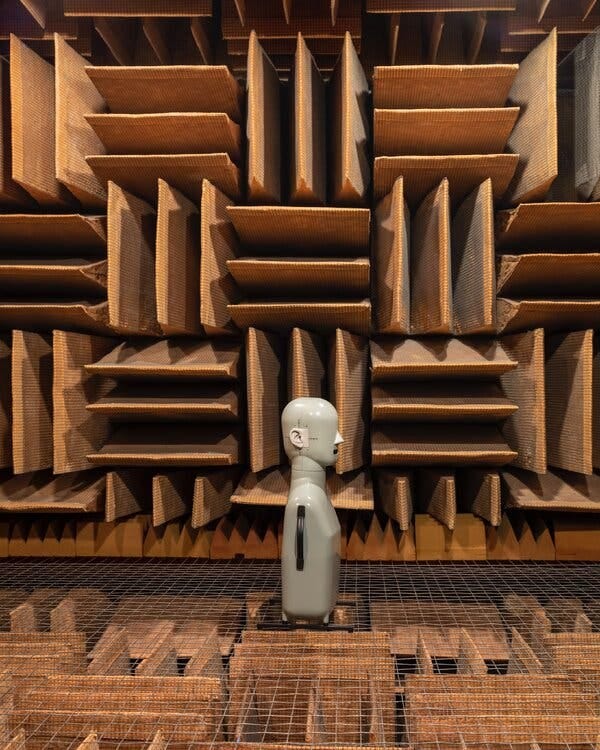
In a leafy Minneapolis neighborhood under a thick cloak of ivy stands a modest concrete building. Contained within the building is silence exceeding the bounds of human perception. This hush is preserved in a small room, expensively engineered to be echoless. Certain people find the promise of such quiet irresistible; it entices them, like a soundless siren call, to visit the building at great personal cost. The room of containment, technically an “anechoic chamber,” is the quietest place on the planet — according to some. According to others, it’s more like the second-quietest. It is quieter than any place most people will ever go, unless they make a point of going to multiple anechoic chambers over the course of a lifetime.
What happens to people inside the windowless steel room is the subject of wild and terrible speculation. Public fascination with the room exploded 10 years ago, with an article on The Daily Mail’s website. “The Longest Anyone Can Bear Earth’s Quietest Place is 45 Minutes,” The Mail declared. The story left readers to extrapolate their own conclusions about why this was so from the short, haunting observations of the room’s soft-spoken proprietor, Steven J. Orfield, of Orfield Laboratories.
“You’ll hear your heart beating,” Orfield was quoted as saying. And: “In the anechoic chamber, you become the sound.” The experience was so “disconcerting,” The Daily Mail reported, that no one had ever “survived” a visit of longer than 45 minutes. In the decade since, the legend has been propagated, and sometimes further embellished with details about room-induced hallucinations, in outlets from Smithsonian Magazine (the official journal of the Smithsonian Institution) to UberFacts (an online trivia font with 13.6 million Twitter followers, no connection to the ride-sharing app and a tenuous one to facts).
Earlier this year, members of the public began, apparently spontaneously, and via TikTok and YouTube, convincing one another that the room was created as an invitation to compete; that spending a few hours alone inside it entitled a person to a cash prize; that the value of this cash prize was up to $7 million; and that anyone could attempt to win it. Orfield Labs was bombarded with phone calls and emails from people demanding a shot at winning the money. There was no contest. But the mystique of the too-quiet room, if construed by outsiders, has perhaps been bolstered by the company’s website, which advertises an experience called “The Orfield Challenge,” whereby, for $600 an hour, a person can attempt to set a new “record” for time spent in the chamber.
A person inside an anechoic chamber will not hear nothing. The human body is in constant motion — inhaling and expelling air, settling limbs into new positions, pumping blood — and so, constantly creating sounds (although usually we cannot hear them). Environments we think of as ultraquiet are typically quite a bit louder than the floor of the human hearing threshold, which is around zero decibels; a library reading room, for instance, might clock in at 40 decibels. An anechoic chamber does not sharpen hearing; it removes the noise that otherwise drowns out the soft, ceaseless sounds of a body, enabling them to be perceived with novel clarity. The body is only totally still — totally silent — in death.
Here’s a psychological thriller in waiting. A woman (Robin) wakes up to find herself in darkness. Apparently, she has been drugged and brought somewhere she does not know.
A mysterious voice: Fate has brought you to this place.
A bit of exposition which titillates the audience. Then it’s time to be ushered into…
The Quiet Room.
Strapped to a chair, Robin finds herself motored out of the darkness into a room (see photo above). The door slams shut behind her … and whatever noise she heard before is gone.
This is the quietest room in the world.
With absolutely no external noise, Robin can hear her heart beat … the blood slosh through her body … her breathing.
The noises conjure up the memories of one frightening experience from her past … to the next … to the next.
We see them as she remembers them.
Each builds off the other to tell a story about how Robin was involved in a crime of innocence that led to the death of…
I’ll leave it there. Silence as torture and ultimately … revenge.
There you go, my 15th story idea of the month. And it’s yours. Free! What would YOU do with it?
Day 1
Day 2
Day 3
Day 4
Day 5
Day 6
Day 7
Day 8
Day 9
Day 10
Day 11
Day 12
Day 13
Day 14
Each day in April, I invite you to join me in comments to do some brainstorming. Take each day’s story idea and see what it can become when we play around with it. These are valuable skills for a writer to develop.
See you in RESPONSES to hear YOUR take on this story idea. And come back tomorrow for another Story Idea Each Day For A Month.