A Story Idea Each Day for a Month — Day 14
This is the 15th year in a row I’ve run this series in April. Why a story idea each day for the month? Several reasons which I’ll work my…

This is the 15th year in a row I’ve run this series in April. Why a story idea each day for the month? Several reasons which I’ll work my through during this series of posts.
Tip: Go random.
This is going to sound really stupid. Well, it is really stupid. But all it takes is one time to pay off, then it becomes clever because as we know, there’s a fine line between clever and stupid.
Anyway, the very first screenwriting class I taught over 20 years ago was at UCLA. One night, I took two caps and some 3x5 inch index cards. I handed out 10 cards to each student, then instructed them on 5 cards to write a job [e.g., plumber, lawyer, dog catcher] and on the other 5 cards to write a location [e.g., shopping mall, swimming pool, church]. I collected the cards, jobs in one hat, locations in the other.
Then we went around the room, each student pulling a card from each hat, an exercise in generating totally random story conceits.
Someone pulls out “Doctor” and “Cruise Ship.” Nothing much there.
Then another person pulls out “Jockey” and “Restaurant.” Again nothing.
Then someone pulls outs “Cop” and “Kindergarten.”
I. Kid. You. Not. “Kindergarten Cop,” totally random, right there in that Westwood classroom. Okay, so the moment of inspiration was twelve years after the movie, but still it proved — sorta — that sometimes totally random, stupid ideas have the potential to generate story concepts… and even be a little clever.
Today’s story: “A Jewish family, a famous European museum and the battle for a Nazi-looted masterpiece.”
It was early 1939 and the window for Jews like Lilly Cassirer Neubauer to escape was rapidly closing. The Nazis had been tightening their grip on Germany, ransacking synagogues and Jewish homes and schools. Death camps would follow soon.
In desperation, she surrendered an exquisite impressionist painting in her family’s art collection for a visa to flee Germany at the dawn of World War II.
Six decades later, Lilly’s grandson in San Diego made a shocking discovery: the painting had resurfaced in Europe, tied to the scion of a German industrialist family that helped finance Adolf Hitler’s rise to power.
Today, Lilly’s great-grandson David Cassirer awaits a decisive ruling in the family’s long legal battle to reclaim the painting, now in a Spanish museum. The work by Camille Pissarro is estimated to be worth tens of millions of dollars.
The fight isn’t only about money, but family legacy and a conflict between law and morality.
From the early 1930s until the war’s end in 1945, the Nazis stole an estimated 650,000 paintings and other artworks. Many have never been found, while legal battles for others rage on. Each family’s case is different, but a decisive legal victory for one often benefits many, and Jewish families, restitution experts and attorneys the world over have been watching the Cassirer case closely for decades.
That is a shocking figure: 650,000 stolen paintings. The story cited in this article offers one angle on a potential movie leading to a legal courthouse drama. But …
What if we went with an action genre take?
Lilly, 90 years old. A Holocaust survivor whose parents and siblings all died in German concentration camps.
The single memory she has before her family was hauled away in the trains: a painting. It was the family’s prized possession and hung in a place of honor in their apartment living room.
As a child, Lilly would like on the floor, peering up at the painting, an impressionist vision of a magical world far away: Paris. She memorized every detail of that painting. Indeed, it was that memory which sustained her during her time in the concentration camp.
Now she is approaching death. In her later years, she has spent a good portion of her accumulated wealth to track down the whereabouts of her family’s painting, stolen by the Nazis.
And now … private investigators have determined who owns the painting. A multi-billionaire family who, as it turns out, are financing the rise of the Neo-Nazi movement in Europe and the United States.
Meet Ursula. A trained assassin. Killer for hire. Lone wolf. She meets Lilly. “I don’t find art. My art is murder.”
To get access to the painting will likely require several … “dispatches” … and so, Ursula agrees. Partly due to the money. Mostly due to the injustice of it all (she has her own background which is revealed over time).
Then there are the Bad Guys. If you write this story, make them really … really … bad.
There you go. My 14th story setup this month.
Previous articles in this year’s series:
Day 1
Day 2
Day 3
Day 4
Day 5
Day 6
Day 7
Day 8
Day 9
Day 10
Day 11
Day 12
Day 13
Each day in April, I invite you to join me in comments to do some brainstorming. Take each day’s story idea and see what it can become when we play around with it. These are valuable skills for a writer to develop.
See you in RESPONSES to hear YOUR take on this story idea.
Let’s say you’ve found a story concept from an article in this series. Or you have an idea of your own, but you’re at the very beginning of the story-crafting process.
How to develop, then write it as a screenplay?
May I humbly recommend my book The Protagonist’s Journey: An Introduction to Character-Driven Screenwriting and Storytelling.
Hundreds of people have sent photos of my book. Here’s one.
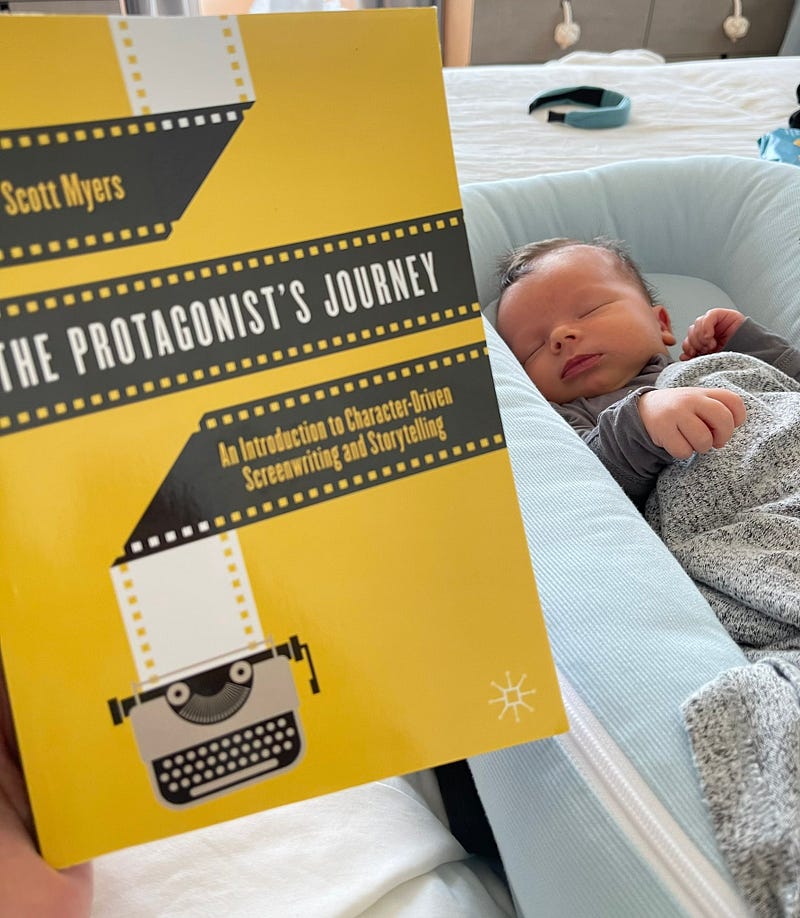
Never too young to get your child started learning character-driven storytelling!
The book is structured to provide writers an approach to the story-crafting process grounded in immersing oneself in the lives of the characters (Parts I and II). Then Part III presents a stage by stage approach to break story: from concept to outline.
Go here to read endorsements from dozens of professional screenwriters, authors, and academics.
You may purchase The Protagonist’s Journey here:
Come back tomorrow for another Story Idea Each Day For A Month.