A Matter of Survival: How the WGA Is Trying to Save Feature Screenwriters
John August and Writers Guild leaders weigh in about the exploitation of feature screenwriters and the contract proposals that would help…

John August and Writers Guild leaders weigh in about the exploitation of feature screenwriters and the contract proposals that would help them…and the whole film industry in the process.
One area of concern I have about the ongoing social media conversation about the WGA strike is a lack of focus on writers who work on movies. Yes, the current television system is broken and needs drastic repair. But so is the system facing screenwriters.
Cole Haddon, who has worked as a writer in both features and television, recently launched an excellent substack: 5AM StoryTalk. Recently, he wrote an excellent article which directly deals with issues confronting screenwriters. Cole begins the piece with a truly upsetting true story.
Will Appelbaum had three months left on his WGA health insurance plan when he delivered his feature screenplay to a studio that shall remain nameless here. His contract only guaranteed one step, known colloquially around Hollywood as a one-step deal, but what concerned him at present was getting his employer to pay him for the work he had already done. More was on the line for him than his business partners, agents, or lawyers understood that January. His life, to be precise.
Will told me his story over a phone conversation as he washed the evening dishes (which he apologized for multiple times, worried the sound of it was disturbing me).
The weeks passed with no response from the studio, and March 31st, the last day he could meet his union’s earning requirements to maintain his health insurance, inched closer and closer. He became increasingly nervous as they did.
Then, a call from his agent. This was in February, more than a month after he emailed his screenplay off to his studio executive. The studio had notes, which isn’t unusual. Nor was their request, frustratingly. They wanted a free pass on the script before they would officially accept delivery.
In other words, the studio wouldn’t pay up until Will executed their notes.
The Writers Guild of America has rules that ensure this never happens, but, of course, all screenwriters know studios, streamers — anyone with deep pockets — are the ones who really dictate the terms. Your representatives will almost always pressure you into doing this free work — “It’s just the way it is, everyone does it,” they say — and is the price we all must pay to “make it” in Hollywood.
Will explained to me that there was no choice but to do whatever he was told. The studio knew how worried he was about losing his health care, so they used that as leverage.
But even after that second draft, there were more notes, of course.
By March 29th, Will was shitting himself, to put it bluntly. In a few days, his life was about to fall apart. His agent and lawyer had even gotten involved, imploring the project’s studio exec for help.
Finally, the news came. Delivery of the draft had been accepted. Crisis averted…for now.
None of this should’ve ever come to pass, but it’s what inevitably occurs because of one-step deals. It’s not that free work didn’t exist before them, but these days, without a once-standard guaranteed second step to ensure the studios and streamers’ investment in a project, producers and studio execs are incentivized to strong-arm free work out of screenwriters instead.
In the case of Will Appelbaum, what no one involved — not even his agent and lawyer — understood was that he has a life-threatening medical condition. He kept this condition hidden from the Hollywood community at the time, for fear of how it might impact his employment. Sure, there are protections against this kind of thing; but there’s also this thing called reality. This is why, I should point out, he is not using his real name in this article, for fear of harming his professional future.
What Will’s studio employer had done was imperil his ability to medically care for himself, had literally put his life and his family’s well-being at risk, all because it knew it had the power to wring more free drafts out of him. This kind of story, far more common than you might think, goes to the heart of some of the rejected contract proposals that led the WGA to go on strike.
Will’s story is an apt metaphor for the persistent anxiety confronting most screenwriters and it’s a situation which has gotten much worse over the last 15–20 years.
In the article, Cole quotes notable WGA members John August, Michele Mulrooney, and Dante Harper who provide actionable items the AMPTP could embrace to create a more sustainable playing field for screenwriters. Some of the proposals require zero additional dollars on the part of the companies such as the idea of splitting up 50% of a screenwriter’s fee into weekly payments. The AMPTP’s response: Rejected the proposal. Refused to make a counter.
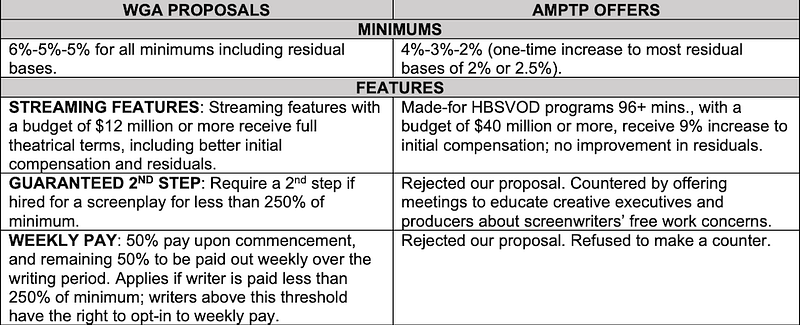
At some point, the AMPTP will return to the negotiating table. I hope they not only agree to improve things for TV writers, but also film writers.
To read the rest of “A Matter of Survival: How the WGA Is Trying to Save Feature Screenwriters,” go here.
For the latest updates on the strike and news resources, go here.