30 Things About Screenwriting: A spec script will not sell unless it has a strong story concept
If you write a spec script based upon the first story idea that comes into your mind, that script likely won’t sell.

If you write a spec script based upon the first story idea that comes into your mind, that script likely won’t sell.
Why? Because almost assuredly, it is not a strong story concept.
It is impossible to overemphasize the importance of a story idea to the eventual success of a spec script.
A good story concept enables producers and studio execs to ‘see’ the movie.
A good story concept provides ammo for marketing departments to advertise the film.
A good story concept emboldens managers and agents to sell the crap out of your script.
Although I have no way of proving it, I believe the story concept may represent up to half of the value of a screenplay to a potential buyer. That’s right, half.
Here are some quotes from a pair of established screenwriters about the importance of story concepts:
“Most aspiring screenwriters simply don’t spend enough time choosing their concept. It’s by far the most common mistake I see in spec scripts. The writer has lost the race right from the gate. Months — sometimes years — are lost trying to elevate a film idea that by its nature probably had no hope of ever becoming a movie.” — Terry Rossio (Aladdin, The Mask of Zorro, Shrek, Pirates of the Caribbean: The Curse of the Black Pearl)
“Ideas cost NOTHING and require ZERO risk. And yet, oddly, the LEAST amount of time’s usually spent in the idea stage before a small fortune is dumped on a whimsy that’s still half-baked… Ideas cost nothing yet have the potential to yield inexplicably long careers and happy lives.” — Kevin Smith (Clerks, Mallrats, Chasing Amy, Dogma, Zak and Miri Make a Porno)
Are you thinking of story ideas every day? Do you have a master list of story ideas that is… growing? Is one part of your brain on auto-pilot, always sifting through the daily data that comes your way in search of possible story ideas?
Nobel Prize-winning scientist Linus Pauling said this: “The best way to have a good idea is to have lots of ideas.”
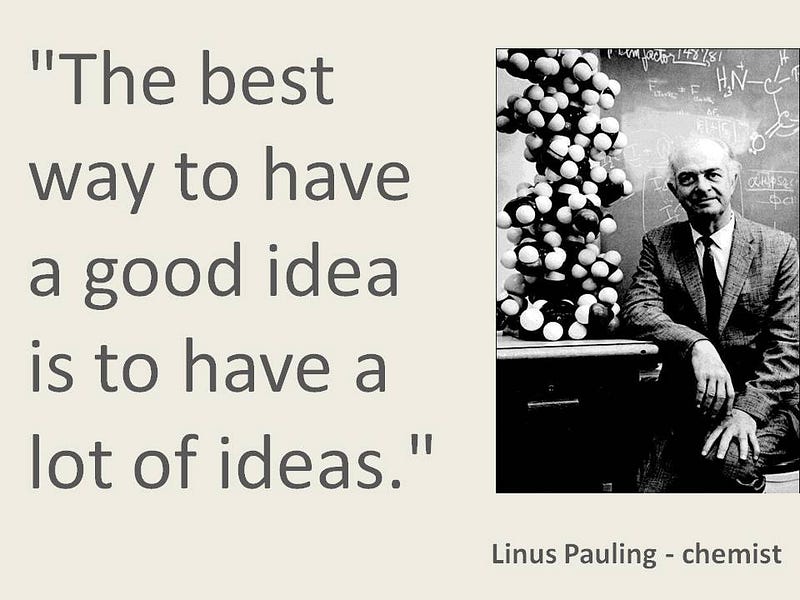
We, as writers, should be generating “lots of ideas.”
How to do that? Perhaps the single biggest key is two simple words: What if?
Consider anecdotes from three screenwriters:
“The inspiration for coming up with the story [Back to the Future] is that I was visiting my parents in the summer of 1980, from St. Louis Missouri, and I found my father’s high-school yearbook in the basement. I’m thumbing through it and I find out that my father was the president of his graduating class, which I was completely unaware of. So there’s a picture of my dad, 18-years-old… The question came up in my head, ‘gee, what if I had gone to school with my dad, would I have been friends with him?’ That was where the light bulb went off.” — Bob Gale (1941, Used Cars, Back to the Future I, II, III)
“The secret, the great key to writing Hook, came from my son. When he was six, he asked the question, ‘What if Peter Pan grew up?’ I had been trying to find a new way into the famous ‘boy who wouldn’t grow up’ tale, and our son gave me the key.” — James V. Hart (Dracula, Contact, Hook)
“The Shakespeare in Love screenplay was written by Marc Norman and playwright Tom Stoppard, although the original idea was rooted in a third creative mind — one of Norman’s son’s, Zachary. It was in 1989, while studying Elizabethan drama at Boston University, that the younger Norman phoned his father with a sudden brainstorm of a movie concept — the young William Shakespeare in the Elizabethan theater. The elder Norman agreed it was a terrific idea, but he hadn’t a clue what to do with it. Two years later, with bits of time stolen from other projects, the notion had formed — what if Shakespeare had writer’s block while writing his timeless classic, ‘Romeo and Juliet’”? — Marc Norman (The Aviator, Cutthroat Island, Shakespeare in Love)
What if I had gone to school with my dad? What if Peter Pan grew up? What if Shakespeare had writers block? Each the basis of a successful movie. Each a strong concept.

Want to jump start your ability to think concepts? Make the words “what if” an essential part of your brainstorming vocabulary. That is the most proactive way you can go about trying to surface strong story concepts.
For more articles in the 30 Things About Screenwriting series, go here.