30 Days of Screenplays, Day 9: “The Queen”
Why read 30 screenplays in 30 days?
Why read 30 screenplays in 30 days?
Because whether you are a novice just starting to learn the craft of screenwriting or someone who has been writing for many years, you should be reading scripts.
There is a certain type of knowledge and understanding about screenwriting you can only get from reading scripts, giving you an innate sense of pace, feel, tone, style, how to approach writing scenes, how create flow, and so forth.
We did 30 Days of Screenplays in 2013 and you can access each of those posts and discussions here. This time, we’re trying something different: I invited thirty Go Into The Story followers to read one script each and provide a guest post about it.
Today’s guest columnist: Paul Graunke.
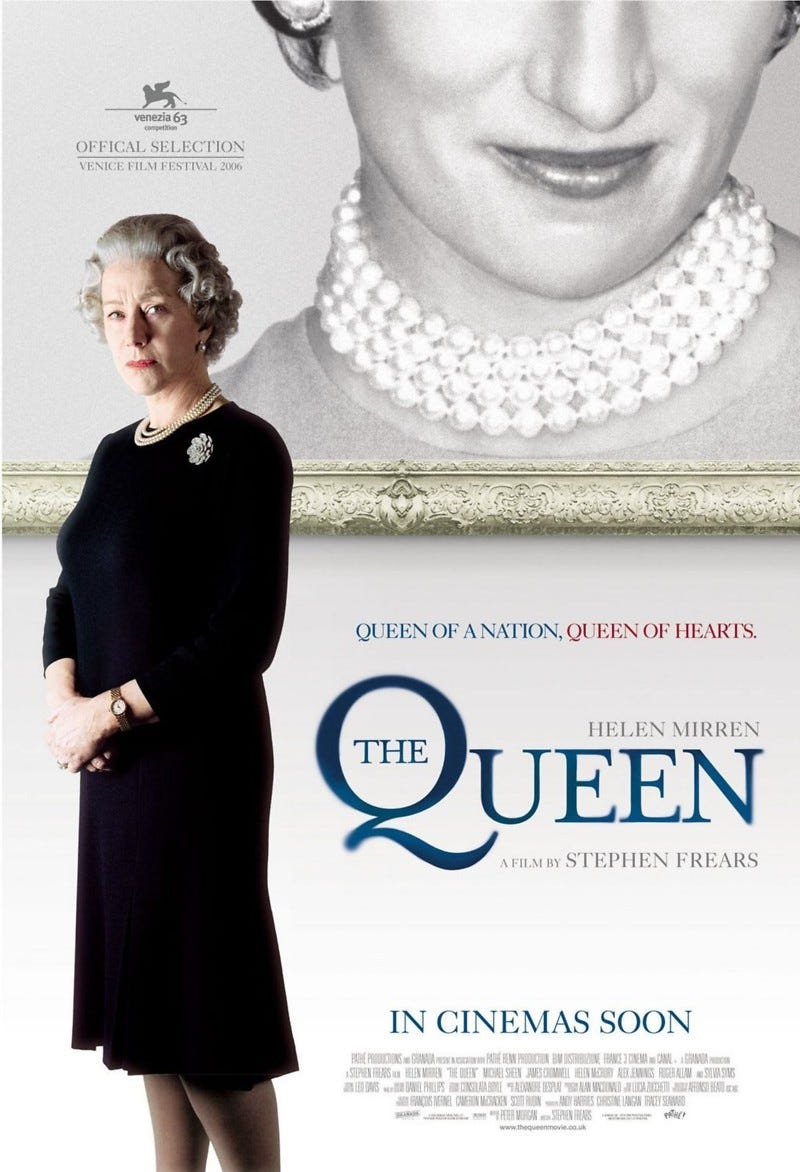
Title: The Queen. You may read the screenplay here.
Year: 2006
Writing Credits: Peter Morgan
IMDB rating: 7.4
Plot summary: The death of Princess Diana forces Queen Elizabeth II to confront her bitter feelings about the “People’s Princess” and the threat the public reaction poses to the future of the monarchy.
Tagline: “One was the Queen of the nation. The other was the Queen of the nation’s heart.”
Awards: Oscar nominated for best original screenplay. Won the Golden Globe for best screenplay, motion picture. BAFTA nominated for best original screenplay. WGA nominated for best original screenplay.
Analysis: In addition to standard story elements, I think that the thematic movement paradigm (Disunity / Deconstruction / Reconstruction / Unity) provides a useful framework for analyzing the script.
Status Quo: The story opens with Tony Blair being elected Prime Minister of Great Britain on a platform to modernize the country. This sets the stage for an inevitable conflict between modernity and tradition. When he formally meets Queen Elizabeth II, she pointedly reminds him that he is the 10th prime minister to serve her government. (Subtext: I’m an experienced hand at governing); that her first prime minster was Winston Churchill. (Subtext: I was tutored by one of the greatest. You’re an unproven whelp who would benefit from my mentoring.)
Inciting Incident and Disunity: Princess Diana’s dies in an auto accident in Paris (page 13). In life Diana had become an embarrassing nuisance after the failure of her marriage to Prince Phillip. In death, her video “ghost” (replayed over and over on TV) becomes a formidable nemesis that exposes a two-fold Disunity: the Queen’s bitter feelings about her, of course; and the Disunity between the Queen and her subjects. The Queen loathed Diana, the public worshipped her.
Crossing the Threshold into Act 2 and the Dramatic Question: The nation plunges into mourning. Flowers pile up in front of Buckingham Palace. Initial plans for a private funeral quickly give way to a public funeral. But the characters find themselves in terra incognita; that is, there is no precedent (page 32) for a public funeral for an ex-member of the royal household. What should they do for Diana?
Act 2, Fumbles and Missteps: It’s important to note that the Queen did not proactively choose to cross this threshold, to go forth on a “Hero’s Journey”. The journey is forced upon her by events. The Queen’s initial answer to the dramatic question is: say nothing, do nothing. Ensconced in splendid isolation at her Balmoral castle in Scotland, she is out of touch with events in London.
Tony Blair, a politician with his fingers on the public pulse, knows this is a colossal blunder. He begins a series of phone calls to tactfully nudge her into an appropriate response. To no avail. The Queen is a woman of formidable defense mechanisms. (The most potent and frequently used being justification: she’s acting to “protect” the two royal princesses, William and Harry.)
Deconstruction: Meanwhile, the wrecking ball of events swings away at her defenses. Others make the decisions about the funeral; she acquiesces. Her first impulse is to clear away the flowers amassing at the front gate (pages 38–40), but she assents to her staff’s suggestion to leave them. And the Greek Chorus of media coverage compels her to at least ponder her own complicity in the failed marriage: after all, she encouraged the ill-fated match (page 47).
Collateral Deconstruction: Initially, Diana’s death is a distraction for Tony Blair, not a crisis. Still, the wrecking ball of deconstruction swings in his direction, too. As events unfold, he back pedals from some of his campaign rhetoric about radical modernization. And he rejects his wife’s arguments for outright abolition of the monarchy.
Raising the Stakes and Theme to the Forefront: The crisis intensifies when the media pounce upon the absence of a flag flying at half-mast over Buckingham Palace (page 51). Now it’s not just about the Queen’s bitter feelings and about funeral protocol. Now the conflict foreshadowed in the setup comes to the forefront: entrenched tradition collides with modern sensibilities. The flag has never flown at half-mast for anyone in over 400 years. The last person the Queen would ever want to break that tradition for is Diana.
Mid-story Impasse: Tony Blair calls again, tries to persuade her to make a gesture with the flag, a public appearance. She will not yield. He is exasperated. (page 61)
A Moment of Emotional Truth and Metaphor: Awhile later, her Land Rover breaks down while crossing a stream. While waiting for help, alone with her own thoughts and feelings, she breaks down, sobs for a moment. Then an Imperial stag appears with a glorious pair of antlers, 14 points. “Oh, you are a beauty,” this most stoic of characters exclaims (page 66).
This moment makes a moving metaphorical statement. As the stag is being hunted down by a merciless pack of hunters, she feels she is being hunted down by a merciless media. Can the stag dodge the bullets? Can she?
Deconstruction, Climax and Dilemma: The next morning, the Queen reads about the latest stalking of her in the press. By now, the wrecking ball of events has weakened her mighty fortress of resolution. Defiance turns to doubt. She begins to realize how her actions — or rather, inactions — are undermining her image, her popularity.
Another phone call from Tony Blair confirms her fears. A new poll has 70% believing her actions have damaged the royal family; 1 in 4 in favor of abolishing the monarchy. The climax of the crisis has come, the moment of greatest peril, of maximum stakes, the moment when she must resolve her dilemma, must choose between two equally unacceptable courses of action.
Reversals and Reconstruction: Three reversals now occur.
#1: The reversal of the formal relationship between the Queen and her Prime Minister. In their first meeting, she defined her role as a mentor with the “constitutional responsibility to advise, guide and warn the government of the day.” (Page 8) Now, he mentors her in the ways of modernity: “I believe it’s my constitutional responsibility to ADVISE the following…” (Page 73)
#2: Over the objections of her husband and the counsel of her mother, she follows his advice. She will come down to London and play out her assigned role as a royal mourner. (Page 76)
Collateral Reconstruction: Throughout the story, Blair’s press secretary has been unsparingly contemptuous of the royals. While never exactly echoing his sentiments, neither has Blair disavowed them.
#3: But when his press secretary gloats over his political triumph with the Queen, Blair explodes: “When you get it wrong, you REALLY get it wrong”. (Page 85) He vehemently defends the Queen. He has come to see the Queen, her character and her predicament, in a new light.
Paying off the Metaphor: As the family is about to leave, Prince Phillip, oblivious to her encounter with the stag, informs her that the stag was killed on an adjoining estate. The Queen rushes over to see for herself. As she inspects the decapitated carcass, she has a portent of the decapitation threatening the royal family. This reinforces her need to do what she must to dodge the bullets of criticism.
Reconstruction Hell: And so she flies down to London, descends into the “Abyss” phase of her “Hero’s Journey” (if one can call it that). She inspects the flowers amassed at the palace, reads messages of sympathy for Diana, painfully critical of her. She dutifully reads the script for a TV eulogy. She subjects herself to public humiliation at the funeral. This is royal hell, her nadir, but for her and the royal family the only way out is through.
New Unity, Status Quo and Closure: Two months later, the Queen and Blair meet again. He apologizes for being so forward with her. She confesses she may never understand what happened. “But I can see the world has changed. And one must ‘modernize’.” By heeding his advice, she dodged the bullets. Public opinion is turning back in her favor. A new status quo has been established, perhaps not radically new, but one that enables her to resume her role as Queen of the nation — and royal mentor to her Prime Minister on the quotidian details of governing.
Most Memorable Dialogue: The opening scene where the Queen watches news about the election on TV while posing for a portrait. The dialogue establishes the situation, her role as monarch, and thematic issues the Queen will have to confront: (political) modernization and (personal) partiality.
ELIZABETH: Have you voted yet, Mr. Crawford?
ARTIST: Yes, Ma’am. I was there when they opened. First in line. Seven o’clock. And I don’t mind telling you, it wasn’t for Mr. Blair.
ELIZABETH: Not a modernizer, then?
ARTIST: Certainly not. We’re in danger of losing too much that’s good about this country as it is.
ELIZABETH: Hmm. I rather envy you being able to vote. (A beat) Not the actual ticking of the box, although, I suppose, it would be nice to experience that ONCE. (A beat) But the sheer joy of being partial.
ARTIST: Yes… One forgets that as Sovereign, you are not entitled to vote.
ELIZABETH: No.
ARTIST: Still, you won’t catch me feeling sorry for you. You might not be allowed to vote, ma’am. (A beat) But it IS your Government.
ELIZABETH: Yes. I suppose that is some consolation.
Most Memorable Moments:
#1: The scene where the Land Rover breaks down. For a few minutes, the Queen is stranded alone with her thoughts and feelings. A rare moment of privacy for a woman compelled to live such a public life. She cries. Then the stag appears, whom she admires and identifies with. Both are being stalked.
#2: The payoff to the encounter with stag. It has been chased down and killed. The headless carcass hanging on a hook, symbolizes the threat to her reign, her dynasty.
(In the movie, the funeral was also a most memorable moment, taking up about 3 minutes of screen time, mostly news clips of the real event. But the script devotes less than half a page.)
What I Learned About Screenwriting From Reading This Script:
- How to establish plot themes. In the script: modernization versus tradition, ritual versus informality, personal partiality versus official impartiality.
- How to build and maintain sympathy for a protagonist who is not an ideal role model for a matriarch, a stoic woman not given to displays of emotion or affection, a woman who for over half the story is simply wrong-headed, doing the wrong things for the wrong reasons. One technique is to give the Queen some endearing qualities like a puckish sense of humor and a love for dogs, particularly her corgis, who smartly obey her every command. Another technique is to use her husband, Prince Phillip, as a rather buffoonish foil to make her look better in comparison.
- How to distribute — and balance — opposing viewpoints among characters. The Queen and Tony Blair do not lead the charge in the partisan arguments. Rather, they seem caught in the cross-fire. In the Queen’s camp, the job of defending tradition and attacking Diana and the ‘mobs’ outpouring of grief is assigned to Prince Phillip. The voice advocating flexibility and compromise belongs to Prince Charles (whose arguments are colored by his own stakes in the outcome). In Blair’s camp, the job of ridiculing the royals is assigned to Blair’s rather buffoonish press secretary. A rational case for abolishing the monarchy is presented by Cherie Blair, the prime minister’s wife, a lawyer.
- How to use a visual metaphor to illustrate the theme in a way that complements the Big Story of what the protagonist wants AND the small story of what she needs. In this script, that is done brilliantly through the fate of the stag.
Finally, it’s worth noting what the script does not do: the young royal princes, William and Harry, are discretely placed in the background or left offstage. This mirrors the response of the press after Diana’s death. They backed away, giving the princes some privacy to recover from the loss of their mother and breathing room to have normal lives — for royalty. No doubt, someday someone will write a coming of age script about this tumultuous week from their point of view, where they are front and center. It ought to make for an equally compelling story.
Thanks, Paul! To show our gratitude for your guest post, here’s a dash of creative juju for you. Whoosh!
To see all of this year’s 30 Days of Screenplays: Vol. 2, go here.