30 Days of Screenplays, Day 8: “Dead Poets Society”
Why 30 screenplays in 30 days?
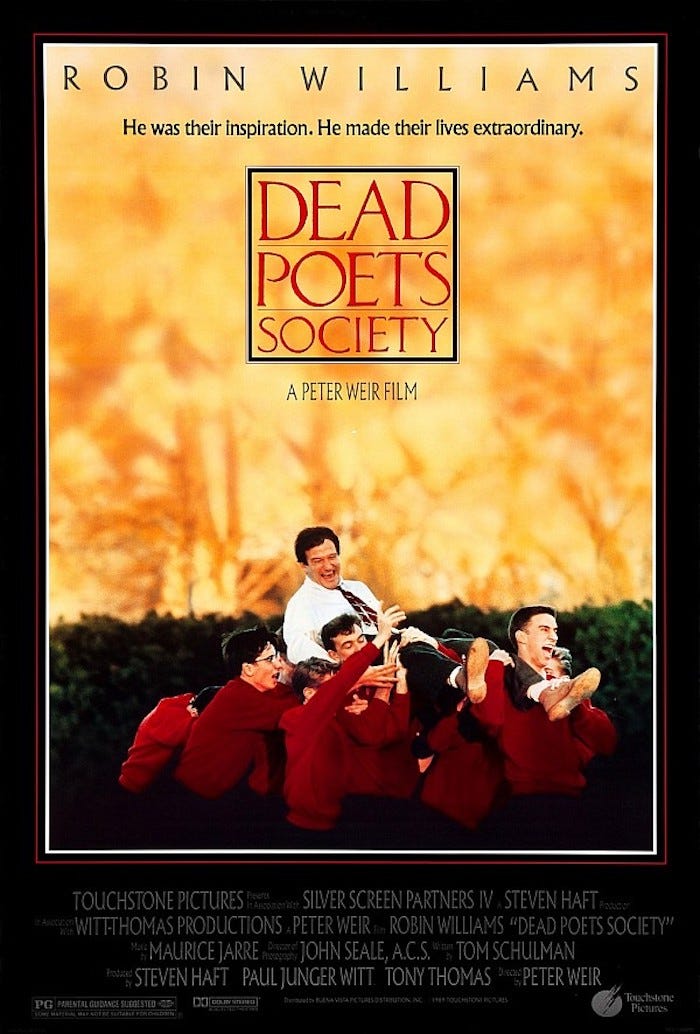
Why 30 screenplays in 30 days?
Because whether you are a novice just starting to learn the craft of screenwriting or someone who has been writing for many years, you should be reading scripts.
There is a certain type of knowledge and understanding about screenwriting you can only get from reading scripts, giving you an innate sense of pace, feel, tone, style, how to approach writing scenes, how create flow, and so forth.
So each day this month, I will provide background on and access to a notable movie script.
Today is Day 8 and the featured screenplay is for the movie Dead Poets Society (1989). You may download a PDF of the script here.
Background: The screenplay was written by Tom Schulman.
Plot summary: English teacher John Keating inspires his students to a love of poetry and to seize the day.
Tagline: He was their inspiration. He made their lives extraordinary.
Awards: Won an Academy Award and was nominated for WGA Award for Best Original Screenplay.
Trivia: The draft that writer Tom Schulman sent out to the studios was his first one.
I want to talk about four things that struck me reading the script again.
First, sometimes movies feel like throwbacks to a different era. Then there are movies that feel like they’re ahead of their time. And then there are movies that feel like they could only have come into being precisely when they did. That was my reaction to Dead Poets Society, the result of a combination of the script’s style, subject matter, approach to female characters, even the tone of the drama. I remember when I saw the movie how it just flat-out worked. I’m not so sure that a script like this would get made today. As I say, it got made precisely when it could and should have been produced.
Second, this time I read the script with new knowledge: when director Peter Weir came on board the project, he decided to make the movie about the boys, not Keating. Knowing that, I was attuned to a tension in the story where Keating was the center of everything that happened — typically a Protagonist dynamic — but whenever his role seemed about to dominate things, the action shifted to the boys. Yes, Keating is a powerful character in large part because he’s charismatic and a profound Mentor figure. But I think Weir’s instinct was the correct one because it’s much more interesting to see the impact of Keating’s ideas on the boys.
Third, when I saw the movie the first time, Neil’s story grabbed my attention most, directly from the beginning — how would he fare with such an overbearing father? Reading the script this time, as an exercise I tracked him as the story’s lead Protagonist. The other boys each have their own Protagonist’s journey, but it’s Neil who goes through the most significant transformation, indeed, the one who has to change the most because of the restrictive environment of his familial upbringing, personified powerfully by his father Mr. Perry.
Neil begins the story in Disunity — doing what his father wants, not what Neil wants — but Keating and poetry are devices that Deconstruct Neil’s defenses, allowing his own identity to emerge in the second half of Act Two (Reconstruction). But when told by his father, “Tomorrow I am withdrawing you from Welton and enrolling you in Braden Military School. You are going to Harvard and you are going to be a doctor,” Neil is faced with a choice: Deny the creative soul he has become by following his father’s path for him or seize the day? And how does Neil seize the day? He commits suicide. It’s an act of passion, rage, sorrow, regret, and ultimately (we can argue) a mistake — but it is his choice, not his father’s.
The fourth thing ties into Neil’s death. There is a scene in the script where Keating is alone in his classroom, obviously distraught over the suicide. Here is the scene:
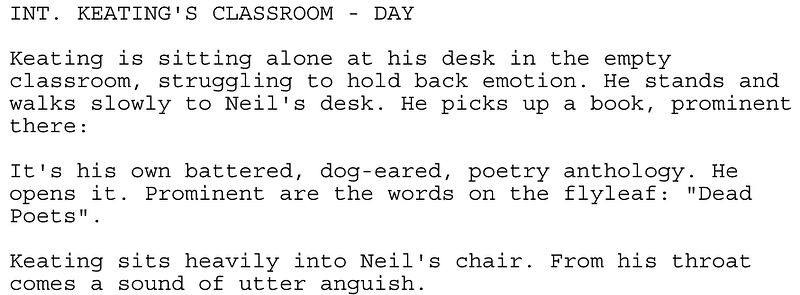
I didn’t remember this moment from the movie, so when I read it, it hit me hard. Of course, given what has transpired with Neil, there is bitter irony here with the words “Dead Poets.” But then I was struck by a thought: As the dead poets had inspired Keating’s boys to get in touch with their creative self and to seize the day, so does Neil. Because his suicide — as awful as it is — drives home the point of carpe diem in a way even Keating can’t. Death has its own special meaning and power over those exposed to it.
And then this thought: Through his suicide, Neil functions in relation to his friends in a similar way that Brooks in The Shawshank Redemption functions with Red: “Get busy livin’, or get busy dyin.’” The shadow of Neil and Brooks, their suicides, is like a dividing line across the ground for those who follow in their path. Seize the day / get busy livin’ are dangerous words because they challenge us to go deep within ourselves, engage our fears, and do what we can to live authentically. But as Neil and even Brooks in his way determined, if they couldn’t live the way they wanted, death was a better choice.
In Dead Poets Society, Neil’s suicide is carpe diem’s shadow.
In Shawshank, Brooks’ suicide is “get busy livin’s” shadow.
Let’s hope that Neil and Brooks find each other in cinema heaven. Perhaps they can sit on a park bench together, feeding pigeons, and reading poetry aloud to each other.
What’s your take on Dead Poets Society? Stop by comments and post your thoughts.
To see all of the posts in the 30 Days of Screenplays series, go here.
This series and use of screenplays is for educational purposes only!