30 Days of Screenplays, Day 7: “Amour”
Why read 30 screenplays in 30 days?
Why read 30 screenplays in 30 days?
Because whether you are a novice just starting to learn the craft of screenwriting or someone who has been writing for many years, you should be reading scripts.
There is a certain type of knowledge and understanding about screenwriting you can only get from reading scripts, giving you an innate sense of pace, feel, tone, style, how to approach writing scenes, how create flow, and so forth.
We did 30 Days of Screenplays in 2013 and you can access each of those posts and discussions here. This time, we’re trying something different: I invited thirty Go Into The Story followers to read one script each and provide a guest post about it.
Today’s guest columnist: John Hörnschemeyer.
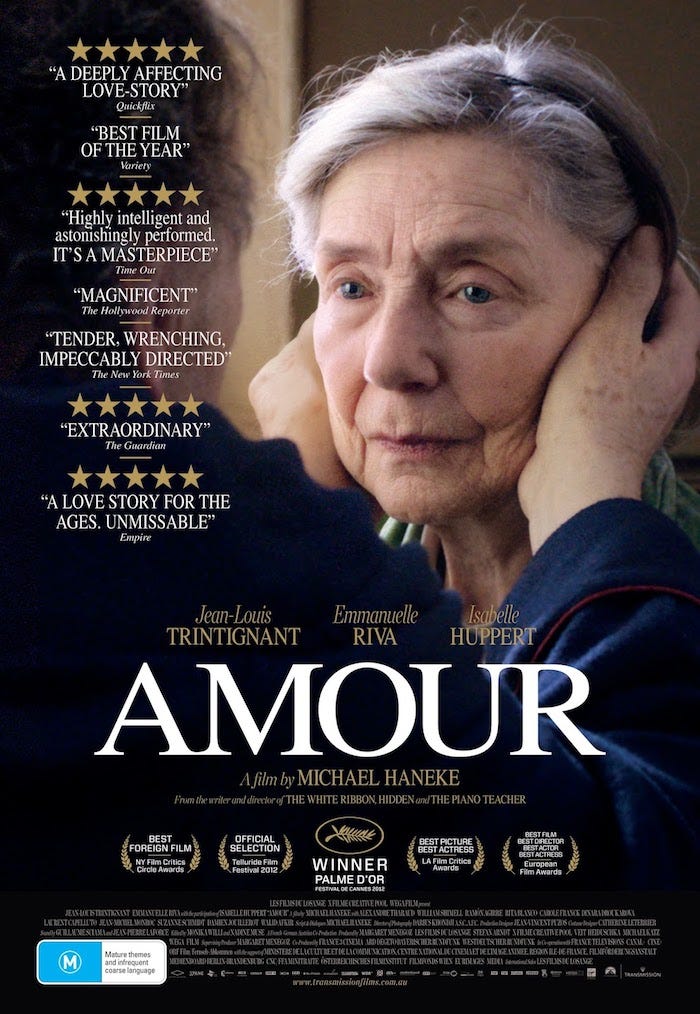
Title: Amour. You may read the screenplay here.
Year: 2012
Writing Credits: Michael Haneke
IMDB rating: 7.8
IMDB plot summary: Georges and Anne are an octogenarian couple. They are cultivated, retired music teachers. Their daughter, also a musician, lives in Britain with her family. One day, Anne has a stroke, and the couple’s bond of love is severely tested.
Awards: This would make for a very long blog post, so I’ll simply add the link to the IMDB page that references the long list of awards and nominations. Suffice to say that among the awards, are:
Palme d’Or — Cannes Film Festival 2012
Best Film — European Film Awards 2012 & Los Angeles Film Critics Association Awards 2012
Best Foreign Language Film — Academy Awards 2013, Golden Globes 2013 & BAFTA Awards 2013.
Trivia: Michael Haneke wrote the script for Jean-Louis Trintignant. Although it was filmed in French, Haneke wrote the screenplay in German, and had it translated before sending it to Trintignant.
The film was previously titled “These Two” and then “The Music Stops” before one day at lunch, the film’s star Jean-Louis Trintignant suggested to director Michael Haneke that since the subject of the film was love, why not call it Amour (French for Love). Michael Haneke thought that the title made sense and worked beautifully, so the film was then named Amour.
One constant bit of direction that director Michael Haneke gave to the cast was to avoid sentimentality at all costs.
With the announcement of the 2012 Academy Award (Oscar) nominations on January 10, 2013, Emmanuelle Riva became the oldest person ever nominated for a Best Actress Oscar (at age 84). She broke the record of the previous oldest-ever Best Actress nominee (and winner), Jessica Tandy, who was nominated for Miss Daisy und ihr Chauffeur (1989) at age 80.
Analysis: This is a story about love, the dignity of suffering, and of the pain of separation.
After an opening scene that reveals the ending, eliminating any kind of false suspense, the rest of the script is written as a chronological flashback. Through this structural decision, Haneke chooses to concentrate not on the inevitable ending, death, but rather on the events that lead up to it.
Inevitably, the film raises questions concerning assisted suicide, yet Haneke remains adamant that his film is about how one copes with the degrading effects of a degenerative illness on a loved one, and not about euthanasia.
Set almost entirely in the couple’s apartment, this choice allows Haneke to treat the story in the manner of a tragedy of classical theater, set within the confines of the décor of a traditional stage set.
Interestingly, and despite the fact that the running time of the film is 127 minutes, the English version of the screenplay is only 67 pages long, underlining the restrained pacing of the filmed scenes, many of which are purely visual, without dialogue. Often slow, and prolonged, they invite the spectator to partake in the rhythm of the elderly couple’s lifestyle.
Centered on the two main characters, Georges’ story treats the way in which individuals rationalize and externalize their internalized emotional conflicts, whereas Anne suffers the indignity of her degenerative physical state, trapped in an increasing isolation that distances her from the man she loves. On the one hand emotional internalization, on the other, physical internalization, neither desired, neither acceptable, nor sustainable. This conflict is epitomized when Anne rebels by refusing food, only for Georges to argue that she will die if she does not eat. When he does eventually force the spoon inside her mouth, she responds by spitefully spitting the food back out at him.
Most Memorable Dialogue: The dialogue, as a whole, is both understated and profoundly credible, yet before I propose my favorite passage, I think it necessary to underline the rarity of the fact that not a word of the script was changed during production. The film was shot exactly as it was written, word for word.
The manner in which Georges struggles to come to terms with the situation in which he finds himself is evident in the scene in which he discuses Anne’s condition, for the first time, with their daughter Eva. Unable, or perhaps too proud, to express his sense of helplessness, the emotional challenge remains interiorized. It also reveals the distance between Georges and Eva, underlining, if need be, the fact that Georges and Anne have retreated from the potentially ‘threatening’ external world, into the security of their certitudes and the comfort of their bourgeois apartment.
EVA: What’s aphasia?
Georges gestures that it’s too complicated.
GEORGES: What can I say? The carotid artery was blocked. They did an ultrasound scan, two in fact, and they said they had to operate on her. She was scared. She was confused and scared. You know she has always been afraid of doctors. They said the risk was very low and that if they didn’t operate, she’d be certain to have a serious stroke.
EVA: And what do they say now?
GEORGES: Just that it didn’t go well. It’s one of the 5% that go wrong.
He yawns.
GEORGES: It’s pretty upsetting.
He looks at his watch.
GEORGES: Usually at this time, I take a nap. My blood sugar is somewhere down in my socks.
PAUSE.
EVA: I’m so sorry.
GEORGES: Yeah.
PAUSE.
EVA: What can I do for you?
GEORGES: Nothing. It was nice of you to come despite all of your stress.
Brief PAUSE.
She doesn’t know what to say.
Most Memorable Moments: This is without doubt Georges’ monologue, and what follows, at the end of the film. Haneke uses an anecdote, a vivid emotional scar, as a means to express Georges’ painful, yet inevitable, acknowledgement that he finally understands his wife’s need to escape from the confines of the physically diminished state in which she finds herself; her ‘isolation ward’. This is Georges’ way of saying both, ‘I love you’, and ‘Goodbye’.
He sits down beside her on the bed. Takes her hand.
GEORGES: It’s all right… it’s all right … I’m here… everything’s fine… we’ll… Hold on, I’ll tell you a story… but you must be quiet, I can’t talk too loud, it wears me out… Here we go: when I was little… well, I wasn’t as little as all that… it was toward the end of primary school, so I was about ten, Dad and Mom sent me to a holiday camp. They thought it would do me good to spend the summer with kids my own age… We were lodged in an old castle in the midst of a magnificent wooded landscape… I think it was in the Auvergne… I don’t know… in any case it was the opposite of what I’d expected… We had to get up at 6 and go for a morning swim. Not far from the castle, there was a pond fed by an icy mountain stream. We entered it running, in a double file. You know, I was never very sporty. They had a program to keep us on the go all day, probably to nip any potential pubescent impulses in the bud … But the worst thing was the food. The third day after our arrival, there was rice pudding for lunch. I hate rice pudding. We sat at long tables in a huge hall. I didn’t want to eat the stuff and the housemaster said to me: You won’t get up until you’ve cleared your plate. So after the meal everybody left the room, and I remained seated, in tears. I had made a secret pact with Mom. I was to send her a postcard every week. If I was pleased with the place I was to draw some flowers on it, or if not, some stars. She kept the card; it was covered all over in stars. After three hours, I was allowed to leave the table. I went up to my room, got into bed and had a fever of 42 degrees. It was diphtheria. They took me to the nearest hospital where I was put in an isolation ward, which meant that Mom, when she came to visit me, could only wave at me through a window. At some point I lost that postcard. It’s a pity.
Anne has become ever calmer during Georges’ story. He still holds her hand.
LONG SILENCE.
Then Georges reaches across Anne’s body to get hold of his pillow and presses it over her face. STIFLED SOUNDS from Anne. Everything that can still move in her body starts to move. Georges presses down heavily on the pillow, lies on it with his whole weight, for a long time, until all Anne’s movements stop. Then he sits up, exhausted, and without removing the pillow from her face, remains seated beside her.
SILENCE.
What Did I Learn About Screenwriting From Reading This Script: Other than confirming the notion that ‘less is more’, Haneke’s script is a wonderful example of how an intense character-driven story can be written for a confined environment and a minimal cast, without falling into the trap of the ‘talking heads’ syndrome. It also constitutes a master class in the use of subtext, and the importance of what is not on the page.
Thanks, John. To show our gratitude for your guest post, here’s a dash of creative juju for you. Whoosh!
To see all of this year’s 30 Days of Screenplays, go here.