30 Days of Screenplays — Day 6: “Die Hard”
Why 30 screenplays in 30 days?

Why 30 screenplays in 30 days?
Because whether you are a novice just starting to learn the craft of screenwriting or someone who has been writing for many years, you should be reading scripts.
There is a certain type of knowledge and understanding about screenwriting you can only get from reading scripts, giving you an innate sense of pace, feel, tone, style, how to approach writing scenes, how create flow, and so forth.
So each day this month, I will provide background on and access to a notable movie script.
Today is Day 6 and the featured screenplay is for the movie Die Hard (1988). You may download a PDF of the screenplay here.
Background: The screenplay was written by Jeb Stuart and Stephen E. De Souza, based on a novel by Roderick Thorp.
Plot summary: New York cop John McClane gives terrorists a dose of their own medicine as they hold hostages in an LA office building.
Tagline: Twelve terrorists. One cop. The odds are against John McClane… That’s just the way he likes it.
Awards: Nominated for 4 Academy Awards.
Trivia: This was based on a book by Roderick Thorp entitled “Nothing Lasts Forever” — a sequel to another book entitled “The Detective”, which in 1968 was made into a film starring Frank Sinatra. Because of a clause in Sinatra’s contract for “The Detective” which gave him the right to reprise his role in a sequel, he was actually the first person offered the McClane role, even though he was 73 years old at the time. Also, Coincidentally, Bruce Willis made his movie debut in The First Deadly Sin walking out of a bar as Sinatra walks into it.
Die Hard was one of the first action scripts I read, actually several different drafts (Larry Gordon, who produced Die Hard, also produced K-9). And I think it was while I was going through those drafts that the concept of narrative voice began to form in my mind, the idea that there is an invisible character in our scripts — the Narrator — reflected in the style and tone of the scene description we write. Because when you read the screenplay, the scene description just oozes with… well… action! Precisely what it’s supposed to per the formula: Genre + Style = Narrative Voice.
As you read it, you will note that this is a shooting script with scene numbers and lots of camera shot references. Reminder: Do not do this in your spec script. You are writing a selling script which per current style guides is supposed to be as ‘literary’ as possible.
Also while you’re reading the script, think about these character archetypes: Protagonist, Nemesis, Attractor, Mentor, Trickster. The characters in Die Hard fall neatly into place into the paradigm.
OBSERVATIONS: In his fantastic book “Adventures in the Screen Trade,” William Goldman states point blank that the single most important thing a screenwriter can do is write roles that name actors want to play. And even though Hollywood’s fascination with CGI, which has elevated eye-popping technologies above movie stars in terms of their relative importance to most major motion pictures, it’s still hugely beneficial to write lead roles that feel ‘big,’ and depending upon the genre and scope of the story, even iconic. John McClane is certainly that kind of role.
Don’t forget, there is another big star in Die Hard — the skyscraper itself. Actually named Fox Plaza and located ironically enough in Century City (which used to be the back lot of 20th Century Fox), it figures in every scene in the movie.
But the main thing I want to focus on is this: finding an emotional connection in an action film.
The Protagonist, John McClane (Bruce Willis), finds himself in an extraordinary situation — a lone cop versus a heavily armed group of thieves who take over a skyscraper and hold a group of employees hostage. But how emotionally connected to all that action would we be if we weren’t somehow emotionally connected to McClane? And what is the core of that emotional connection? Something simple and relatable: McClane is estranged from his wife Holly (Bonnie Bedalia). Here’s the key scene in the movie that handles their discord:
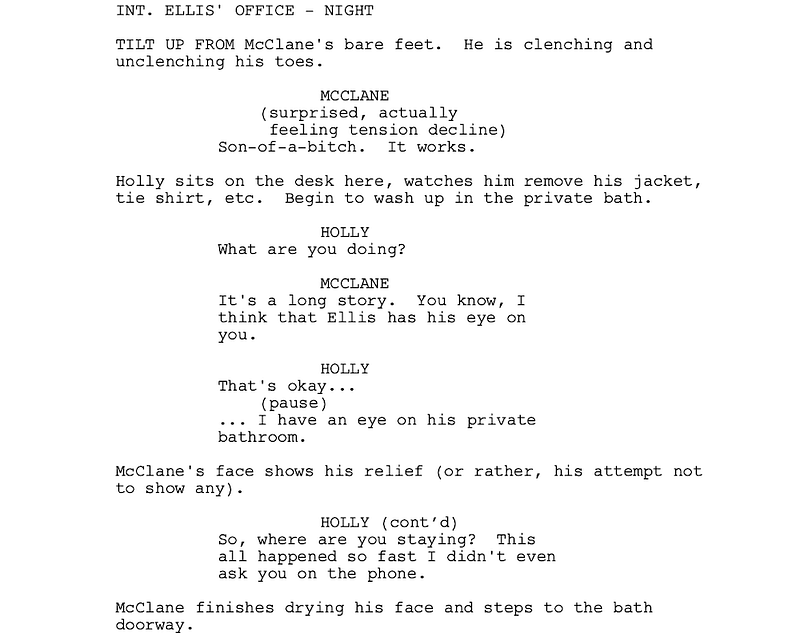
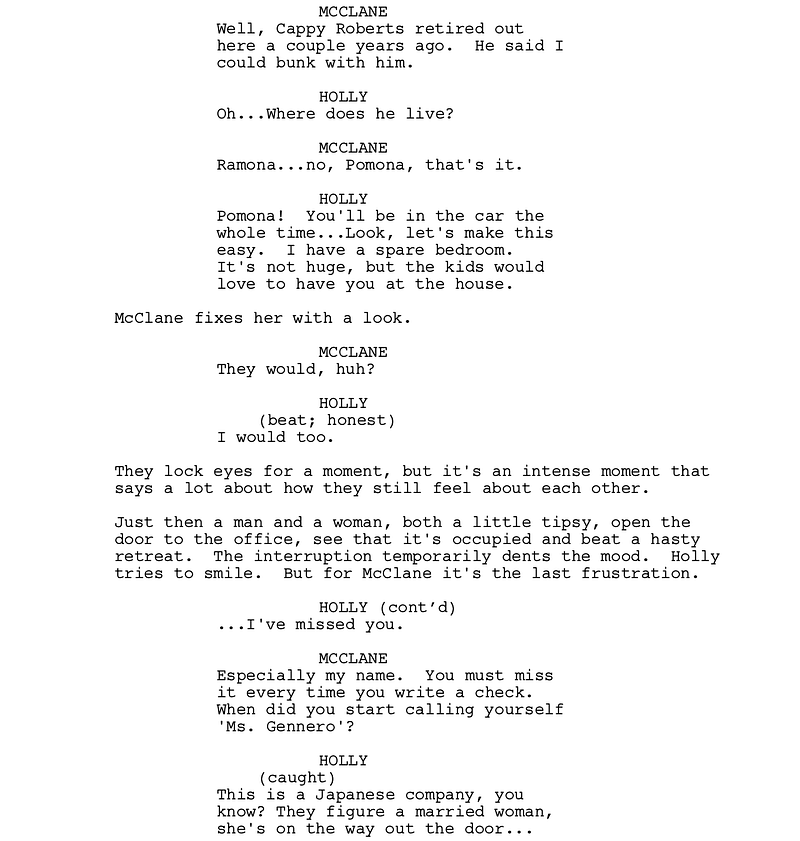
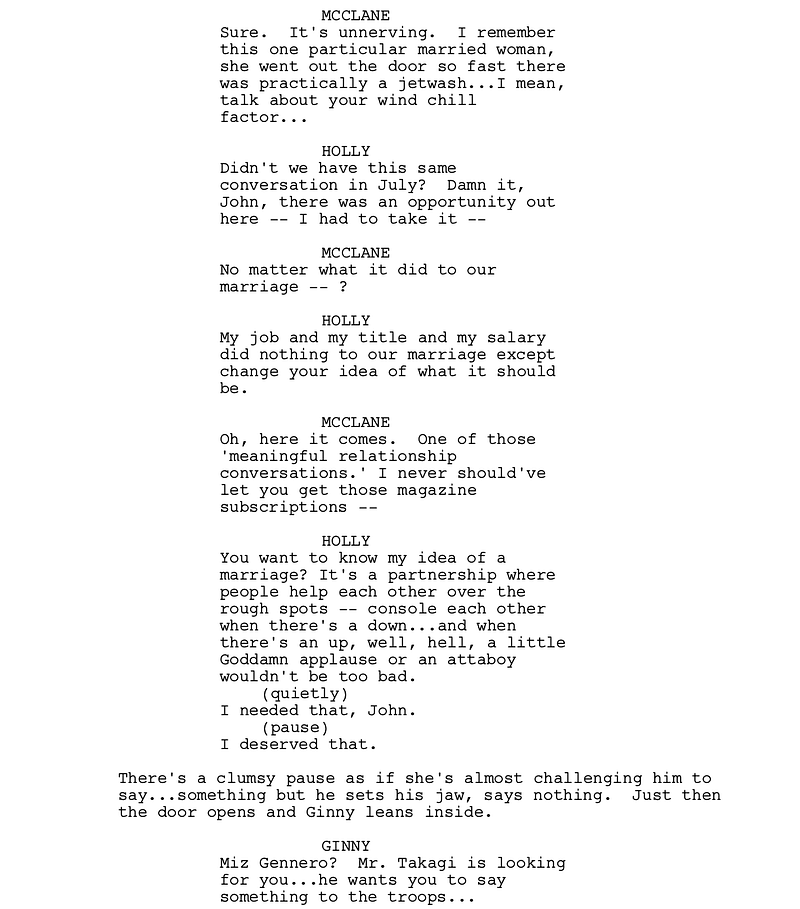
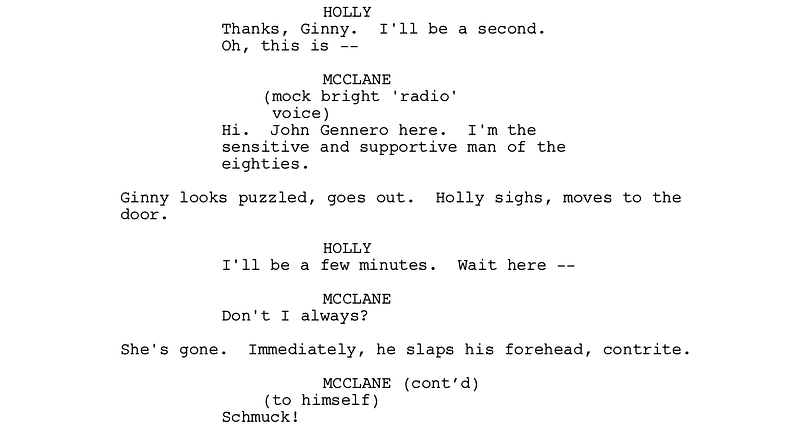
Of course, it won’t be a few minutes as the story’s Nemesis, Hans Gruber (Alan Rickman), and his gang are just about to take over the building — which means that McClane carries this cliffhanger of a conversation with his wife all the way throughout the rest of the story.
A much later scene where he talks to Powell, to give her a message should he never see Holly again, brings it all home:
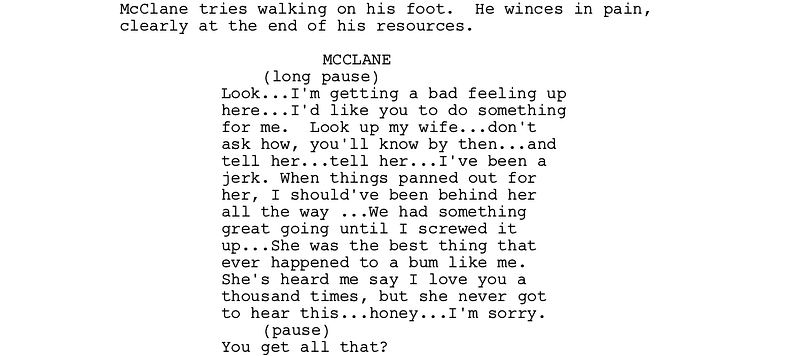
So in the External World, McClane is fighting to defeat the Bad Guys and save the Good Guys including his wife, but in the Internal World, he’s fighting to save their marriage. And in the end, in part by going through a simple metamorphosis: Away from his proud, pissed off mode with his estranged wife Holly to a more honest appraisal of his role in the couple’s falling out.
It should be noted that Holly’s character has her own mini-arc with that satisfying little bit of business at the end where John introduces her as “my wife, Holly Gennero,” and she corrects him by saying, “Holly McClane,” a payoff to an earlier setup.
Characters do not need to be overly complex in genre movies like Die Hard, however they do need to have enough emotional depth and texture that a reader will resonate and sympathize with them.
What’s your take on the script for Die Hard?
To see all of the posts in the 30 Days of Screenplays series, go here.
This series and use of screenplays is for educational purposes only!