30 Days of Screenplays, Day 5: “Dallas Buyers Club”
Why 30 screenplays in 30 days?
Why 30 screenplays in 30 days?
Because whether you are a novice just starting to learn the craft of screenwriting or someone who has been writing for many years, you should be reading scripts.
There is a certain type of knowledge and understanding about screenwriting you can only get from reading scripts, giving you an innate sense of pace, feel, tone, style, how to approach writing scenes, how create flow, and so forth.
We did 30 Days of Screenplays in 2013 and you can access each of those posts and discussions here. This time, we’re trying something different: I invited thirty Go Into The Story followers to read one script each and provide a guest post about it.
Today’s guest columnist: Claudia Blanton.
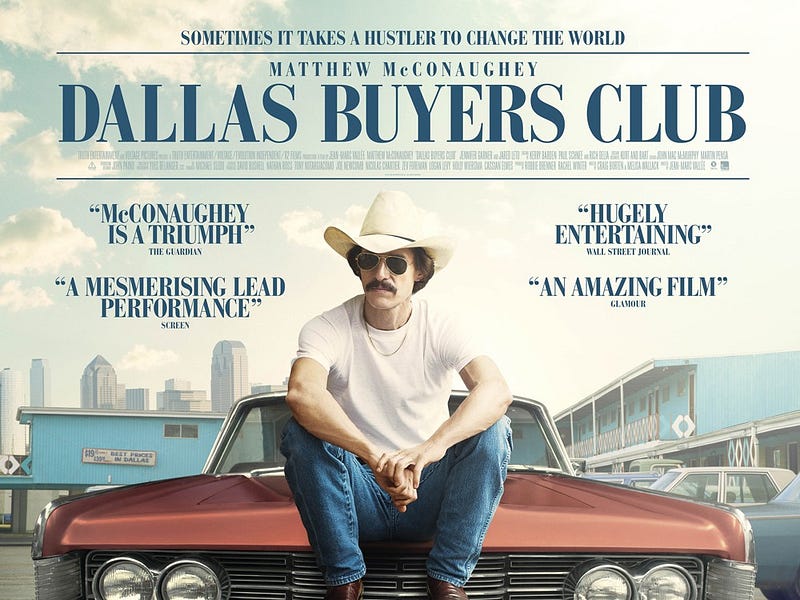
I jumped on the chance to review Dallas Buyers Club as I am a huge fan of the movie, it’s intriguing cast, and the background it risen from. As a child of the 80’s I remember the fear that the AIDS crisis brought with it, and how the views on this disease was that of initial prejudice. We could go into a deep discussion of the subject matter, and choice of actors to portray the characters — those imagined and based on real people, but that would not be a point to be made here.
With the above in mind, and the fact that I have watched the movie several times, this analysis was a privilege.
Title: Dallas Buyers Club. You may read the screenplay here.
Year: 2013
Writing Credits: Craig Borten, Melisa Wallack
IMDB rating: 8.0
IMDB plot summary: A fight for survival for a homophobic Texas electrician, Ron Woodroof, after being diagnosed with the HIV virus, in 1985. Battling for his rights to use alternative treatments, he takes on the medical establishment, and the FDA, while aiding fellow HIV -positive people to acquire the same treatment, via his Dallas Buyers Club. Assisted by an unlikely alley, Rayon, who is a transsexual woman, he manages to improve his health, and that of others, despite a constant run in with the FDA.
Tagline: Dare To Live
Analysis: The script aimed to make Ron Woodroof as authentic to the 80’s with it’s homophobic views on HIV and AIDS as possible. They succeeded in that endeavor, not sugar coating his outbursts toward the LGBT community, not censoring who he really was. He grows, gradually and gently in a person who find some respect for the people that he views as so foreign and different then him, but not in a sentimental way, and rather via interactions via the members of his Dallas Buyers Club, and most of all because of Rayon. His alienation throughout the story from the life he used to live gives him a taste how it is to be an outsider, one of THEM, rather then a member of a societal group he grew up in.
Rayon is not an actual but a fictional character, created by the writers in a most effective way to bring Ron from the outside in — his way to the people who he seemingly hated, or at least feared, not because of facts, but because, as so many of us, there is a fear of the unknown. Rayon is the humanity, the soft side to Ron, an outsider who like him is trying to survive, despite a death sentence.
It took about 20 years for this script to be turned into a movie — not in this edition, as it is available for us today, so I speculate if it was just the content that made the production until now impossible, or the fact that this is a story told in a very raw form, without the restriction of political correctness. Or maybe it was the controversy of Rayon, the young transgender woman, which even in this time (sadly) would face discrimination.
This is not a script (or movie) for those who get easily offended. But without that rawness, the honesty with what the writers decided to describe the characters, it would not be the high quality script and essentially movie it ended up becoming.
Most Memorable Dialogue: In this scene, Rayon is visiting her Dad:
RAYON’S FATHER: What do you want, Raymond?
RAYON: I’m fine, thanks. And you? Long time no see.
RAYON’S FATHER: I suppose I should thank you for wearing men’s clothes and not embarrassing me.
RAYON (sarcastic) Are you ashamed of me? Because I never realized that.
RAYON’S FATHER: (shaking his head) God help me.
RAYON: He is helping you. I got AIDS.
Most memorable moment: There are many moments I would consider memorable, from the dialogue above, to the hug Rayon and Ron shared, when Rayon handed him her life insurance. But I chose at the end, the scene where Ron made his “friend” apologize to Rayon in the grocery store after insulting her. It showed a real change in Ron, a real care for Rayon, and ultimately the growth he experienced since living his life with this death sentence. NOTE: You can see a video of the director describing this scene while it plays out here.
Thanks, Claudia. To show our gratitude for your guest post, here’s a dash of creative juju for you. Whoosh!
To see all of this year’s 30 Days of Screenplays: Vol. 2, go here.